

ApharmC Skills Assessment:
Your Pharmacy Assessment Guide in Australia
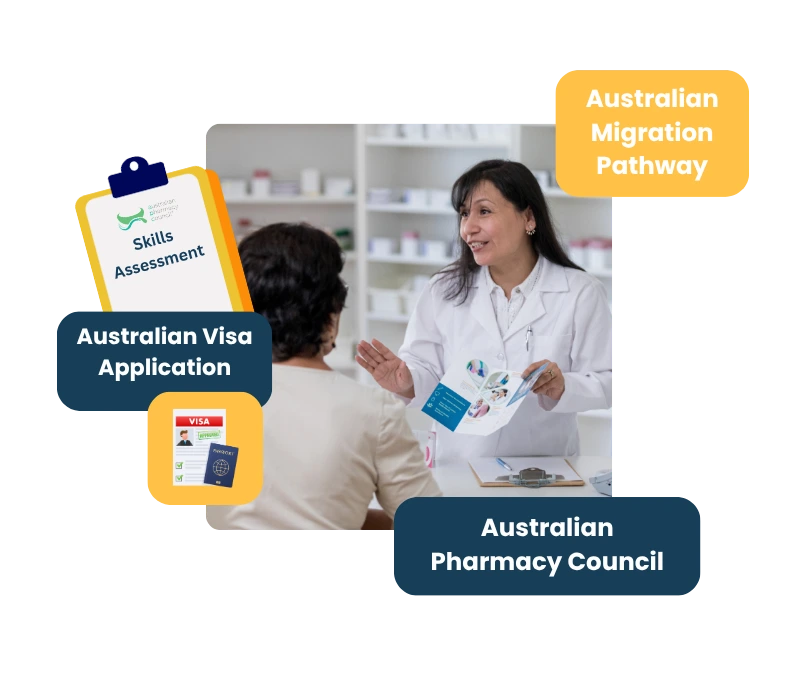
ApharmC is associated with the Australian Pharmacy Council which is the organization that is responsible for assessing the skills and competency of pharmacists for Australian registration and migration pathways. The Australian Pharmacy Council, i.e., APharmC skills assessment, is the designated assessing body who are responsible for assessing pharmacists who obtained their qualifications outside Australia and provides them with Skills Assessment Outcomes which may be used to support Australian visa applications.
If you’re an overseas-trained pharmacist planning to migrate to Australia, then APharmC is the authority standing between you, your qualification and your visa. Or, if you are a pharmacist planning an Australian migration pathway, then this process can initially appear to be a little complicated due to its assessment requirements depending on:
- Where the pharmacy qualification was obtained,
- The candidate’s registration status,
- The pathway they qualify for.
What is APharmC Assessment and
Why Does it Matter for Migration
APharmC is an independent, not-for-profit organization that accredits pharmacy education and evaluates the competency of pharmacists trained both in Australia and overseas. It was established in 2002 and today serves two main connected functions:
- Protecting the quality of Pharmacy practice in Australia
- Providing the official Skills Assessment Outcome
which is the requirement of the Department of Home for General Skilled Migration visa application. The council’s role is broader than just simply checking an academic qualification. APharmC assessment evaluates the knowledge, skills and competency of the pharmacists against Australian requirements and its work supports not only professional registration pathways but also the migration- related skills assessments.
For an overseas-trained pharmacist, it is important to distinguish between: A skills Assessment for migration and professional registration, which are somehow related but are not exactly the same process. The applicants should identify their ultimate objective before starting the process.
Get free consultation
Australian Pharmacy Council skills assessment:
Who Needs It?
If you’re a trained pharmacist outside Australia and hoping to migrate here or eventually practise here as a pharmacist locally then the Australian Pharmacy Council skills assessment is the process that you will need to go through.
Which pathway applies to you comes down largely to where you got your APharmC skills assessment qualification. APC currently sorts applicants into four main streams:
- Competency Stream
- International Student Stream
- Knowledge Stream
- New Zealand Registered Pharmacist Stream
If you are a graduate even if it’s somewhere other than Australia, Canada, Ireland, New Zealand, and the UK or the US, you’ll likely fall under the Knowledge Stream. On the other hand, the Competency Stream is for the pharmacists who completed their qualification or went through an approved adjudication process in Canada , Ireland, the UK and the USA and who are still registered there.
Understanding the Main APharmC Pathways
The APharmC assessment process varies according to an applicant’s educational and professional background. Which APharmC pathways you follow comes down mainly to where you trained:
Knowledge stream:
This applies if your qualification is from outside Australia, Canada, Ireland, New Zealand, the UK, or the US. Eligible candidates typically sit the OPRA® exam which is a computer-based test covering biomedical, pharmaceutical, and clinical sciences, with 120 multiple-choice questions over 2.5 hours.
Competency stream:
This is for pharmacists who qualified (or went through an approved adjudication) in Canada, Ireland, the UK, or the USA, and are still registered there. This route usually involves the CAOP® exam, which tests how well you can apply your knowledge and skills in an Australian pharmacy setting.
International Student Stream:
If you completed an accredited pharmacy degree in Australia or New Zealand as an international student, this is likely your pathway and the good news is you may not need to sit OPRA® or CAOP® at all to get your Skills Assessment Outcome.
Don’t assume your APharmC assessment process will look like everyone else’s. Check your specific eligibility before applying, it’s worth getting right from the start.
How the APharmC Assessment Process Works
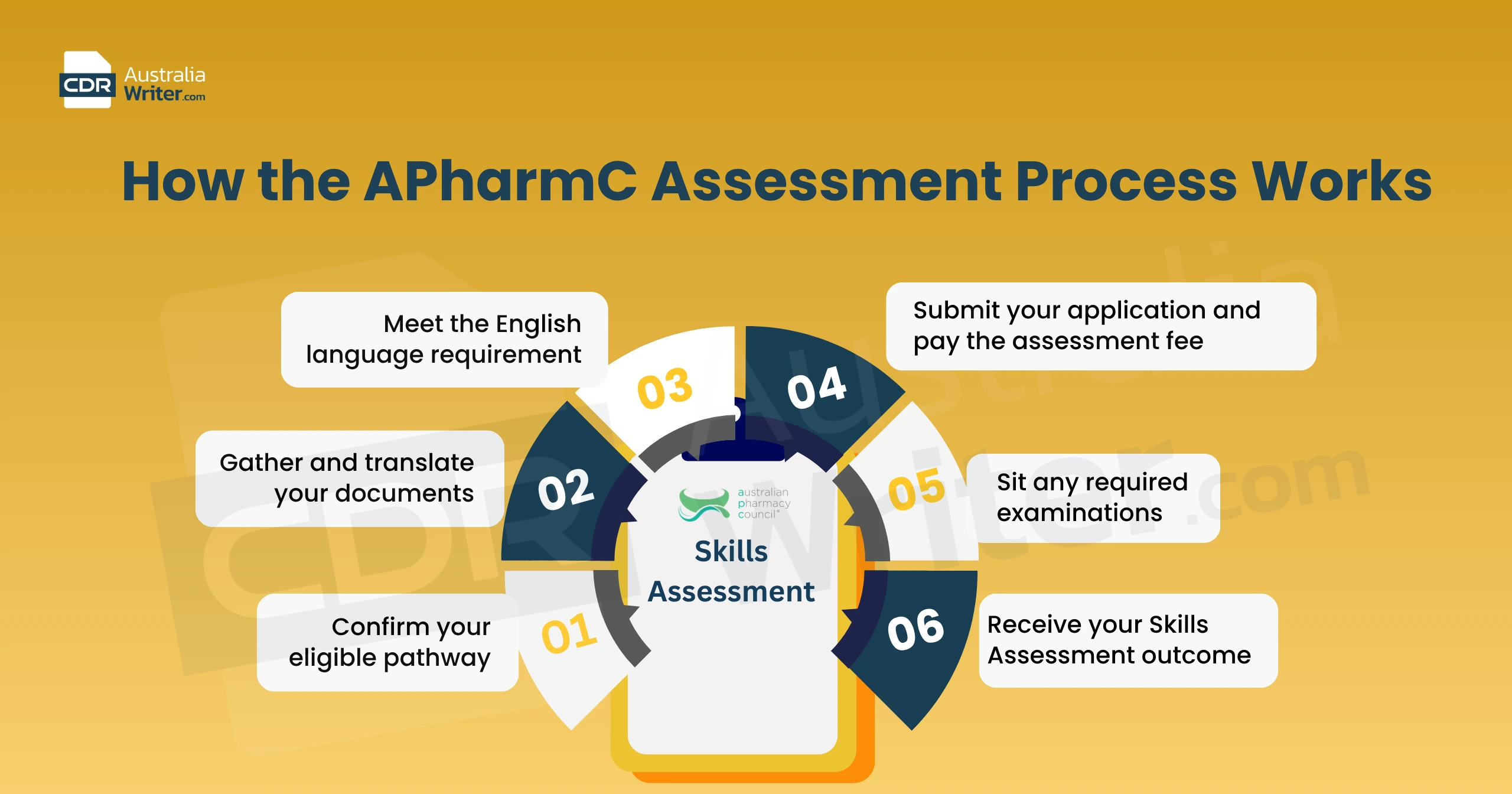
The overall APharmC assessment process can feel bureaucratic, but it follows a predictable sequence once you know what’s coming:
1. Confirm your eligible pathway
Determine whether your qualifications and professional experience correspond to the Medical Laboratory Scientist, Medical Laboratory Technician, Pathology Collector/Phlebotomist or another applicable AIMS occupation.
2. Gather and translate your documents
All non-English documents must be translated in full by a NAATI-accredited translator, with both the original and translated versions submitted together. A typical documentation includes all of your:
- Academic transcripts,
- Proof of registration,
- Evidence of your work history and
- Identity documents.
3. Meet the English language requirement
Most applicants whose qualification was obtained in a non-English speaking country must sit and attend an approved English test. IELTS is one of the most commonly accepted tests, which generally requires a strong score across all the four components, i.e. reading, writing, speaking, listening, though other tests such as PTE or TOEFL iBT may also be accepted depending on current requirements.
4. Submit your application and pay the assessment fee
Fees are paid directly to APharmC skills assessment at the time of lodgement. Meanwhile, the processing is not instant, most applicants should budget for a wait measured in weeks rather than days.
5. Sit any required examinations
Depending on your pathway, you may need to complete the KAPS or OPRA exam before a final outcome is issued.
6. Receive your Skills Assessment outcome
If you receive a successful outcome, you’ll receive a formal letter and Statement of Pharmacist Qualification, which becomes part of your visa application evidence.
Pharmacist skills assessment Australia:
Documents You May Need
When you apply for a pharmacist skills assessment in Australia, then you will need to back it up with solid supporting evidence, i.e. proof of identity, your qualifications, and a few more other pieces depending on which stream you’re applying under.
Generally, you can expect to provide:
- A valid passport or other accepted ID
- Your pharmacy qualification documents
- Academic transcripts
- Proof of professional registration, if applicable
- Evidence of any name changes
- Certified translations for anything not in English
- Any additional documents APC specifically asks for
One thing that trips people up more than what you’d expect is inconsistencies. If your name or date of birth is spelled or formatted differently across your passport, degree certificate, transcript, and registration record, then expect APC to come back asking for clarification, which only slows things down. And more documents isn’t necessarily better, what matters is that what you submit is relevant, legible, accurate, and matches what your specific APharmC pathways actually requires.
Fees and Processing Considerations
Fees of the Australian Pharmacy Council skills assessment are worth checking before you pay for anything, since they do change from time to time. As it stands, APC lists:
- the eligibility check at AU$810 and
- the skills assessment outcome request at AU$300 for eligible candidates.
- Exam fees sit at AU$2.245 for
- OPRA2,245®and
- AU$2,100 for CAOP®.
Given the cost involved, it really pays to know your pathway before you start paying for the wrong assessment or exam is an expensive mistake to make, and one that also sets you back on time. Processing speed of the pharmacist skills assessment often comes down to your paperwork. Incomplete or incorrect documents can slow things down considerably, so it’s better to take the time to get your application right the first time than to rush something half-finished.
Have Any Question?
CDR Australia Writer specialises in high-quality CDR, RPL and VETASSESS reports for engineers. CDR Australia Writer offer low-cost, customized and reliable services in diverse engineering disciplines.
- +61 485 981 327
- [email protected]
Common Mistakes Applicants Should Avoid
A few common mistakes tend to slow this process down more than necessary.
Picking the wrong stream:
Not every overseas-trained pharmacist follows the same path, basing your choice on nationality alone, rather than your actual qualification and registration status, can send you down the wrong track.
Inconsistent documents:
Small mismatches such as a name spelled differently, a date that doesn’t line up, often trigger extra requests for clarification.
Relying on outdated information:
Requirements change. Some older articles still reference the former KAPS exam, when APC’s Knowledge Stream now uses OPRA®.
Mixing up migration and registration:
A positive APharmC Skills Assessment Outcome supports your visa application, but it doesn’t automatically register you to practise as a pharmacist which are the two are separate processes.
Using unofficial channels:
Always apply and pay through APC’s official Candidate Portal. APC has specifically warned applicants to watch out for scams targeting this process.
Get our free consultation
Do you have a question?
Get our free consultation with specialist and experienced counsellors. Explore our CDR writing packages immediately and receive 100% plagiarism free CDR report
Contact us right now! and Get your CDR report ready for approval.

Do you have a question?
We have mentioned common questions asked by our clients regarding CDR report, ACS RPL report, KA02 report, and skill assessment process.
The ApharmC Skills Assessment is an assessment process for overseas-qualified pharmacists who want to demonstrate that their qualifications and professional background meet the requirements for migration or pharmacy registration purposes in Australia.
Overseas-qualified pharmacists who intend to migrate to Australia under a skilled migration pathway may need an APC skills assessment. The exact requirement depends on the visa subclass and the applicant’s circumstances.
An APC skills assessment for migration and professional registration are related but are different processes. A successful migration skills assessment does not automatically mean that an applicant is registered to practise as a pharmacist in Australia meanwhile, registration involves meeting the requirements of the relevant Australian pharmacy registration pathway.
No, it depends on the assessment pathway you choose. Knowledge Stream candidates typically sit the OPRA® exam, meanwhile, Competency Stream candidates may instead be required to sit the CAOP® exam.
You can improve by, firstly, start confirming the correct assessment pathway and reviewing the current document requirements carefully. Make sure your qualification, identity, academic, and professional evidence is complete, accurate, and consistent across all documents and follow the APharmC pathways before you submit for the skills assessment.
Requirements and fees change from time to time according to different situations, so don’t rely on secondhand summaries for anything final. Go directly to the official Australian Pharmacy Council website and the Candidate Portal, that’s the authoritative source for current eligibility rules, document checklists, exam details, and fees.