

Chartered Engineer Assessment:
A Complete Guide for Engineers
Chartered Engineer Assessment is considered as one of the most misunderstood steps involved in an engineer’s professional journey in Australia. Many engineers confuse it with the migration skills assessment (CDR), assuming both processes lead to the same outcome. They don’t. The Chartered credential is different from a standard migration skills assessment. It is a professional credential rather than simply an assessment of whether your qualification meets migration requirements. One gets you a visa. The other gets you recognised as a senior, competent, and ethical practitioner within your field which is a credential that carries weight with employers, clients, and state regulators alike.
If you are an experienced engineer planning to strengthen your professional standing in Australia, this is an important pathway to understand. Engineers Australia currently states that applicants generally need to be an Engineers Australia member and have at least five years of engineering experience. The assessment focuses on how you apply your engineering knowledge in real professional situations, rather than only looking at your academic qualification.

What Is Engineers Australia Chartered Assessment?
The Engineers Australia Chartered Assessment is the competency assessment that is a professional credentialing process run by Engineers Australia, separate from the General Skilled Migration pathway. It evaluates whether an engineer has the depth of experience, technical judgement, and ethical grounding expected of a senior practitioner.
Unlike a qualifications check, it looks at what you have actually done on the job, the decisions you have made, the risks you have managed, and the responsibility you have carried. There are three Chartered categories, and choosing the right one matters:
- Chartered Professional Engineer (CPEng): for engineers working at a professional/degree level
- Chartered Engineering Technologist (CEngT): for technologists working at associate degree level
- Chartered Engineering Associate (CEngA): for engineers working at diploma level
Each category has its own competency expectations, so it pays to confirm which one reflects your actual role before you start compiling evidence.
Get free consultation
Who Needs Engineers Australia Chartered Assessment Status?
Not every engineer needs to pursue it, but for many, it becomes essential at a certain career stage. You will typically want it if you:
- Work in a state where engineering registration is mandatory, such as NSW, Victoria, or Queensland, since Chartered status aligns directly with the National Engineering Register
- Are applying for senior technical or managerial roles where clients or employers require proof of chartered credentials
- Want international recognition of your competency, since the credential is respected across multiple engineering jurisdictions
- Are aiming to sign off on engineering work, certify designs, or take on liability-carrying responsibilities
Engineers with overseas experience can also apply, but their professional history needs to be documented clearly enough to demonstrate the required competencies with vague job descriptions or unsupported claims that rarely survive scrutiny.
Pathways to Engineers Australia Chartered Assessment Status
Engineers Australia offers a few distinct routes, and picking the wrong one can add years to your timeline unnecessarily. This is designed to examine your professional engineering experience against the applicable competency requirements.
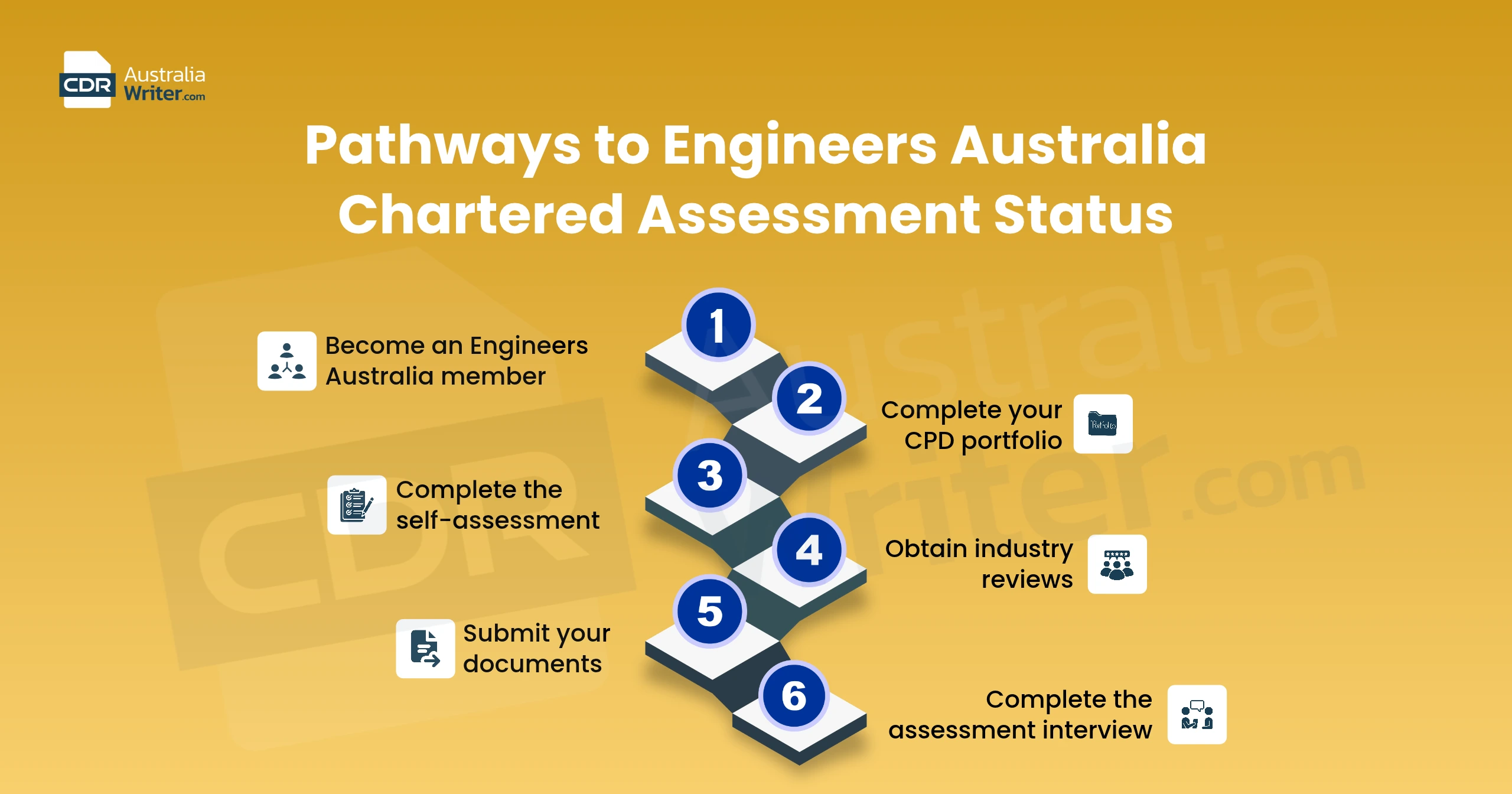
For the standard five-to-15-year pathway, the process generally involves:
1. Become an Engineers Australia member
Membership is required before applying for Chartered recognition.
2. Complete your CPD portfolio
Keep records of relevant learning and professional development throughout your engineering career.
3. Complete the self-assessment
You assess your own competency against the relevant independent-practice elements.
4. Obtain industry reviews
Industry reviewers provide feedback on your professional skills and abilities. Engineers Australia recommends choosing reviewers who know your work and are in the same or a relevant area of practice.
5. Submit your documents
In this stage, you need to proceed with the enrolment and submit your required documents such as your identification, detailed CV and your CPD records.
6. Complete the assessment interview
If you meet the initial requirements, you receive an invitation to an assessment interview. During the interview, you discuss recent engineering work and share work documents to demonstrate your ability to practise competently and independently.
For engineers with 15 or more years of experience, Engineers Australia provides a streamlined pathway that also includes document review and an assessment interview for Chartered engineer assessment.
Chartered Engineer Assessment:
A Complete Guide for Engineers
What Evidence Should You Prepare for Chartered Engineers Australia?
A strong application for Chartered engineer assessment depends on evidence that clearly connects your professional experience with the competency requirements.
Useful evidence for Chartered engineers Australia may include:
- Detailed CV
- CPD records
- Project plans
- Technical reports
- Drawings and designs
- Risk assessments
- Project or development plans
- Peer review records
- Presentations
- Relevant workplace correspondence
- Evidence of technical decision-making
- Records showing professional responsibility
Engineers Australia specifically identifies examples such as emails, presentations, development plans, project plans, peer review reports, drawings and plans as possible evidence of applying the independent-practice competencies.
The goal is not to submit a large collection of documents without explanation. Your evidence should help demonstrate:
- your role,
- your decisions,
- your technical contribution and
- your professional responsibility.
Chartered Engineer Requirements
Understanding the Chartered Engineer Requirements before beginning your application can help you prepare evidence properly.
The current Chartered Engineers Australia requirements include:
Engineers Australia membership
You must be a member of Engineers Australia to apply for the Chartered credential.
Relevant engineering experience
Applicants need at least five years of engineering experience. The pathway differs depending on whether you have five to 15 years or more than 15 years of experience.
Demonstrated competency
You need to demonstrate competency across the relevant independent-practice elements. Your evidence should show what you actually did in your engineering work, the decisions you made and the professional outcomes of your work.
Continuing Professional Development
You need evidence that you have undertaken appropriate and adequate CPD. CPD can include professional training, safety training, engineering events, networking, discussions and other relevant activities.
Professional evidence
Your application needs evidence that supports your claims. Depending on the pathway, this can include your CV, CPD records, work examples, project documentation and other evidence demonstrating your engineering competence.
The important point is that simply having several years of experience does not automatically demonstrate competency. Your evidence needs to explain how your experience demonstrates independent professional practice.
Chartered Engineer Assessment vs Migration Skills Assessment
One common source of confusion is treating Chartered assessment and migration skills assessment as the same thing. They serve different purposes.
A migration skills assessment helps to evaluate an applicant’s qualifications and, where applicable, other evidence for the migration purposes. Engineers Australia provides applicants with different migration assessment pathways, including different CDR-based assessments for certain applicants.
A Chartered Engineer Assessment, on the other hand, is focused on professional recognition and independent engineering practice.
Therefore, before preparing documents, identify the actual purpose of your assessment. Preparing a CDR when you need a Chartered application, or assuming a Chartered credential automatically replaces a migration assessment, if you assume that thinking can create unnecessary work.
Have Any Question?
CDR Australia Writer specialises in high-quality CDR, RPL and VETASSESS reports for engineers. CDR Australia Writer offer low-cost, customized and reliable services in diverse engineering disciplines.
- +61 485 981 327
- [email protected]
Things to Avoid When Applying
- Don’t confuse this process with your migration skills assessment, they serve different purposes and different authorities.
- Don’t submit vague, duty-list style career reports; assessors are looking for evidence of judgement and responsibility, not job titles.
- Don’t leave CPD tracking until the audit notice arrives, since it builds the habit early.
- Don’t apply for the wrong category (CPEng, CEngT, CEngA) without first confirming which matches your actual scope of work.
- Don’t underestimate the interview stage if you’re on the Mature Experienced Engineers Pathway, the preparation still matters even with a streamlined process.
- Don’t copy report language from templates or other applicants; assessors are experienced at spotting generic or duplicated content.
How to Maintain Your Engineers Australia Chartered Status
The Chartered Engineer Assessment is fundamentally about demonstrating that you can practise engineering independently and professionally. Your academic background provides the foundation, but your professional experience, decision-making, technical capability, ethical practice, communication and supporting evidence are important parts of the assessment.
If you are preparing for Chartered recognition, start by understanding the current Engineers Australia chartered engineer requirements, organise your CPD records, identify suitable professional evidence and map your real engineering experience against the relevant competencies.
Most importantly, use the current Engineers Australia guidance when preparing your application because competency standards and assessment arrangements can change during the transition to the NCSE 2026 framework.
Get our free consultation
Do you have a question?
Get our free consultation with specialist and experienced counsellors. Explore our CDR writing packages immediately and receive 100% plagiarism free CDR report
Contact us right now! and Get your CDR report ready for approval.

Do you have a question?
We have mentioned common questions asked by our clients regarding CDR report, ACS RPL report, KA02 report, and skill assessment process.
It is an Engineers Australia assessment pathway for engineers seeking Chartered recognition. It evaluates professional competency and independent engineering practice.
No, A CDR supports a migration skills assessment, meanwhile Chartered status is a professional credential that helps in assessing on-the-job competency and experience.
Engineers Australia currently requires at least five years of engineering experience for Chartered eligibility. Different pathways apply depending on whether you have five to 15 years or more than 15 years of experience.
Yes, if applicants have provided their documents clearly and demonstrates the required competencies against Australian standards.
Yes, the standard pathway includes a professional assessment interview for engineers where applicants can discuss their recent engineering work and helps them demonstrate how their work documents support their competency.
It doesn’t expire outright, but it must be maintained through CPD hours and is subject to periodic audit.