

Engineers Australia Membership:
Your Pathway to Chartered Success
Engineers Australia membership gives engineering students and professionals an opportunity to connect with:
- the Australian engineering community,
- access professional development resources,
- build networks and
- gain professional recognition.
Engineers Australia is the national body for the engineering profession and currently represents around 140,000 members.
However, the membership is not simply just about having a name on a professional list. Depending on your career stage, it can provide you with access to learning resources, networking opportunities, events, career support and professional recognition. It is also important for applicants to understand that membership is different from credentials such as Chartered or the National Engineering Register (NER).

What Is Engineers Australia Membership?
Engineers Australia membership (EA membership) is a professional membership system designed for people at different stages of an engineering career.
There are several membership grades, including:
- Student,
- Graduate,
- Member and
- Fellow.
Engineers Australia also offers Affiliate and Companion membership for people who have an interest in the engineering profession but do not hold a formal engineering qualification. The appropriate grade for engineers trying for membership depends on factors such as your qualifications, professional experience and occupational category. For students, membership can provide you with an early connection with the different engineering profession. Graduates can also use membership to support their transition into professional employment, meanwhile many experienced engineers may join as Members or progress towards Fellowship when they meet the relevant criteria.
It is also worth understanding that becoming a member does not automatically mean you are Chartered or listed on the NER. These are separate professional credentials with their own assessment requirements.
Get free consultation
Understanding Membership Grades
One of the most common points where engineers experience confusion is the range of membership grades, each tied to your qualification level and career stage. Broadly, these fall into three occupational categories:
- Professional Engineer,
- Engineering Technologist, and
- Engineering Associate.
Within each category, you’ll typically progress through:
- Student: free, for those currently studying an accredited engineering degree
- Graduate: for recent graduates, often at a discounted rate for the first few years
- Member: the standard professional grade once you’re established in the workforce
- Fellow: a senior, invitation-eligible grade recognising sustained contribution to the profession
Choosing the right grade matters because it determines your fees, your voting rights within the organisation, and in some cases your eligibility for committee or volunteer roles.
How to Apply for Membership
The application process depends on your circumstances and the Membership grade you are seeking.
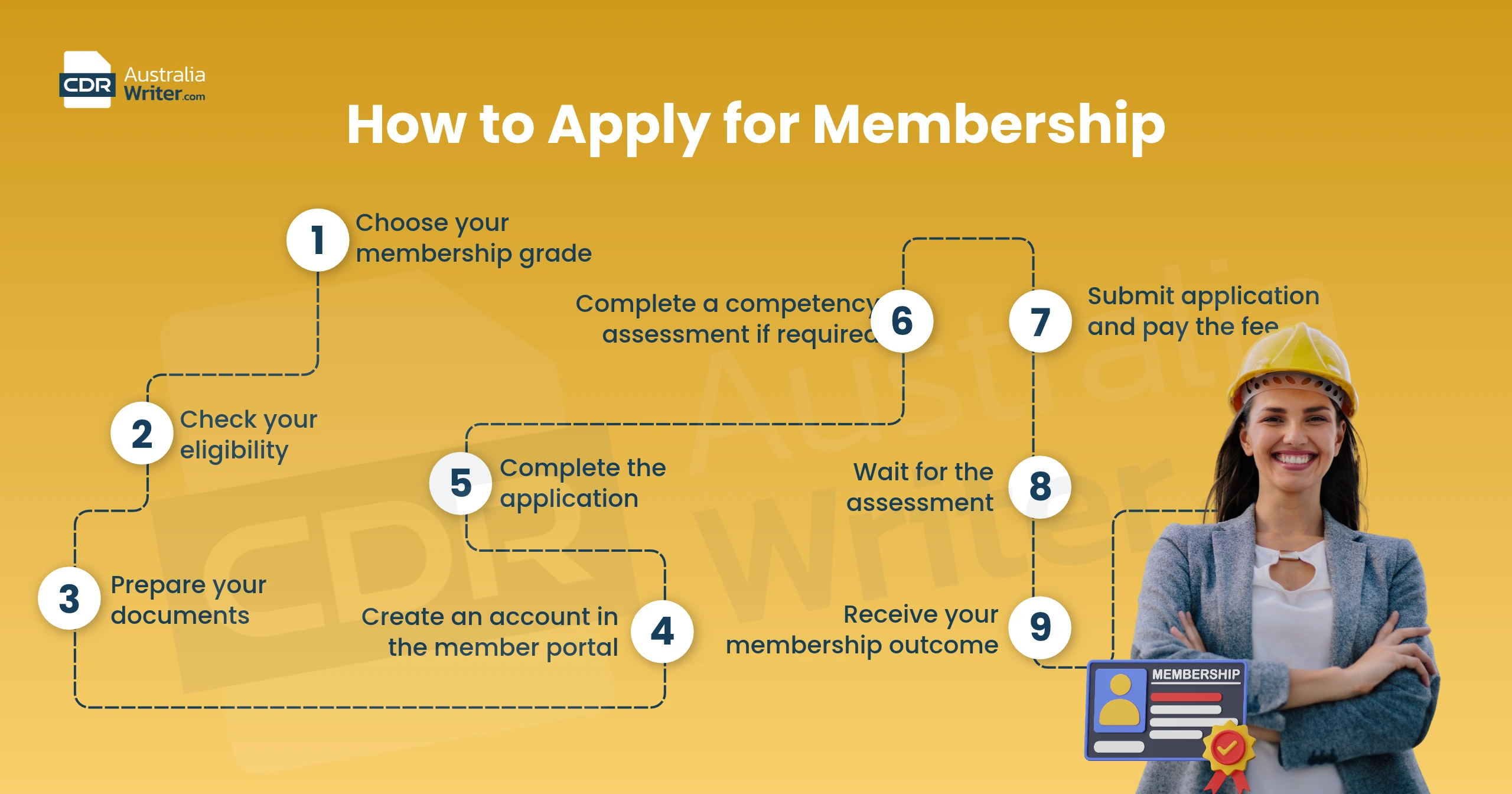
A typical process involves:
1. Choose your membership grade
First, you have to determine whether you should apply as a Student, Graduate, Member, Fellow, Affiliate or Companion. What matters is your education, experience and professional background that will determine which option is appropriate.
2. Check your eligibility
You need to review all the requirements for your chosen grade and also check whether your engineering qualification is recognised by Engineers Australia or not. If it is not, then you may need a competency assessment.
3. Prepare your documents
You have to have documents like your photo ID, degree certificate, academic transcript and current CV ready. Depending on your pathway, other additional documents may be also required.
4. Create an account in the member portal
You should go to the Engineers Australia member portal and create or access your account, from which you can then begin your membership application online.
5. Complete the application
You have to enter your personal, educational and professional information very carefully. You need to make sure that the information matches with your supporting documents.
6. Complete a competency assessment if required
If your qualification does not meet the stated standard recognised pathway, then Engineers Australia may require a competency assessment before membership can be approved. For this membership, the competency assessment requirements can involve your qualifications, detailed CV and evidence of engineering competence.
7. Submit your application and pay the applicable fee
Once you get your application and documents ready to submit, you can then submit them through the relevant portal and then pay the applicable membership fee. Fees can depend on your membership grade and occupational category you choose.
8. Wait for the assessment
Engineers Australia reviews applicant’s applications being based on the membership pathway. Standard Member applications are generally processed within three to four business days, meanwhile applications requiring additional assessment can take longer.
9. Receive your membership outcome
Once you get your application approved, you can then become an Engineers Australia member and also can use the relevant post-nominal associated with your membership grade, such as MIEAust for a Professional Member.
Before applying for the membership, the applicant must check whether your engineering qualification is recognised through an accredited pathway or whether additional assessment is required. Applicants should also make sure that their personal details, qualification information and supporting documents are accurate. Because, providing incomplete or inconsistent information can create unnecessary delays.
EA Membership Benefits
The EA Membership benefits can be useful throughout different stages of an engineering career.
One of the main advantages of this membership is that it accesses professional networks. Members can participate in events, conferences and networking opportunities and can even connect with other engineers who are working in different fields. Engineers Australia also provides them mentoring and career-related opportunities.
Another important benefit is professional development. Members can also access different webinars, training, technical resources, collaboration platforms, engineering publications and other learning materials. These resources can help those engineers keep their knowledge updated and current as technology, standards and industry practices change.
Graduate members receive additional early-career support, including access to CPD-focused development, networking and a member-only jobs board.
Membership can also provide the right to use Engineers Australia post-nominals associated with the relevant membership grade. Members may additionally access selected discounts and rewards through Engineers Australia’s member rewards program.
For engineers who are building a long-term professional career in Australia, these resources can be valuable beyond the initial membership application.
Membership Fees Worth Knowing
Fees vary depending on your occupational category and grade, and they’re reviewed annually (typically with a modest increase each financial year). Fees for this membership operate on a financial-year basis from 1 July to 30 June.
For the 2026–27 financial year, the published annual fees include:
Membership grade | Professional Engineer | Engineering Technologist | Engineering Associate |
Student | Free | Free | Free |
Graduate* | $200 | $200 | $200 |
Member | $640 | $495 | $320 |
Fellow | $855 | $645 | $425 |
Professional Engineer grades sit at the higher end, Engineering Technologist in the middle, and Engineering Associate at the lower end, with concessions available for early-career graduates and those who’ve been financial members for extended periods. It’s worth checking the current fee schedule directly on the Engineers Australia website before applying, since figures do shift each renewal cycle. Because fees and promotions can change, applicants should check the official fee schedule before submitting an application.
In return, members get access to CPD-accredited training, industry events, technical society memberships, a national jobs board, and the pathway toward Chartered recognition benefits that, for most working engineers, comfortably justify the annual cost.
Engineers Australia Membership Requirements
To apply for Engineers Australia membership, you generally need to meet the requirements for your chosen membership grade. For Member grade, the requirements may include following:
Relevant engineering qualification:
It is essential that you have to hold an Australian-accredited or recognised tertiary engineering qualification.
Professional experience:
Member applicants generally need at least three years of postgraduate engineering experience.
Current engineering practice:
For this membership you should be working or practising as a professional engineer, engineering technologist, or engineering associate.
Recognised qualification pathway:
If your qualification is not recognised or accredited by Engineers Australia, you may need to complete a competency assessment.
Identity documents:
You will need valid photo identification, such as a passport or current driver’s licence.
Qualification documents:
Prepare your degree certificate or testamur and academic transcript.
Updated CV:
Your CV should clearly show your education, engineering experience, skills and relevant professional background.
Additional assessment if required:
Engineers with certain overseas or unrecognised qualifications may need to demonstrate their engineering competence through an assessment.
For students and recent graduates, the requirements are different. Engineers Australia provides Student and Graduate membership pathways, so you do not necessarily need three years of professional experience to become a member. Graduate membership is generally available to people who have completed a recognised engineering course within the relevant eligibility period.
Have Any Question?
CDR Australia Writer specialises in high-quality CDR, RPL and VETASSESS reports for engineers. CDR Australia Writer offer low-cost, customized and reliable services in diverse engineering disciplines.
- +61 485 981 327
- [email protected]
Things to Avoid When Applying for membership
When researching or applying for membership, avoid these common mistakes:
- Do not assume membership equals Chartered status.
- Do not assume membership guarantees a migration or skills assessment outcome.
- Do not select a membership grade without checking your eligibility.
- Do not rely on outdated fee information from third-party websites.
- Do not submit inconsistent qualification or employment information.
- Do not ignore CPD requirements if you are pursuing credentials that require ongoing CPD.
- Do not confuse Engineers Australia membership with an Engineers Australia migration skills assessment.
- Do not treat professional membership as a substitute for Australian state or territory registration where registration is legally required.
Is Engineers Australia Membership Worth Considering?
The value of membership depends on your career goals.
A student may be interested in both networking and early professional exposure. A recent graduate may find career resources, CPD and professional connections very useful. An experienced engineer may value the industry networking, it’s technical resources, professional recognition and access to development opportunities.
The EA membership benefits can therefore be different for each person. Someone primarily looking for migration information may have different priorities from an engineer seeking professional networking or Chartered development.
Before joining, consider what you actually want from membership and compare the available grade, fees and benefits with your career plans. For people already working toward Chartered or NER credentials, membership can also provide access to resources that support continuing professional development.
Get our free consultation
Do you have a question?
Get our free consultation with specialist and experienced counsellors. Explore our CDR writing packages immediately and receive 100% plagiarism free CDR report
Contact us right now! and Get your CDR report ready for approval.

Do you have a question?
We have mentioned common questions asked by our clients regarding CDR report, ACS RPL report, KA02 report, and skill assessment process.
It is a professional membership system for engineering students and professionals, with different membership grades based on career stage, qualifications and professional experience.
No, Outside a few regulated areas (like Queensland’s Board of Professional Engineers requirements), engineering isn’t a licensed profession nationally. Membership is a professional credential, not a legal requirement to practise.
Membership may be very relevant to an engineer’s professional development and recognition, but it does not exactly mean that by itself guarantee a successful migration skills assessment or visa outcome.
No, Membership and Chartered status are separate. Chartered requires its own assessment against the relevant professional competency requirements.
Your membership lapses, and you lose access to benefits, post-nominals, and any progress toward Chartered status tracking until you reactivate.
Yes, Engineers Australia offers applicants with international membership options for those who are based outside the country, though fee structures differ slightly.