

Relevant Skilled Employment Assessment: What Engineers Need to Know
Relevant Skilled Employment Assessment is considered as one of the most misunderstood add-ons in the Engineers Australia Migration Skills Assessment (MSA) process and for those engineers who are applying under the Engineering Manager category, it isn’t even optional.
If you are an engineer who is planning to migrate to Australia, then your qualifications are only one part of your skills assessment. Your professional experience may also matter when you want to claim skilled employment points for a points-tested visa. It is important to understand that this assessment is not the same as simply having a job in engineering. Your employment needs to be supported by proper and relevant evidence, and the work must meet the relevant requirements for skilled employment.

What Is a Relevant Skilled Employment Assessment?
Relevant Skilled Employment Assessment is a review of your employment history by Engineers Australia that examines documentary evidence which are related to your engineering work and can cover employment completed as an employee or as a self-employed professional. This service Engineers Australia offers alongside your Competency Demonstration Report (CDR) or accredited qualification assessment. Rather than just confirming your qualifications match a nominated ANZSCO occupation, the RSEA specifically evaluates whether your paid work experience is genuinely “skilled” and relevant to that occupation.
The purpose is to establish whether particular periods of employment can be recognised as relevant skilled employment. This can be important when preparing an Expression of Interest (EOI), because employment experience can contribute to the points test for skilled migration. However, Engineers Australia does not award migration points itself. The Department of Home Affairs is responsible to determine whether the employment evidence supports the points claimed in a visa application.
Get free consultation
Who Needs an Engineers Australia RSEA?
Not every applicant who applies for Engineers Australia RSEA needs to pay for this add-on, so it’s worth checking your category before you submit anything.
If you are applying under the Engineering Manager category, then the assessment is compulsory. Engineers Australia requires engineers to provide their documented employment evidence for every Engineering Manager application, and it cannot be skipped or substituted with career episodes alone.
For everyone else, i.e:
- Professional Engineers,
- Engineering Technologists, and
- Engineering Associates,
the assessment is optional but strongly recommended in specific situations:
- You want your skilled employment years counted toward the points test for visas such as subclass 189, 190, or 491.
- Your work history includes roles that could be questioned as not “closely related” to your nominated occupation.
- You’re relying on employment years to meet a state or territory nomination requirement.
If your points calculation doesn’t depend on employment history, a Relevant Skilled Employment Assessment may simply add cost and processing time without changing your outcome. This is a decision worth making early, ideally before you start compiling reference letters.
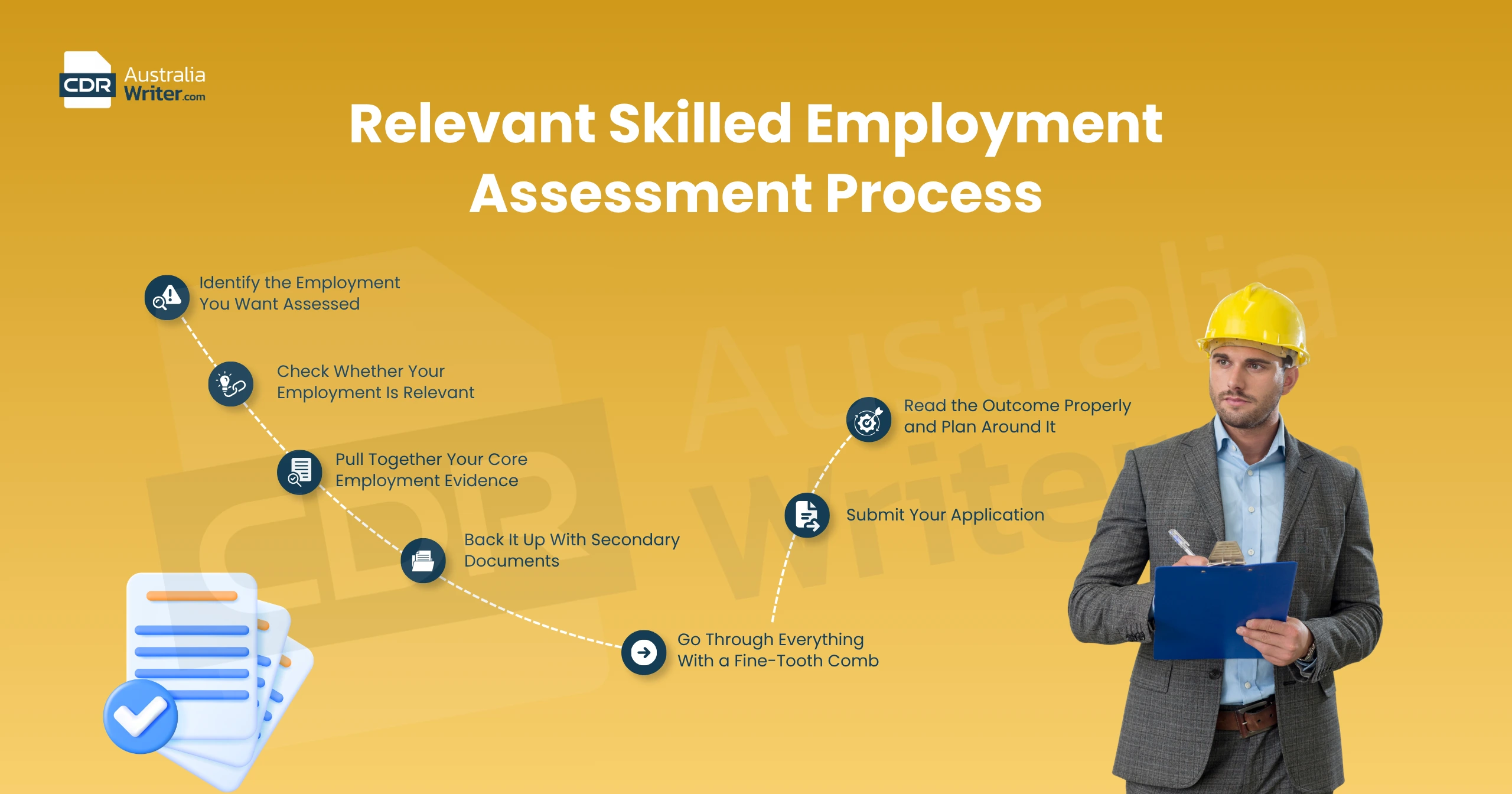
Relevant Skilled Employment Assessment Process
The assessment process involves several important steps. Those applicants who are trying for RSEA should prepare their employment information very carefully before submitting their application in order to avoid problems like missing documents or unnecessary inconsistencies.
1. Identify the Employment You Want Assessed
Applicants must begin by firstly listing the engineering positions you want to have assessed. Then, you need to note your employer’s name, job title, employment dates, working hours, and main engineering responsibilities. You also have to focus on employment which is relevant to your nominated occupation and that you can help you support with reliable documents.
2. Check Whether Your Employment Is Relevant
Review your actual engineering duties and compare them with your nominated occupation. Your job title alone is not just enough to establish relevance. So, you also need to consider the type of engineering work you performed, your level of responsibility, and how closely your duties can relate to the occupation that is being assessed.
3. Pull Together Your Core Employment Evidence
This starts with your employer. Ask for a reference letter that actually says something then your job title, when you started and finished, whether you worked full-time or on contract, your pay rate, and a real description of the engineering work you did day to day. Vague letters cause more problems than almost anything else in this process, so it’s worth pushing your employer for specifics rather than accepting a generic template. Whatever you submit needs to line up with everything else in your application and dates especially.
4. Back It Up With Secondary Documents
A reference letter on its own rarely tells the full story, so it helps to have something independent that confirms the employment actually happened. Depending on where you worked, this could be tax records, provident fund or retirement contributions, a work permit, a residence permit, or similar official paperwork. None of these need to be dramatic, they just need to quietly confirm that you were where you say you were, doing what you say you were doing, during that period.
5. Go Through Everything With a Fine-Tooth Comb
Before you submit anything, sit down and actually compare your documents side by side. Names spelled the same way? Company details matching? Job titles and dates lining up across every document? Even small, innocent inconsistencies or a slightly different job title, an overlapping date range can raise questions and slow things down, so it’s worth catching these yourself rather than having Engineers Australia flag them for you.
6. Submit Your Application
Once you’re confident your evidence holds together, go ahead and lodge your Relevant Skilled Employment Assessment through Engineers Australia’s RSEA service, along with the relevant fee. Upload everything in the format they ask for, and take one more pass to make sure nothing’s missing before you hit submit.
7. Read the Outcome Properly and Plan Around It
When Engineers Australia comes back with a decision on your skilled employment, don’t just file it away and read it carefully and keep a copy with the rest of your migration paperwork. A positive outcome supports your claim that the employment was relevant, but it’s worth being clear-eyed here: this assessment doesn’t hand you migration points on its own. It’s the Department of Home Affairs that ultimately decides, under the visa’s own rules, whether that employment counts toward your points total.
Engineers Australia Skilled Employment Assessment: Why Evidence Matters
A common mistake that most of the applicants make is to treat an employment reference letter as sufficient evidence. In reality, the Engineers Australia skilled employment assessment considers both primary and secondary documentation.
There are two types of evidence that serve different purposes. A reference letter explains the position and duties, while independent documents can help support the fact that the employment actually occurred during the claimed period.
For this reason, applicants should make sure their dates are consistent across their documents. The same principle applies to job titles, employers, and periods of employment. Inconsistencies can create questions about the claim and may result in requests for additional information.
Skilled Employment Documents You Should Prepare
Strong skilled employment documents are one of the most important parts of the application. Engineers Australia currently requires primary and secondary evidence for each employment period being assessed.
For employees, the primary evidence includes an employment reference letter on company letterhead. According to the current Engineers Australia guidance, the letter should include the following essential documents to be prepared:
- Whether the employment was full-time or part-time
- Pay rate
- Employment start and end dates
- Job title
- At least five main engineering duties
- Signature or endorsement from an appropriate manager, HR representative, or direct supervisor
- The issuer’s work email address and telephone number
- Date of issue
- Company stamp, where applicable
If the reference letter does not contain enough detail that you need about your duties, then Engineers Australia RSEA allows you to provide certain additional evidence, such as a job offer letter containing detailed engineering duties or an annual performance review on company letterhead.
Secondary evidence is also important because it provides independent support for the employment claim. Engineers Australia lists government-issued evidence such as:
- income tax statements,
- superannuation or retirement contribution records,
- social security insurance statements,
- provident fund records,
- work permits,
- residence permits, or
- other official employment documentation.
Does It Guarantee Migration Points?
No, this is an important distinction. A successful employment assessment does not itself grant migration points. Engineers Australia skilled employment assessment assesses the employment evidence, while the Department of Home Affairs applies the migration points test.
Under the current points table for subclass 491, for example, overseas skilled employment can contribute up to 15 points depending on the number of qualifying years, while Australian skilled employment can contribute up to 20 points. The employment must meet the applicable requirements, including being in the nominated occupation or a closely related occupation.
Applicants should therefore calculate their points carefully and avoid assuming that every period of engineering employment will automatically be counted.
Have Any Question?
CDR Australia Writer specialises in high-quality CDR, RPL and VETASSESS reports for engineers. CDR Australia Writer offer low-cost, customized and reliable services in diverse engineering disciplines.
- +61 485 981 327
- [email protected]
Skilled Employment Documents:
Common Things to Avoid
Weak or incomplete skilled employment documents can make an otherwise straightforward application for Relevant Skilled Employment Assessment more difficult.
Some common things to avoid include:
- Don’t submit generic reference letters. A letter that only states your job title and dates, without describing specific engineering duties, is one of the fastest ways to get your employment period rejected.
- Don’t assume all your work history automatically counts. Only periods matching your nominated ANZSCO occupation are assessed as skilled.
- Don’t skip secondary evidence. Reference letters alone are rarely enough, like payslips, tax documents, or super statements strengthen your case.
- Don’t leave gaps unexplained. Unaccounted employment gaps often trigger follow-up requests that delay processing.
- Don’t request the assessment if you don’t need it. If your points don’t depend on employment years, you may be paying for a service that won’t change your outcome.
What This Means for Your Application
A Relevant Skilled Employment Assessment can be an important part of an engineer’s Australian skilled migration preparation when previous employment may contribute to their skilled employment claim.
The strongest applications are supported by:
- clear employment references,
- consistent dates,
- detailed engineering duties,
- and independent evidence
covering the claimed employment period. Most importantly, applicants should understand the difference between an employment assessment and the final migration points decision.
Because assessment requirements and fees can change, always check the latest Engineers Australia guidance and Department of Home Affairs rules before submitting an application.
Get our free consultation
Do you have a question?
Get our free consultation with specialist and experienced counsellors. Explore our CDR writing packages immediately and receive 100% plagiarism free CDR report
Contact us right now! and Get your CDR report ready for approval.

Do you have a question?
We have mentioned common questions asked by our clients regarding CDR report, ACS RPL report, KA02 report, and skill assessment process.
It is an Engineers Australia assessment of documentary evidence relating to an applicant’s engineering employment. It can determine whether particular employment periods are considered relevant for the assessment process.
No, Engineers Australia states that it is available as an additional service for engineering occupation categories and is mandatory for applicants seeking assessment as an Engineering Manager.
It’s generally requested and paid for at the same time as your main MSA application. Adding it separately afterward may involve a new application, so it’s best to decide upfront.
No, Engineers Australia skilled employment assessment assesses the relevant employment evidence, while the Department of Home Affairs determines points under the applicable migration rules.
Only the confirmed periods count toward your points test. The rest of your application, including your competency outcome, isn’t affected.
Yes, Engineers Australia states that relevant skilled employment can be requested for employment undertaken as an employee or while self-employed.