

P.Eng Competency Canada 2026: CBA Requirements to Get Licensed
P.Eng Competency Canada refers to the Competency-Based Assessment (CBA) framework that every provincial engineering regulator in Canada now uses to evaluate whether an engineer’s work experience meets the professional standard required for a Professional Engineer (P.Eng) licence. In 2026, the CBA is the standard evaluation method across every major provincial association, PEO in Ontario, APEGA in Alberta, EGBC in British Columbia, and APEGS in Saskatchewan among others.
A P.Eng licence allows you to take legal responsibility for engineering work, stamp and seal engineering documents, and supervise other engineers in Canada. Without it, your engineering title in Canada remains unofficial regardless of your overseas qualifications or years of experience.

What Is the P.Eng Competency Canada Assessment?
The P.Eng Competency Canada assessment, formally the Competency-Based Assessment, is a collection of structured, evidence-based narratives that demonstrate your individual engineering judgment, technical application, ethics, and professional responsibility across a defined set of competency categories. It replaced the older time-based experience log in most provinces, marking a fundamental shift in how regulators evaluate engineering readiness. Instead of simply logging months on the job, applicants must now show, in writing, exactly how they applied engineering principles to real situations.
The shift from counting years to evaluating competency narratives means two engineers with the same job title and the same years of experience can receive very different outcomes. What assessors evaluate is not what you worked on but how clearly you demonstrate your personal technical decisions, the engineering judgment you applied, and the outcomes you were directly responsible for. Even engineers from the same company working the same project can end up with completely different results, depending purely on how precisely each one isolates their own role.
Mostengineers fail the CBA not because they lack experience but because they describe team outcomes and project results rather than their own specific contributions and decisions. A narrative built around “we” instead of “I” tells an assessor nothing about your individual capability. Success in the CBA comes down to precision, personal accountability, and the ability to separate your engineering judgment from the collective effort around you.
Get free consultation
The Five Core CBA Requirements Engineers Must Meet in 2026
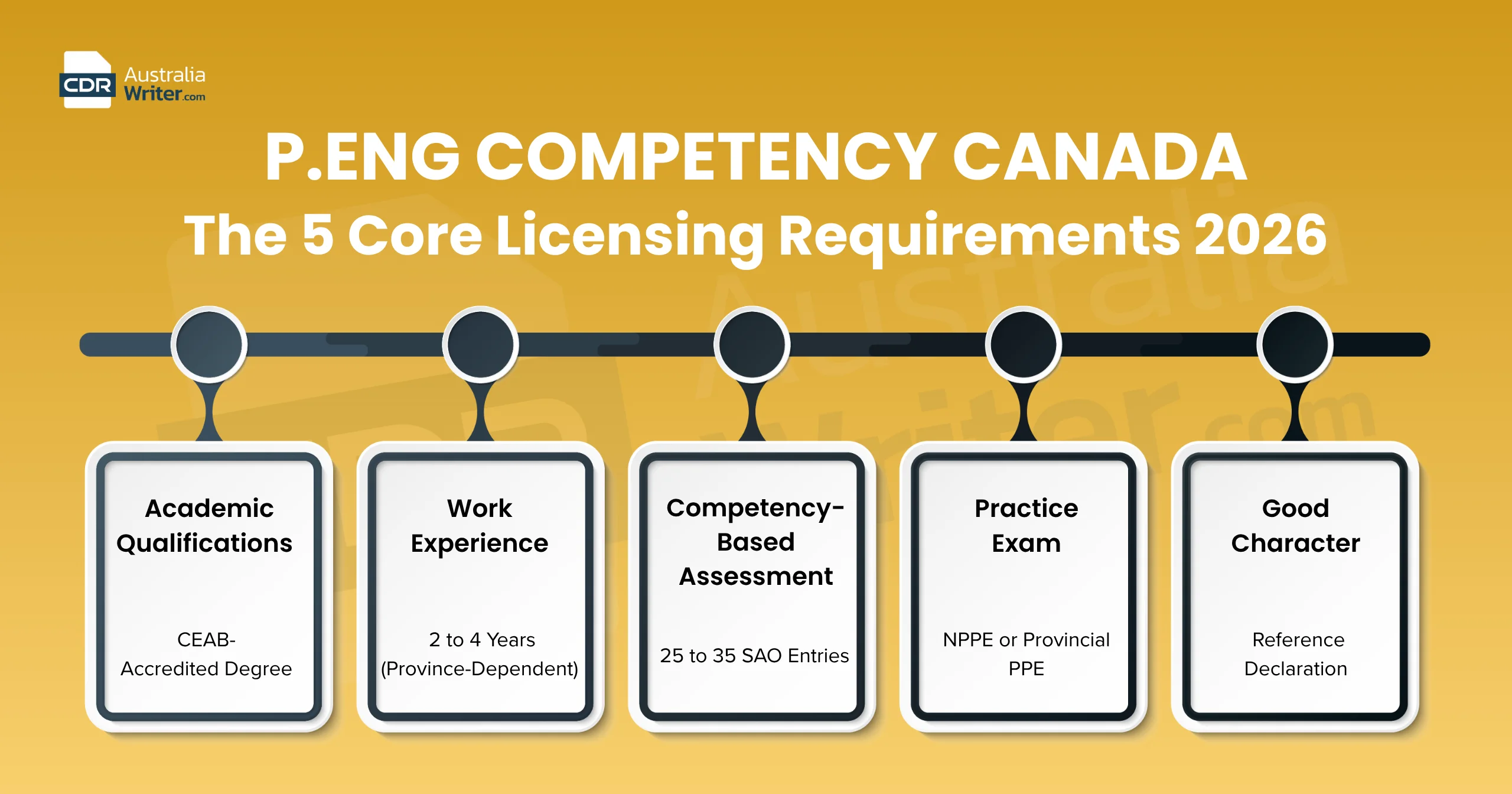
Every provincial regulator builds its P.Eng process around the same five pillars, even though the details shift from one association to the next. Missing or under-preparing even one of these can stall an otherwise strong application for months. Here’s exactly what each requirement demands before you’re cleared for licensure.
Academic Qualifications
A four-year bachelor degree in engineering from a CEAB-accredited Canadian institution, or an overseas degree assessed as equivalent through your provincial regulator’s academic assessment process. Overseas graduates may be assigned confirmatory technical examinations if their degree does not fully align with CEAB standards.
Work Experience
Most provinces require 48 months (four years) of acceptable post-degree engineering experience supervised by a licensed P.Eng. Ontario (PEO) is the significant exception, from 1 July 2026, PEO reduced the minimum experience requirement from four years to two years for graduates of CEAB-accredited programs. The two-year floor is a minimum, not a guarantee. You must still demonstrate all 34 PEO competency indicators regardless of how many calendar years you have worked.
Competency-Based Assessment
The CBA is the core of the P.Eng application. Depending on your province, you write between 25 and 35 structured narrative examples, called SAO (Situation, Action, Outcome) entries, mapped against specific competency indicators. Each example must describe a real engineering situation, the personal action you took, and the measurable outcome.
National Professional Practice Exam
The NPPE or equivalent provincial professional practice exam covers engineering law, ethics, and professional responsibility. Most provinces accept the nationally standardised NPPE. British Columbia uses a BC-specific PPE. Quebec requires fluency in French and a separate OIQ process.
Good Character Assessment
A declaration of good character, typically confirmed by professional references and any disclosure of criminal or disciplinary history.
CBA Competency Categories Across Major Provinces
The competency categories vary by province but share a common structure. The following comparison covers the three largest engineering provinces.
Competency Area | PEO Ontario | APEGA Alberta | EGBC British Columbia |
Technical | 34 competency indicators across technical and professional categories | 5 competency areas including technical, management, communication, team, accountability | 6 competency categories with sub-indicators |
Experience minimum | 2 years from 1 July 2026 (CEAB graduates) | 4 years including 1 year in Canadian jurisdiction | 4 years including 1 year in Canadian jurisdiction |
SAO entries required | Typically 30 to 35 narrative examples | Structuredcompetency record with narrative entries | Structured competency log with narrative evidence |
Canadian experience | Not required (removed 2023) | At least 1 year in Canadian jurisdiction required | At least 1 year in Canadian jurisdiction required |
Exam | PPE (Professional Practice Exam) | NPPE | BC PPE |
Fees (approx.) | AUD 1,000 to AUD 3,000 CAD total | Similar range | Similar range |
Have Any Question?
CDR Australia Writer specialises in high-quality CDR, RPL and VETASSESS reports for engineers. CDR Australia Writer offer low-cost, customized and reliable services in diverse engineering disciplines.
- +61 485 981 327
- [email protected]
Provincial Licensing Requirements: Ontario, Alberta and BC Compared
No two provinces license engineers the same way, and the gaps matter more than most applicants expect. Ontario has moved to a two-year experience floor, while Alberta and BC still hold firm at four years with a Canadian-jurisdiction clause. The table below breaks down exactly where these regulators diverge, so you can plan your application around the province that actually fits your timeline.
Ontario (PEO)
PEO is the largest engineering regulator in Canada with over 90,000 members. From 1 July 2026, PEO reduced the experience requirement from four to two years for CEAB-accredited graduates. The Canadian experience requirement was removed in 2023. Ontario is now the most accessible P.Eng pathway in Canada for both domestic and internationally trained engineers.
Alberta (APEGA)
APEGA requires four years of engineering experience including at least one year in a Canadian jurisdiction. APEGA’s competency framework covers five categories:technical competency, communication, project and financial management, team effectiveness, and professional accountability. The academic assessment compares overseas degrees against CEAB standards and may assign confirmatory examinations.
British Columbia (EGBC)
EGBC requires four years of experience including at least one year in a Canadian engineering environment. BC uses its own PPE (Professional Practice Exam) rather than the national NPPE. The PPE covers BC-specific engineering law, environmental responsibilities, and professional ethics. EGBC’s competency framework uses six competency categories.
Other Provinces
Nova Scotia (NSPE), New Brunswick (APEGNB), Manitoba (APEGM), and Saskatchewan (APEGS) all use variations of the NPPE and competency-based experience requirements consistent with national standards. Quebec (OIQ) operates in French and has its own distinct administrative process.
How to Write Strong CBA SAO Narratives Assessors Approve
The SAO (Situation, Action, Outcome) format is the standard method for writing P.Eng competency narratives across all Canadian provinces. Each entry must be written in first person and must demonstrate your individual engineering contribution, not your team’s performance.
Situation: Describe the engineering problem, project context, or technical challenge you faced. Be specific: name the project, the client type, the engineering discipline, and the constraint you were working within.
Action: Describe what you personally did. Name theengineering calculations, standards, codes, and tools you applied. State the decisions you made and the technical judgement you exercised. Avoid “we”; assessors evaluate your contribution, not your team’s.
Common failures in SAO writing:
- Describing what the project achieved rather than what you personally contributed
- Using passive voice – “the analysis was conducted” instead of “I conducted the analysis”
- Vague technical descriptions without named codes, standards, or software
- Writing the same type of project for multiple competency indicators instead of demonstrating range
- Not specifying supporting documents behind the claim
- Overstating ownership instead of acknowledging gaps

CBA Application Fees and Licensing Timeline for 2026
Budgeting for your P.Eng application means more than just the application fee — academic assessments, exam sittings, and confirmatory exams for overseas graduates all add up. Timelines vary just as widely, from as little as two years for CEAB graduates in Ontario to seven years for some overseas pathways. Here’s a clear breakdown of what to expect on both fronts.
Item | Cost CAD (approx.) | Notes |
Application fee | CAD 200 to CAD 500 | Varies by province |
Academicassessment | CAD 200 to CAD 400 | Required for overseas graduates |
NPPE or PPE exam | CAD 200 to CAD 350 | Per sitting |
Confirmatory exams | CAD 100 to CAD 250 per exam | Overseas graduates only if assigned |
Annual licence renewal | CAD 200 to CAD 400 | After P.Eng granted |
Total (domestic) | CAD 1,000 to CAD 1,500 | CEAB graduate pathway |
Total (overseas) | CAD 2,000 to CAD 3,500 | Including credential assessment |
Timeline for CEAB graduates in Ontario from 2026: approximately 2 to 3 years from graduation to P.Eng licence under the new two-year minimum. For overseas graduates across most provinces: 4 to 7 years depending on confirmatory exam requirements and experience accumulation.
Get Your P.Eng Competency Canada CBA Written Correctly
P.Eng Competency Canada applications fail most often because engineers cannot translate genuine engineering experience into the structured SAO format assessors evaluate. The engineering work is real. The competency evidence is there. The writing is what fails, vague narratives, team language, missing technical specificity, and poor mapping to competency indicators.
CDR Australia Writer prepares P.Eng CBA narratives, SAO competency entries, and full competency logs for engineers applying to PEO, APEGA, EGBC, and other provincial regulators, written to 2026 CBA standards, with zero plagiarism and structured evidence mapping across all required competency categories.
Get your P.EngCompetency Canada CBA right the first time. Contact CDR Australia Writer today.
Get our free consultation
Do you have a question?
Get our free consultation with specialist and experienced counsellors. Explore our CDR writing packages immediately and receive 100% plagiarism free CDR report
Contact us right now! and Get your CDR report ready for approval.

Do you have a question?
We have mentioned common questions asked by our clients regarding CDR report, ACS RPL report, KA02 report, and skill assessment process.
It’s the Competency-Based Assessment (CBA) Canadian regulators use to evaluate an engineer’s work experience through structured narrative evidence, not just years worked.
Typically 25 to 35, depending on your province. PEO Ontario requires coverage of 34 competency indicators.
PEO cut the experience requirement from four years to two years for CEAB graduates, effective 1 July 2026.
Yes. All applicants complete a CBA, plus overseas graduates need an academic assessment and often one year of Canadian experience.
2 to 3 years for CEAB graduates in Ontario; 4 to 7 years for most overseas pathways.