

APC Skills Assessment: Complete Guide for Physiotherapists Migrating to Australia
APC Skills Assessment is an important requirement for overseas-qualified physiotherapists planning to use their qualifications and professional experience for skilled migration to Australia. The assessment examines an applicant’s qualifications and relevant professional background to determine whether they meet the requirements applicable to migration. Australia continues to face strong demand for allied health professionals, and physiotherapy is no exception. Hospitals, private clinics, aged care facilities, and community rehabilitation centres across the country are actively seeking qualified physiotherapists.
If you’re an overseas-trained physiotherapist planning a move to Australia then this Skills Assessment is almost certainly the first formal hurdle standing between you and your visa application. It is a mandatory and document-based evaluation that determines whether your qualifications, clinical competencies, and professional training measure up to Australian standards and without a positive outcome, you can’t lodge an Expression of Interest (EOI) for most skilled migration visas.

What Is the Australian Physiotherapy Council (APC)?
The Australian Physiotherapy Council is the independent accreditation and assessment authority for the physiotherapy profession in Australia. It is the national body that is responsible for:
- Assessing overseas-qualified physiotherapists
- Accrediting physiotherapy education programs in Australia
- Supporting registration pathways
- Conducting migration-related skills assessments
- Ensuring candidates meet Australian physiotherapy competency standards
For migrants and international graduates, the APC is best known for the second role. It’s the designated assessing authority recognised by the Department of Home Affairs for the physiotherapist occupation on the skilled migration occupation lists, and its certification also feeds into registration with the Physiotherapy Board of Australia through AHPRA (the Australian Health Practitioner Regulation Agency).
Get free consultation
Eligibility Criteria for the APC Assessment
Before you apply for APC assessment, you’ll need to confirm whether you meet the current eligibility settings or not.
As of the criteria updated in late 2024, applicants must demonstrate:
- An overseas physiotherapy qualification at diploma level or higher, from a recognised institution
- Either unrestricted registration to practise in your country of training, or the legal right to practise without restriction where no regulatory body exists
- Competency across the domains expected of a first-contact practitioner, including cultural safety and culturally responsive practice relevant to First Nations peoples of Australia
- English language proficiency that meets Ahpra’s Registration Standard
The APC periodically revises these requirements, so it is worth checking the current published criteria before you submit, rather than relying on older blog posts or forum threads. A mismatch here is one of the most common reasons applications stall.
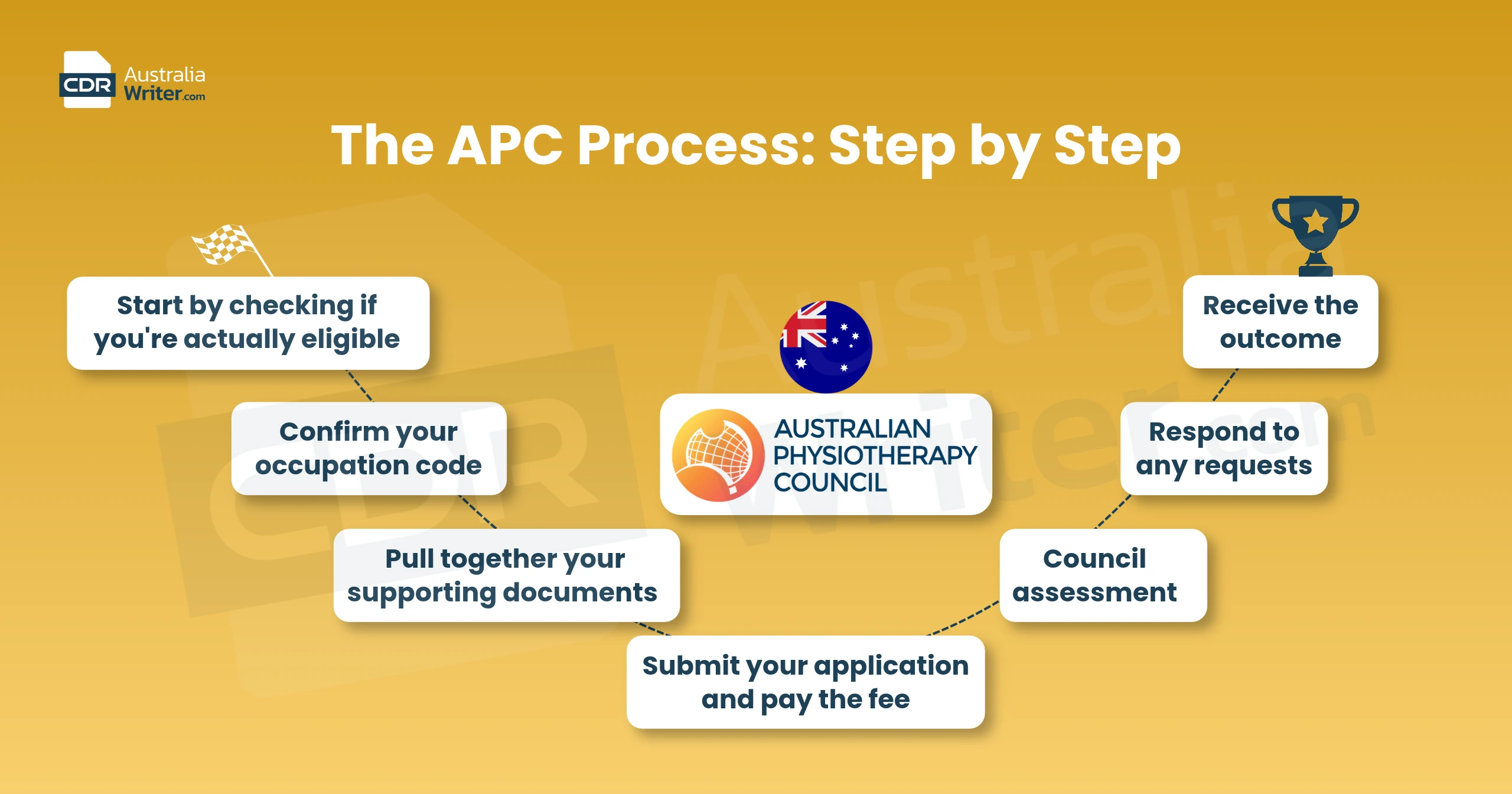
The APC Process: Step by Step
Before you apply for APC assessment, you’ll need to confirm whether you meet the current eligibility settings or not.
As of the criteria updated in late 2024, applicants must demonstrate:
1. Start by checking if you're actually eligible
Before you do anything else, look into the APC’s current migration assessment criteria. Requirements shift from time to time, so it’s worth confirming where you stand before you invest time gathering documents.
2. Confirm your occupation code
If you’re a physiotherapist, you’ll be assessed under ANZSCO code 252511 for skilled migration purposes. It sounds like a small detail, but it’s the code your entire application hinges on.
3. Pull together your supporting documents
This is usually the most time-consuming part. You’ll need evidence of your qualifications, proof of identity, any registration or professional history, employment records, and anything else the Council asks for. Give yourself more time here than you think you’ll need and especially if translations are involved.
4. Submit your application and pay the fee
Once everything’s in order, you can lodge your application through the Council’s official process and pay the relevant fee to get things moving.
5. Council assessment
The submitted information and supporting documentation are reviewed by the council.
6. Respond to any requests
If additional information or clarification is required then provide it within the specified timeframe.
7. Receive the outcome
A successful applicant receives a Skills Assessment Certificate which can be used as a part of the relevant migration process.
Applicants should carefully review every document mentioned above in the APC process before submission. Incomplete applications, incorrect documentation, or inconsistencies between documents can contribute to assessment delays.
APC Pathways and the Documents You'll Need
The Council runs several pathways depending on where you trained and your registration history, including a standard document-based APC Skills Assessment for Migration, the Entry of APC Pathways for those also seeking local registration, and an Express FLYR Pathway offering faster processing for graduates from a shortlist of approved countries (currently including Canada, the UK, Ireland, Hong Kong SAR, and South Africa, alongside a separate FLYR track for the Netherlands, Singapore, Sweden, and selected US states).
Regardless of pathway, your application will typically need:
- Certified academic transcripts and degree certificates, this is to show every subject and result across your training
- Evidence of clinical placement hours and content, that is mapped against Australian competency standards
- Proof of current or prior registration in your country of training
- English language test results, i.e. IELTS, OET, or an accepted equivalent.
- Identity documents, and NAATI-certified translations for anything not issued in English
Document accuracy genuinely matters here because the assessors are comparing your training against a defined competency framework, and gaps in transcript detail or inconsistent naming across documents are a leading cause of delays or requests for further information.
ANZSCO 252511 Physiotherapist and Skilled Migration
ANZSCO 252511, Physiotherapist, is the occupational classification relevant to physiotherapists in Australia’s skilled migration framework. The Department of Home Affairs identifies APC as the assessing authority for this occupation.
However, the things that applicants should check are the occupation list and visa-specific requirements that apply to their intended visa because Australia’s skilled migration system can use different ANZSCO versions depending on the visa program. The Department currently notes that ANZSCO 2022 applies to certain programs that include the Employer Nomination Scheme subclass 186 and Skills in Demand subclass 482, while ANZSCO 2013 continues to apply to several other listed skilled visa programs. This distinction is particularly important for applicants who are preparing documents by being based on information that is found online. Using an outdated occupation list or assuming that the same requirements apply to every visa can lead to incorrect planning.
What Does It Cost?
Costs vary by pathway and are subject to periodic revision, so treat any figure as indicative rather than final. Always confirm current pricing directly through the APC before budgeting, since fees are reviewed regularly. The current APC skills assessment fees for the APEP pathway are:
Assessment Stage | Fee (AUD) |
Eligibility Assessment | $1,170 |
Cultural Safety Training | $235 |
Written Assessment | $2,017 |
Capability Assessment | $2,928 |
Clinical Workshop | $1,464 |
Total | $7,814 |
Common Mistakes to Avoid
A strong physiotherapist skills assessment Australia application is not only about having the right qualification. Errors in documentation and application details can create unnecessary complications.
A few things trip people up more often than you’d expect:
- Applying under the wrong assessment type
- Sending in supporting documents that are missing key pieces
- Employment dates that don’t quite line up across different documents
- Claiming work experience without enough evidence to back it up
- Not checking what the intended visa actually requires
- Relying on outdated info about occupation lists or assessment criteria
- Mixing up the migration skills assessment with professional registration (they’re not the same thing)
- Leaving document prep until the last minute, which rarely ends well
It’s also worth checking the official Council website every so often, since pathways, fees, eligibility criteria, and admin requirements can and do change.
Have Any Question?
CDR Australia Writer specialises in high-quality CDR, RPL and VETASSESS reports for engineers. CDR Australia Writer offer low-cost, customized and reliable services in diverse engineering disciplines.
- +61 485 981 327
- [email protected]
Next Steps for Visa Application After Successful APC Assessment
A positive outcome results in a formal letter confirming your qualifications meet the required standard. This letter becomes a core piece of evidence in your skilled migration file. You will use it to support your Expression of Interest (EOI) in SkillSelect, which directly underpins your eligibility for points-tested visas under your nominated occupation. Just keep in mind that outcome letters are generally tied to validity periods checked against Department of Home Affairs requirements at the time of visa lodgement, so timing your assessment relative to your intended application matters.
If your outcome comes back negative or with conditions, most applicants are able to request a review or reapply once any identified gaps such as: additional coursework, further clinical evidence, or updated English test results can be addressed. It’s rarely the end of the road, but it does mean building extra time into your migration plan.
Because the APC process is document-heavy and detail-sensitive, many of the applicants choose to work with a registered migration agent or a specialist documentation service in order to review their evidence before submission. This won’t guarantee an outcome, but it does reduce the risk of avoidable delays caused by formatting, translation, or evidentiary gaps.
Start Your Assessment With the Right Information
This is a rigorous but navigable process once you understand what the Australian Physiotherapy Council is actually looking for, i.e. comparable qualifications, demonstrated clinical competency, and evidence that you’re ready to practise safely within the Australian healthcare system. For overseas physiotherapists, this skills assessment can be an important step toward an Australian skilled migration pathway. Understanding the assessment criteria, preparing complete evidence, selecting the correct assessment type, and allowing sufficient processing time can help make the application more manageable. Because migration and assessment requirements can change, applicants should rely on current information from the Australian Physiotherapy Council and the Department of Home Affairs rather than outdated guides.
With careful preparation and accurate documentation, international physiotherapists can approach their assessment with greater confidence and avoid many of the common problems that may lead to delays or additional work.
Get our free consultation
Do you have a question?
Get our free consultation with specialist and experienced counsellors. Explore our CDR writing packages immediately and receive 100% plagiarism free CDR report
Contact us right now! and Get your CDR report ready for approval.

Do you have a question?
We have mentioned common questions asked by our clients regarding CDR report, ACS RPL report, KA02 report, and skill assessment process.
- The APC Skills Assessment is a document-based evaluation conducted by the APCl in order to determine whether an overseas-trained physiotherapist’s qualifications and clinical competencies can meet Australian standards.
- Yes, internationally qualified physiotherapists generally need a suitable skills assessment from the designated assessing authority when applying for a skilled migration pathway that requires one. For the occupation of Physiotherapist, the APC is the relevant assessing authority.
- A negative or conditional outcome isn’t necessarily final. Most applicants can address the identified gaps such as additional clinical evidence, coursework, or updated English test results and then reapply or request a review, even though this will add time to your migration timeline.
- The ANZSCO code of the Physiotherapist is252511 which can be used by applicants to check the occupation list and visa-specific requirements applicable to their intended migration pathway because Australia’s occupation classifications and visa requirements can change.
Validity is generally checked against Department of Home Affairs requirements at the time you lodge your visa, so it’s important to confirm current validity rules on the Home Affairs website rather than assuming an older outcome letter will automatically be accepted.