

494 Visa Processing Time:
What Applicants Should Know
494 visa processing time is probably the single thing on your mind right now, if you are waiting on a decision after applying for Australia’s Skilled Employer Sponsored Regional (Provisional) visa. This can help you plan your application, employment and move to regional Australia more realistically. The subclass 494 visa allows skilled workers to live, work and study in designated regional areas for up to five years, subject to the visa conditions.
One important point for applicants who are planning to apply is that there is no guaranteed processing period for every applicant. The Department of Home Affairs uses its processing-time guide to provide an indication based on recently decided applications. Actual processing can be shorter or longer depending on the circumstances of an application.

What Is the Subclass 494 Visa?
The Skilled Employer Sponsored Regional (Provisional) visa, commonly called the subclass 494 visa which is designed for skilled workers who are sponsored by an employer in regional Australia. The visa generally allows the holder to stay for five years and work for the sponsoring employer in the nominated occupation, subject to the applicable requirements and conditions.
The visa has three main streams:
- Employer Sponsored stream
- Labour Agreement stream
- Subsequent entrant stream
The Employer Sponsored stream requires an eligible regional employer and generally requires a skills assessment unless an exemption applies. The Labour Agreement stream applies where the employer has an approved labour agreement with the Australian Government.
Because the visa involves employer sponsorship, nomination and applicant requirements, the overall process can involve more than simply submitting a visa application.
Current 494 Visa Processing Time by Stream
Based on the most recent published figures, most Subclass 494 applications are processed within 8 to 11 months for the Employer Sponsored stream, based on official data as at 29 April 2026. If your employer has a registered Labour Agreement in place, the process tends to be a little quicker such as the Labour Agreement stream typically processes within 8 to 9 months, largely because the terms between the employer and government are already pre-approved.
It is worth being cautious of older articles still quoting outdated figures. As one migration source puts it, you should avoid relying on pages that repeat old “7–13 months” figures as if they were a guarantee where processing benchmarks shift regularly, so always check the current published range close to your lodgement date rather than trusting a number you found months ago.
Zooming out to the full journey rather than just the visa stage, a realistic total timeline from job offer, through nomination and skills assessment, to a final grant which sits at roughly six to twelve months, though this varies significantly case by case.
It’s also worth remembering that the 494 visa processing time isn’t just the same thing as your total wait as a family. If your partner or children are applying separately through the Subsequent Entrant stream, their timeline runs on its own track and may finish at a different point.

494 Subclass Processing Time: How Long Does It Take?
There is no single guaranteed 494 subclass processing time that applies to every applicant. The Department of Home Affairs specifically directs applicants to its visa processing-time guide for an indication based on recently decided applications. It also states that the guide is not specific to an individual application. This means applicants should be careful with websites or advertisements that promise that a subclass 494 application will definitely be approved within a particular number of weeks or months.
The Department’s general processing information explains that processing times can change because of application volume, application complexity, completeness of supporting documents, requests for additional information and checks involving health, character and national security.
For this reason, checking the official processing-time guide close to the date of application is more useful than relying on an old processing-time figure published elsewhere.
Factors That Affect 494 Visa Subclass Processing Time
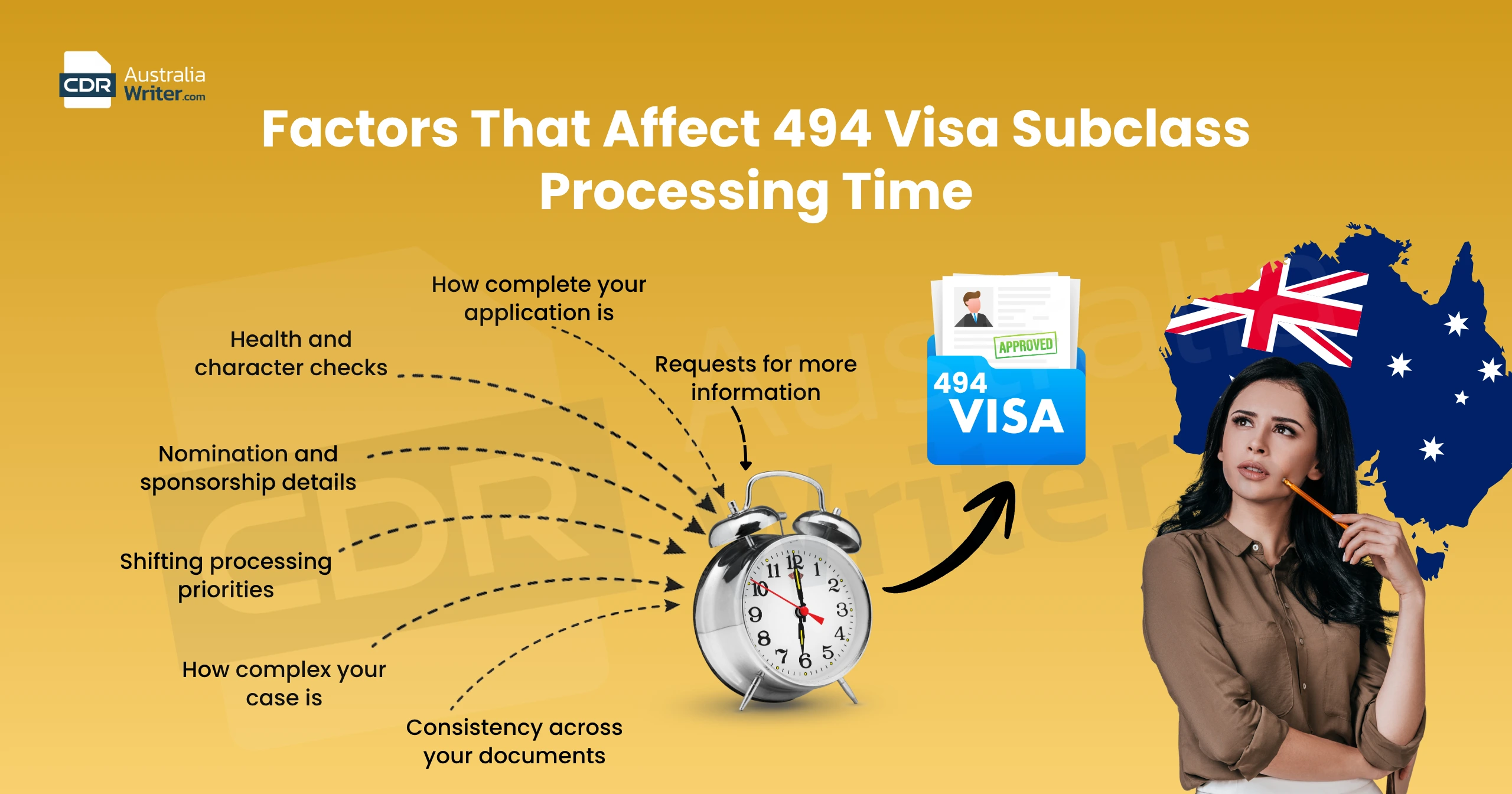
For 494 visa processing time, there are several factors can influence how long an individual 494 visa subclass application takes to process:
1. How complete your application is
This one’s the big one. If you provide every required document and make sure your information is accurate from the start, you sidestep the most common cause of delay which is Home Affairs having to chase you for evidence you could have included the first time.
2. Health and character checks
Medicals and police checks aren’t always quick, especially if the Department needs to verify something with an external authority. Getting these started early gives you a buffer instead of a bottleneck.
3. Requests for more information
Sometimes Home Affairs comes back asking for extra documents mid-process. That is normal, but how fast you respond to them matters. Sit on it for a few weeks and you’ve effectively added those weeks to your own wait.
4. Nomination and sponsorship details
Because this is an employer-sponsored visa, your timeline is tied to more than just your own paperwork. Problems with the nominated position, the employer’s obligations, or the supporting evidence behind the nomination can all slow things down.
5. Shifting processing priorities
Home Affairs doesn’t process every skilled visa at the same pace all year round like priorities shift, and those shifts aren’t always announced loudly. Rather than assuming things work the way they did last year, it is worth glancing at the current Department guidance every so often.
6. How complex your case is
The simpler your circumstances, the smoother things tend to go. But if there’s extra verification involved, a more layered work history, or the need for further assessment, it’s realistic to expect a longer wait than someone with a straightforward file.
7. Consistency across your documents
Everything you submit such as your application, employment records, nomination paperwork, supporting evidence, these all need to be lined up and tell one coherent story. Even minor mismatches can prompt follow-up questions, and each one of those adds time you didn’t need to lose.
How to Check Your 494 Visa Processing Time
The most reliable way to check the current 494 visa processing time is to use the Australian Department of Home Affairs visa processing-time guide. The Department explains that its published processing times are based on recently finalised applications and are intended as a guide. They should not be treated as a guarantee for an individual applicant.
When checking the timeframe, remember that your personal circumstances can make your application take longer or shorter than the published indication. It is also useful to monitor your ImmiAccount for correspondence from Home Affairs. If the Department requests further information, provide the requested material as soon as reasonably possible.
Tips to Speed Up Your 494 Visa Processing Time
While you can’t control the Department’s queue, you can control how “decision-ready” your file is:
- Lodge only once every document is complete and consistent across your application.
- Get medical and police checks done early rather than waiting for a request.
- Make sure your employer’s nomination is airtight before it’s submitted.
- Respond to any Department request within days, not weeks.
- Keep a close eye on ImmiAccount rather than assuming no news is good news.
Doing all five won’t guarantee you land at the fast end of the 494 visa processing time range, but it removes almost every self-inflicted delay.
What Happens After You Apply?
Once you’ve lodged your application through ImmiAccount and paid the visa application charge, it moves into Home Affairs’ hands for assessment. A case officer reviews your application alongside the supporting evidence you have provided. They may come back with a request for additional information if something needs clarifying but it’s worth knowing they are under no obligation to do so before reaching a decision. If your file is already complete and consistent, it’s entirely possible to go straight from lodgement to outcome with no back-and-forth at all.
Applicants should therefore avoid assuming that they will always receive an opportunity to correct missing evidence after submission. While waiting, regularly check the communication associated with your application and respond to any request within the specified timeframe.
The 494 subclass visa also comes with regional work and residence requirements. The visa generally allows eligible holders to live, work and study only in designated regional areas, and certain visa conditions apply.
Have Any Question?
CDR Australia Writer specialises in high-quality CDR, RPL and VETASSESS reports for engineers. CDR Australia Writer offer low-cost, customized and reliable services in diverse engineering disciplines.
- +61 482 072 465
- [email protected]

Our expert writing team has successfully assisted clients in obtaining approval through professional services for skill assessments and migration needs.
Things to Avoid During the 494 Visa Subclass Process
Applicants should avoid several common mistakes:
Relying on guaranteed processing claims:
No private service provider can guarantee how quickly Home Affairs will decide an individual application.
Using outdated processing information:
Visa processing times can change, so always check the current Department of Home Affairs information.
Submitting incomplete documents:
Leaving out evidence rarely saves time where it usually just means Home Affairs comes back asking for it, which adds another round to your assessment.
Ignoring Department correspondence:
If a request for information lands in your inbox, treat it as time-sensitive. Putting it off, even briefly, can push your whole timeline back further than you’d expect.
Providing inconsistent information:
Your visa application, employment documents, nomination details, and supporting evidence should all match up. Contradictions like even small, unintentional ones tend to invite extra scrutiny.
Planning your life around an estimated timeframe:
It’s tempting to book flights or give notice at work based on a published processing range, but that figure is only ever an indication. It’s not a guaranteed decision date, so it shouldn’t be treated as one.
What Applicants Should Remember
At the end of the day, the 494 subclass visa processing time is best treated as a working estimate, not a fixed deadline. Home Affairs updates its processing figures on a regular basis, and no two applications move through the system in exactly the same way and your circumstances will always shape your own timeline more than any published average does.
The most reliable thing you can do is control what’s actually in your hands: put together a complete and accurate application, make sure the sponsorship and nomination requirements are properly met, respond quickly if the Department asks for anything, and check the official Home Affairs processing-time guide for the current figures rather than an old blog post. That combination won’t guarantee a specific date, but it gives you a realistic, up-to-date picture of where you stand which is far more useful than chasing a number that was never a promise to begin with.
Get our free consultation
Do you have a question?
Get our free consultation with specialist and experienced counsellors. Explore our CDR writing packages immediately and receive 100% plagiarism free CDR report
Contact us right now! and Get your CDR report ready for approval.

Do you have a question?
We have mentioned common questions asked by our clients regarding CDR report, ACS RPL report, KA02 report, and skill assessment process.
No, Home Affairs provides an indicative processing timeframe based on recently decided applications rather than a guaranteed timeframe for every subclass 494 applicant.
It can, once you’ve held the visa for at least three years and you’ve met the income and regional living requirements, you become eligible to apply for the Subclass 191 visa which is the permanent residency pathway built specifically for 494 holders.
Yes, your ImmiAccount is where all of this happens, you can log in anytime to see where things stand and pick up any correspondence Home Affairs sends your way.
It does, since sponsorship is baked into how this visa works. The 494 is employer-sponsored and regional by design, so the nomination itself, including the nominated position and, in some cases, labour market testing which is part of what gets assessed alongside your own application.
Definitely, Home Affairs is upfront about wanting all supporting documents provided upfront, and for good reason which is a complete application from day one avoids the back-and-forth that missing information usually causes.
Not really, every case is different like your documentation, occupation, and the nomination itself all play a role. Published processing times are useful as a general guide, but they’re not a promise of when your particular application will be finalised.