

Onshore and Offshore Visa Australia: Which Path Fits You?
Onshore and Offshore visa Australia is the process that depends on where you are when you apply and the specific requirements of your preferred visa. Generally, an onshore application is made while you are physically in Australia, whereas an offshore application is made while you are outside the country. If you are planning to move to Australia or extend your stay? One of the first things you should understand is whether you need to apply for a visa while inside or outside the country. This is where the terms onshore and offshore visa Australia become important.
Understanding the difference between an onshore and offshore visa Australia can save you months of delay, real money, and sometimes a refused application. The idea is simple: it depends on where you are when you lodge, and for some visas, where you are when the decision is made. In practice, the rules change by subclass and have tightened through 2026.
What Is an Onshore Visa Application Australia?
An onshore visa application Australia refers to the process of applying for a visa while you are physically present in Australia. This option is available for those people who are already in the country on a valid visa and also want to apply for another visa without leaving.
Before applying, you should check:
- Whether you are in Australia at the moment and your visa permits you to lodge another application.
- Whether you have your visa type which allows you to apply for a visa onshore.
- Whether you meet the required eligibility requirements which are mentioned.
- Whether your current visa has a condition restricting further applications.
Whether you are applying while you are in Australia does not mean you will be able to stay indefinitely. You must continue to maintain status and comply with the terms of your current visa.
What Is an Offshore Visa Application Australia?
An offshore visa application in Australia refers to the process of applying for a visa when you make an application for a visa whilst you are in Australia. This is considered as a popular option for those who are living abroad and who are looking to move to Australia.
The process generally involves:
- You have to choose the right visa category.
- You need to verify eligibility and application location requirements.
- You should be collecting the required documents.
- If available, then you can submit the application through ImmiAccount.
- Performing health examinations or providing biometrics as required for the application.
- Waiting for the Department of Home Affairs to make a decision.
One important detail is that applying from outside Australia does not mean you must always remain offshore until a decision is made. Your location requirements depend on the particular visa subclass and its conditions.

2026 Rule Changes That Catch People Out
Lodgement rules have shifted quickly, and old advice can now be wrong. From 2 October 2026, most of the temporary visa holders in Australia can no longer apply for a Student visa (subclass 500) from inside the country. That includes working holiday, subclass 482 and subclass 407 holders. They must be outside Australia when they lodge and also when their visa is granted. A few groups, such as school students and doctoral students, keep onshore access. Applications lodged before that date are assessed under the earlier rules.
Another change is close. For Training visa (subclass 407) applications made on or after 12 November 2026, applicants must be outside Australia at lodgement and at grant. Even if ImmiAccount lets you submit, an onshore visa application that breaks the rule will not be considered, so the system accepting your form is not proof it is valid. Check the Home Affairs page for your subclass before you act for the visa.
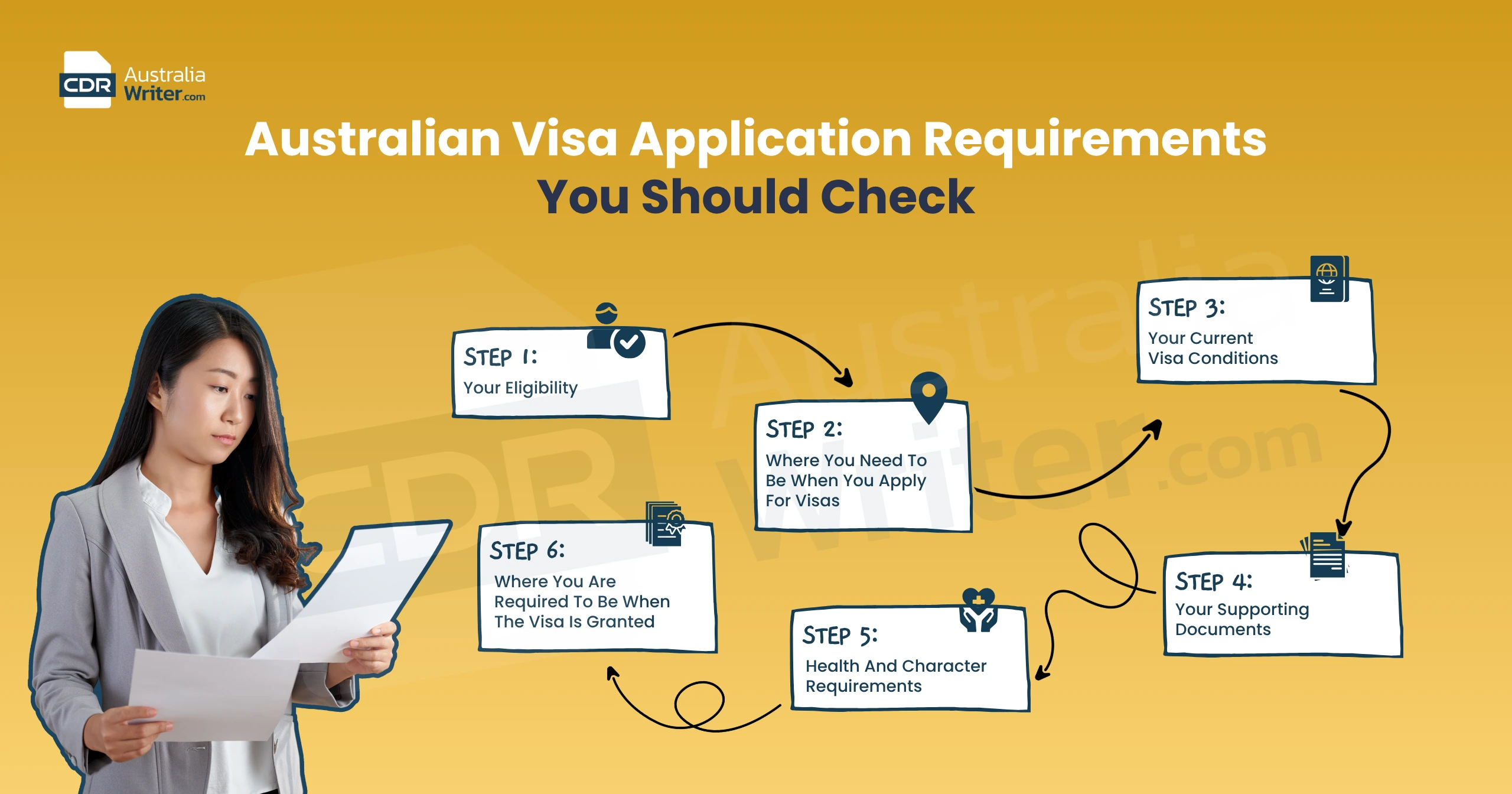
Australian Visa Application Requirements You Should Check
Before you decide where to apply from, read the requirements for the visa you actually want. They vary by visa category and by your own circumstances, so a checklist that worked for a friend may not fit you.
What to check first:
1. Your eligibility:
Make sure you meet the requirements that apply to your visa, such as age, education, English language, work experience or sponsorship.
2. Where you need to be when you apply for visas:
Some visas must be lodged from inside Australia, some from outside, and some allow either.
3. Your current visa conditions:
If you’re already in Australia, look up your conditions in the Visa Entitlement Verification Online (VEVO) service. A condition like No Further Stay can limit what you can apply for.
4. Your supporting documents:
Gather your identity documents, qualifications, employment evidence, English test results and any other records the visa asks for.
5. Health and character requirements:
Complete any medical examinations and get police certificates when they’re requested or required.
6. Where you are required to be when the visa is granted:
Some visas also require you to be inside or outside Australia at the time of the decision, not just when you lodge.
Running through this list before you submit can save you from delays, avoidable mistakes and a lot of stress later.
How to Choose the Right Route
Start with the visa itself, not your preference. Read the Home Affairs page for your subclass and see who can apply from where. Then check your current Onshore and Offshore visa Australia conditions, your expiry date, and whether you hold a No Further Stay condition. Consider family members, whose location may need to match yours. Finally, weigh the practical side which includes: cost, work rights, and whether you can afford to wait overseas. If you are already abroad and the visa allows it, an offshore visa application is often the cleaner path. If you are in Australia on a valid visa that permits lodging, staying put may save you disruption. When the rules are unclear or the stakes are high, speak with a registered migration agent or lawyer before lodging. A wrong-location mistake cannot always be undone.
Onshore and Offshore Visa Australia Differences:
The key difference between onshore and offshore visa Australia applications is the applicant’s physical location when applying. However, this could impact on visa options, bridging visa arrangements and application requirements.
Comparison | Onshore application | Offshore application |
Applicant’s location | Inside Australia | Outside Australia |
Current visa | Usually requires an existing lawful visa status | May not require an existing Australian visa |
Application options | Depends on whether the visa permits an onshore application | Depends on whether the visa permits an offshore application |
Bridging visa | May be available with an eligible valid onshore application | Generally not granted simply because an offshore application is lodged |
Visa conditions | Existing visa conditions must be followed | Entry and grant conditions must be checked |
Main consideration | Maintaining lawful status while applying | Meeting offshore application and grant requirements |
However, it is important to realise that not all visas have the same rules. Some visas allow applications both inside and outside Australia, while others have specific location requirements.For this reason, the onshore and offshore visa Australia decision should be based on your chosen visa subclass rather than assuming one application method is always better.
Have Any Question?
CDR Australia Writer specialises in high-quality CDR, RPL and VETASSESS reports for engineers. CDR Australia Writer offer low-cost, customized and reliable services in diverse engineering disciplines.
- +61 482 072 465
- [email protected]

Our expert writing team has successfully assisted clients in obtaining approval through professional services for skill assessments and migration needs.
Things to Avoid When Applying Onshore or Offshore
Choosing the wrong application pathway for Onshore and Offshore visa Australia or overlooking visa conditions can create problems. Keep these common mistakes in mind:
- Ignoring visa conditions. You have to check your current visa conditions before trying to apply for another visa.
- Overlooking the No Further Stay condition. Conditions such as 8503 can prevent you from applying for most other substantive visas while you remain in Australia, unless the condition is waived or an exception applies.
- Assuming every visa allows onshore applications. Always confirm the application location requirements for your chosen subclass.
- Leaving Australia without checking your bridging visa. If you hold a Bridging Visa A (BVA), it generally ceases the moment you depart. Check your conditions first, and if you need to travel, find out whether you can apply for a Bridging Visa B before you go.
- Waiting until your visa is about to expire. The closer you get to the end date, the fewer options you tend to have. Look at your choices early so you stay lawful.
Your Next Steps Towards an Australian Visa
Not everyone gets the same options when it comes to applying from inside or outside Australia. What’s open to you depends on your eligibility, the conditions on your current visa, and your own situation.
Before you decide where to apply from, take a few minutes to check your visa status and read the requirements for the visa you want. Also confirm where you need to be when you lodge and when the visa is granted. That one detail trips up more people than you’d expect.The Department of Home Affairs website is the best place to confirm the rules before you submit anything. If your visa conditions or eligibility still feel unclear, a registered migration agent can look at your circumstances and point you in the right direction.
Get our free consultation
Do you have a question?
Get our free consultation with specialist and experienced counsellors. Explore our CDR writing packages immediately and receive 100% plagiarism free CDR report
Contact us right now! and Get your CDR report ready for approval.

Do you have a question?
We have mentioned common questions asked by our clients regarding CDR report, ACS RPL report, KA02 report, and skill assessment process.
An onshore application is generally submitted while the applicant is physically in Australia, whereas an offshore application is submitted while the applicant is outside Australia. The permitted location depends on the visa subclass.
Often, if you lodge a valid application before your current visa expires. It is not automatic for every visa, and an invalid application does not trigger one.
Not always, Processing times depend on the visa subclass, the category and Home Affairs priorities, not only your location.
Often no, many offshore visas require you to be outside Australia at grant. Check the grant criteria for your subclass.
No, Each subclass has its own lodgement and grant location rules, and they change. Always confirm on the official Home Affairs page.
It is not compulsory, but advice from a registered agent or lawyer is worth it if you have visa conditions, expiring visas or family members involved.