

Positive CDR Report: What Engineers Australia Looks For
Positive CDR report is the difference between moving ahead with your Australian skilled migration plans and starting again from scratch. Every year, capable engineers receive unfavourable outcomes. They don’t lack skill, but their documents fail to prove it. Preparing a Competency Demonstration Report is an important step for engineers seeking a migration skills assessment through Engineers Australia. Your report needs to demonstrate how you have developed and applied your engineering knowledge, technical skills and professional abilities. A well-prepared positive CDR report should present clear, genuine evidence that your experience meets the competency standards for your nominated engineering occupation.
A good report is not only stating that you are qualified or the projects that you have done. Engineers Australia is interested in what you did, what engineering decisions you made and how you applied your knowledge in real situations. If you are an experienced engineer or a new graduate, then knowing what is the requirement for the assessment will help you to prepare your application more efficiently.

CDR Requirements Engineers Australia: What Makes a Successful Assessment?
Engineers Australia will assess applicants against the relevant Stage 1 competency standards in the nominated occupational category. These standards are the standards which are used to assess whether the applicant possesses the engineering knowledge, skills and professional abilities that are expected at the required level.
If you pass your assessment for a Positive CDR report, this means that Engineers Australia is satisfied that your qualifications and demonstrated competencies meet the relevant requirements. It is considered as a big step for those eligible applicants who require a migration skills assessment even before undertaking skilled migration.
The CDR pathway typically consists of 4 main elements:
- Continuing Professional Development (CPD): A record of your activities demonstrating how you stay current and develop your engineering knowledge.
- Three Career Episodes: Engineering project or activity write-ups that show your individual engineering competencies.
- Summary Statement: A document mapping the required competency elements to the relevant paragraphs of your career episodes.
- Curriculum Vitae (CV): Description of your education, employment, engineering experience and professional background.
Each part has a different function. Together they give the assessors a better feel for your engineering background and what you are able to do. Understanding these Engineers Australia CDR requirements before writing can help you organise your evidence and avoid missing important information.
What Assessors Actually Look For?
Assessors aren’t judging whether you are a brilliant engineer. They are checking whether your documents demonstrate the competencies expected of your nominated occupation: Professional Engineer, Engineering Technologist, Engineering Associate or Engineering Manager. Evidence of personal involvement, sound technical judgement and real problem-solving carries far more weight than impressive vocabulary.
A positive CDR report rests on three qualities: clarity, personal contribution and consistency. Clarity means someone outside your company can follow what you did. Personal contribution means writing “I designed” rather than “we designed”. Consistency means that your dates, job titles and project details are consistent throughout all the documents you submit.

Engineers Australia Skills Assessment:
Common Reasons Applications Face Difficulties
Preparing a detailed report does not automatically mean your application will receive a positive outcome. The quality of your evidence and how well it shows the required competencies is important.
Common problems include:
- Not enough personal input: If you discuss what a team or organization achieved, but fail to highlight your individual contributions, it’s challenging for others to assess your abilities.
- Weak technical explanations: Simply listing engineering activities without providing any explanations of the methods, calculations or decisions may not be sufficient evidence.
- Competency mapping is poor: References to paragraphs are incorrect or unclear and it is difficult to identify where specific elements of competency have been evidenced.
- Inconsistent information: If you have contradictions between your CV, career episodes and supporting documents, it may lead to questions about the accuracy of your application.
- Generic project descriptions: Generic statements that lack relevant technical information can make your experience sound vague or unsubstantiated.
Please review each document prior to submitting your application to ensure you have actual evidence of your engineering knowledge and skills.
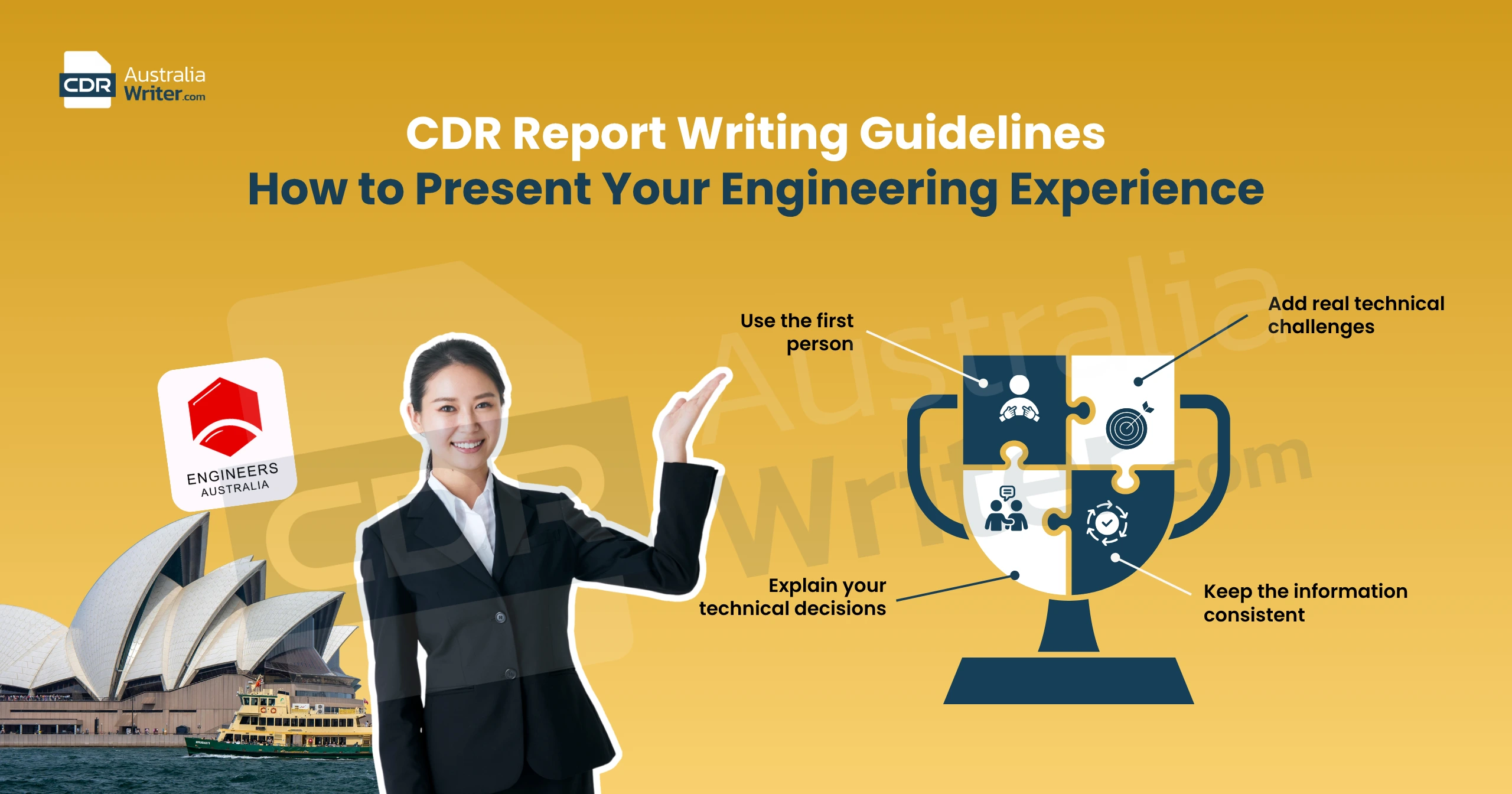
CDR Report Writing Guidelines:
How to Present Your Engineering Experience
A good report is easy to follow, technically meaningful and drawn from your actual experience. Don’t try to make each project sound like a major accomplishment. Explain what you actually did and how you engineered it.
Here are some points to consider when preparing your report:
1. Use the first person:
Your own contribution should be clear from your report. Use statements such as “I designed”, “I calculated”, “I analysed” and “I developed” when describing your own work. If you worked as a team, then you have to mention what your responsibilities were.
2. Explain your technical decisions:
Do not simply mention that you completed a design, inspection or calculation. Explain the engineering principles, methods, tools, or standards that you have used and why they were appropriate.
3. Add real technical challenges:
This includes the fact that real engineering projects often have unforeseen problems
4. Keep the information consistent:
Your career episodes, CV, academic documents and evidence of employment should show a coherent professional history. Assessment can address differences in dates, job titles or project details.
Following the CDR report writing guidelines will make it easier for an assessor to read and assess.
CDR Career Episodes: Demonstrating Your Personal Competencies
Career episodes are among the most important parts of a CDR application. They describe how you used your engineering knowledge in academic projects or in your professional work.
Engineers Australia usually asks for 3 different career episodes. Each should address a different engineering activity, project or period of experience and demonstrate relevant elements of competency.
A career episode is usually divided into 4 sections:
- Introduction:What is the project (length, location, organization, your role)?
- Background:Give a description of the project objectives, the general context, your responsibilities and the working environment.
- Personal Engineering Activity:A description of the actual engineering work you performed including the technical decisions, calculations, methods, challenges and solutions.
- Summary:Describe what is the outcome of the work and your contribution that you did to the project in brief.
One area to focus on in particular is the section of personal engineering activity, as this is where you provide evidence of how you applied your engineering knowledge. The team completed a structural design. I reviewed the design requirements, selected appropriate methods, made calculations and solved technical problems.
Your CDR career episodes should be numbered paragraphs as well so that the information can be cross referenced in the Summary Statement. Under the current Engineers Australia guidance, each episode must demonstrate relevant competencies, with all 16 competency elements addressed at least once across the three episodes.
CDR Summary Statement: Connecting Your Evidence to Competency Elements
The Summary Statement helps assessors identify where you have demonstrated the required engineering competencies in your career episodes.
It is not simply a summary of your three projects. Instead, it links specific competency elements to paragraphs that contain evidence of those abilities.
For each competency element you should:
- Determine the relevant competency requirement.
- Tell us briefly, how do you see that in your experience?
- Mention the exact paragraph numbers in your career episodes.
Keep your CDR summary statement brief and easy to understand. Avoid adding paragraph references simply to fill the table. Every reference should direct the assessor to genuine evidence of the competency being claimed.
A carefully prepared CDR summary statement makes it easier to understand how your experience relates to the required engineering standards.
Originality, Plagiarism and AI-Generated Text
Engineers Australia uses plagiarism-detection software and takes originality seriously. Copying sample reports, borrowing a colleague’s wording or relying on generic text can lead to rejection. Heavily generic or machine-produced writing also reads as unconvincing, because it lacks the specific, slightly messy detail of real project work. A positive CDR report reads like one person describing work they actually did.
Using samples to understand structure is fine, but copying their sentences isn’t. If you get professional guidance, make sure every claim is yours and that you can defend it.
Have Any Question?
CDR Australia Writer specialises in high-quality CDR, RPL and VETASSESS reports for engineers. CDR Australia Writer offer low-cost, customized and reliable services in diverse engineering disciplines.
- +61 482 072 465
- [email protected]

Our expert writing team has successfully assisted clients in obtaining approval through professional services for skill assessments and migration needs.
How to Improve Your Chances of Getting a Positive CDR Assessment Result
A positive CDR report is considered more than just simply following a certain format. The application must show that your engineering background that you have selected is relevant to the occupation category which you applied for.
Review relevant competency standards and identify projects that will provide suitable evidence. Select examples that demonstrate your technical ability, your level of responsibility, your decision-making and your problem-solving skills.
Then prepare your career episodes with actual data of your projects. Make sure your Summary Statement accurately maps competency elements to the correct paragraphs. Your CPD record and CV should also be complete and consistent with the rest of your application.
Please do these checks before you submit:
- Is the correct occupational category selected?
- Do your three career episodes demonstrate the required competencies?
- Is your personal contribution clearly explained?
- Are all career episode paragraphs numbered correctly?
- Does your Summary Statement reference the right paragraphs?
- Are your credentials and supporting documents ready?
- Have you had a look at the latest Engineers Australia application instructions?
It takes time to cover these details, but it can help you avoid easily preventable mistakes and improve the overall quality of your submission.
Things to Avoid When Preparing Your Positive CDR Report
Even engineers with a solid technical background can make mistakes preparing their applications. Keep these points in mind:
- Copy another engineer’s report: Career Episodes must reflect your own experience and engineering activities.
- Blowing up your responsibilities: I did the job you wanted me to do.
- Overusing technical jargon: I’m not sure there is an easy answer to this, but let me try and break it down.
- Ignoring the competence requirements: Make sure your experience relates to the competency elements.
- Above repeated: Each career episode should provide concrete evidence NOT general description of projects.
- Submitted documents are inconsistent: Ensure all dates, qualifications, employment history and project information are consistent throughout your application.
- Relying on promises of guaranteed approval: No consultant or service provider can guarantee the result of an Engineers Australia assessment.
A well-prepared report, honest reporting and a good grasp of the assessment criteria are more valuable than trying to make your report sound impressive.
Your Next Steps to a Winning CDR Assessment
Writing your CDR is a great opportunity to demonstrate your engineering knowledge, experience and professional development in a structured way. First, you have to understand the assessment requirements, then select the appropriate projects, and prepare the required documentation.
A positive CDR report writing must be accurate, clear and substantiated with real evidence of your engineering capabilities. Please review your career episodes carefully, check your competency mapping and ensure consistency across all documentation before submitting your application.
If you need help you might want to consult with an experienced CDR professional who knows Engineers Australia’s assessment requirements. Engineers Australia makes the final decision and no service provider can guarantee a specific assessment outcome.
Get our free consultation
Do you have a question?
Get our free consultation with specialist and experienced counsellors. Explore our CDR writing packages immediately and receive 100% plagiarism free CDR report
Contact us right now! and Get your CDR report ready for approval.

Do you have a question?
We have mentioned common questions asked by our clients regarding CDR report, ACS RPL report, KA02 report, and skill assessment process.
A positive CDR assessment outcome means Engineers Australia has assessed your application successfully against the relevant requirements for your nominated engineering occupation. It provides an outcome letter for migration purposes where applicable.
Applicants using the CDR pathway generally need to prepare three career episodes. Together, these must demonstrate all 16 relevant competency elements at least once.
Yes, You can create your own CDR report writing with your real engineering experience and the official Engineers Australia guidelines. There are also professionals who can check and sort out your papers for you.
If you are unsuccessful, take time to read the outcome letter carefully to understand the assessment concerns. Engineers Australia offers the opportunity to request a review or make an appeal, subject to its applicable rules and time limits.
No, CDR assessment is not a visa approval. It is a skills assessment step that may assist a skilled migration application. Applicants must also separately meet the Department of Home Affairs visa requirements.
You have to use your genuine engineering projects which helps you to explain your personal contribution by including relevant technical details and also demonstrate how you approached challenges. You need to make sure that your examples which you mentioned clearly relate to the competency elements for your nominated occupation.