

VETASSESS Migration Assessment: A Clear Guide for Skilled Applicants
VETASSESS migration assessment is often considered as the very first formal step for professionals who want to move to Australia on a skilled visa. If your occupation is not a trade, there is a good chance this is the body that decides whether your qualifications and work history match what Australian employers expect. The process can look confusing at first, but it becomes much easier once you understand what is checked and why.
If you are planning to migrate to Australia as a skilled professional involves several important steps, and getting your qualifications and work experience recognised is one of them. For many applicants, the VETASSESS migration assessment is considered as an important part of this journey. This helps in ascertaining whether the applicant’s education and work experience meet the requirements of the nominated occupation. Knowing its requirements before applying can help you prepare the right documents, avoid unnecessary delays and make informed decisions on your migration plans.
What Is a VETASSESS Skills Assessment?
VETASSESS is an independent assessing authority which is approved for Australian skilled migration. It reviews hundreds of professional and general occupations, from accountants and marketing specialists to HR advisers and construction project managers. A positive outcome confirms that your skills are comparable to the Australian standard that is set for your nominated occupation.
For most points-tested visas, such as the Skilled Independent (189), Skilled Nominated (190) and Skilled Work Regional (491), a positive result is required before you can move ahead. A VETASSESS skills assessment is also used for certain DAMA and graduate visa pathways. In short, it is the document that proves you are genuinely qualified for the job you claim.
VETASSESS Skills Assessment Requirements: Who Can Apply?
Before starting an application, you should check whether your nominated occupation is assessed by VETASSESS migration assessment and whether you meet its specific eligibility criteria.
For many professional occupations, the assessment considers two main areas:
1. Educational Qualifications
Your qualifications must be closely related to the nominated occupation and at the required level of education. VETASSESS migration assessment compares your overseas qualification to the Australian Qualifications Framework (AQF) and the relevance of your main field of study.
2. Employment Experience
You must show in your employment history that you have worked at the required skill level in occupations relevant to your nominated occupation. How much experience you need and when you need it will depend on the assessment criteria for your occupation.For many professional occupations, applicants are required to have a minimum of one year of highly relevant employment at the required skill level during the five year period prior to application. These may include positions in management, business, education, hospitality, agriculture and other professional fields depending on the occupation.
Don’t assume everyone has the same requirements. Applicants need to look at the individual occupation criteria.

VETASSESS Occupation List: Finding the Right Occupation
Selecting the correct occupation is one of the most important parts of the application process. Your job title doesn’t decide what occupation you should apply for. VETASSESS migration assessment assesses your suitability for an occupation by looking at your actual responsibilities, qualifications and employment experience.
Find the correct occupation. This is achieved by:
- Please tell us your academic credentials, and what you studied.
- Duties: What are your principal duties in your previous and current position?
- Compare your experience with the relevant ANZSCO occupation description.
- Check whether VETASSESS migration assessment is the designated assessing authority for your desired occupation.
- Read the occupation-specific qualification and employment requirements.
The VETASSESS occupation list covers various professional and general occupations. Depending on the occupation, these may be in management, business, education, hospitality, agriculture and other professional fields.
You should also check the relevant skilled occupation list which is published by the Department of Home Affairs. An occupation being assessed by VETASSESS migration assessment generally does not automatically mean it is eligible for every skilled migration visa.
How to Apply for a VETASSESS Skills Assessment
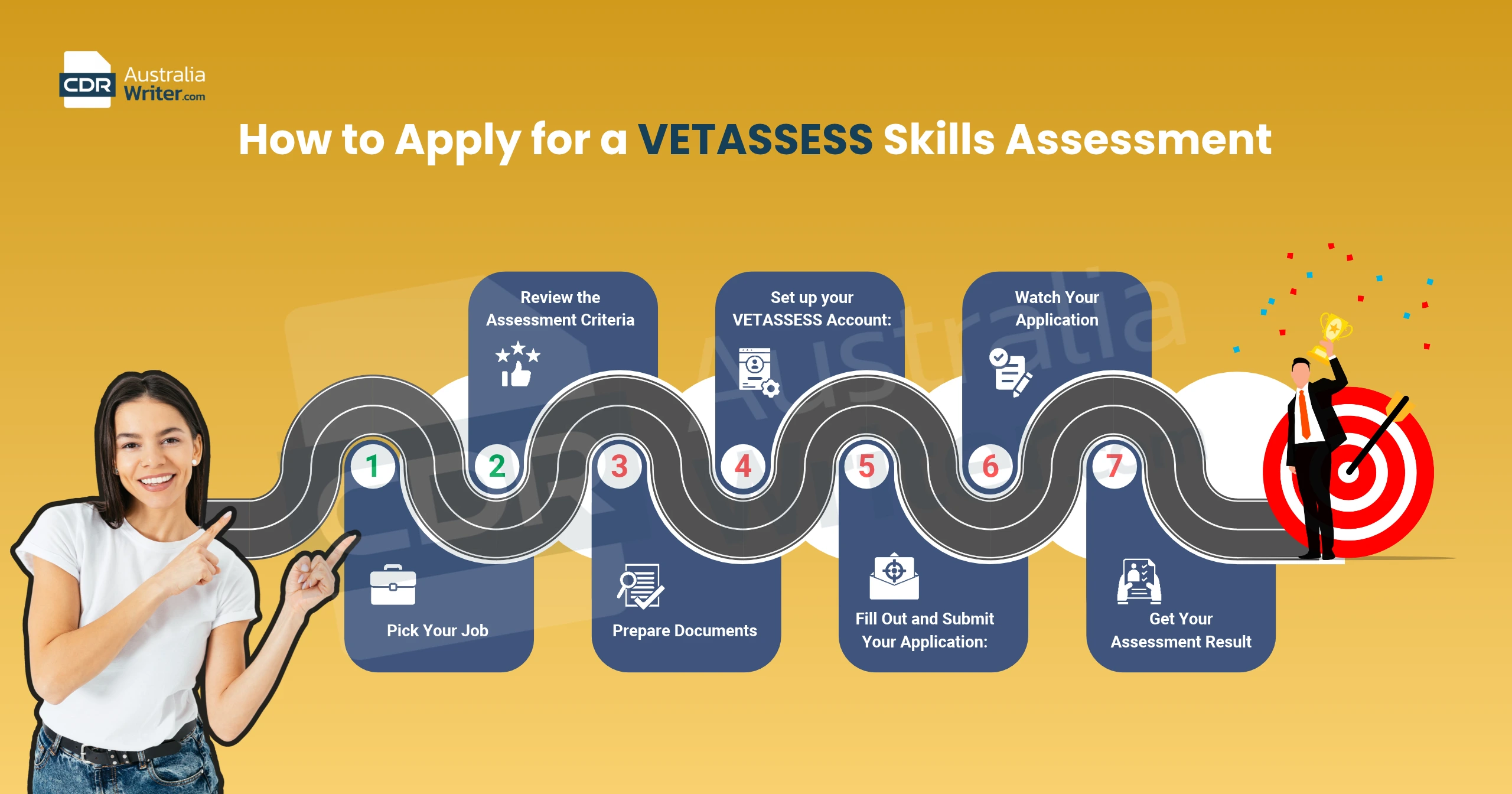
Once you know what is needed for VETASSESS migration assessment, then you can start preparing your application. The process of assessing professional or general skills normally involves the following steps:
1. Pick Your Job:
Choose a title that most accurately describes your skills and responsibilities. You have to check whether VETASSESS is the right assessing authority or not.
2. Review the Assessment Criteria:
Carefully read the specific guidelines for the occupation. Check the level of qualifications needed, the area of study they pertain to and the work experience.
3. Prepare Documents:
Collect all of your identity cards, educational certificates and academic transcripts, CV and proof of employment. Documents not in English will normally need to be accompanied by appropriate English translations.
4. Set up your VETASSESS Account:
You can apply through the VETASSESS application portal and then select the suitable assessment service.
5. Fill Out and Submit Your Application:
Enter valid information about yourself, your education, your employment. Upload clear high quality colour scans of required documents. Proceed to payment.
6. Watch Your Application:
After you submit your application, you can check your online account for more updates or also can request for more information. If you are asked for more documents, then you have to respond within the time limit.
7. Get Your Assessment Result:
Once your assessment is finalised you can view your outcome on the online portal. If you disagree with the decision, review the available options for an outcome review, reassessment or appeal, where applicable.
Following these steps carefully can help you avoid common application mistakes.
VETASSESS Processing Time and Fees
The latest published VETASSESS processing time for professional occupations is about seven weeks for a standard application. Outcome reviews and reassessments are also around seven weeks, while appeals take roughly twelve. Priority processing exists for urgent situations, such as when you already hold a visa invitation with a deadline.
Application fees were adjusted from 9 September 2026 in line with inflation, so always check the official fee schedule before you pay. Timelines can shift during busy periods, so build a buffer into your plans rather than counting on the minimum.
VETASSESS Employment Evidence: Documents You Need
Employment documentation is an important part of the VETASSESS migration assessment because it helps establish where you worked, how long you worked and what responsibilities you performed.
Providing full and verifiable evidence of your employment will help the assessor to determine whether your experience meets the requirements of your nominated occupation.
Some of the common documents that are required are:
1. Statement of Service:
Ideally this should be on official company letterhead and should generally include your job title, exact dates of employment, your working hours, salary, main responsibilities that you performed and referee details. It also needs signing off by someone in an authorised position such as your line manager or a representative from HR.
2. Review the Assessment Criteria:
You may need to state if you were paid or not paid for your work. These may include, as appropriate to the evidence requirements:
- Pay cheques.
- Tax Records.
- Salary credits in bank statements.
- Superannuation or employment insurance record
3. Additional Employment Documents:
Additional supporting documents are required such as employment contracts, appointment letters, position descriptions, organisational charts and project records may also be required depending on the occupation that you choose. If you are self-employed, you may be asked to submit business registration documents, tax papers, invoices, contracts with clients and other evidence that you really run a business.
Understand that you may not have enough with only a reference letter. VETASSESS migration assessment requires evidence that is verifiable. The exact combination of documents will vary depending on your application type and occupation.
Have Any Question?
CDR Australia Writer specialises in high-quality CDR, RPL and VETASSESS reports for engineers. CDR Australia Writer offer low-cost, customized and reliable services in diverse engineering disciplines.
- +61 482 072 465
- [email protected]

Our expert writing team has successfully assisted clients in obtaining approval through professional services for skill assessments and migration needs.
Common Mistakes to Avoid During the Assessment
If you have the relevant qualifications and experience it can be difficult if your applications are poorly prepared.
Here are some common mistakes to avoid:
- Choosing an inappropriate job: Don’t just pick a job based on your job title. Compare the official description of the occupation with your actual job duties.
- Incomplete submission of employment history: Support your work history with the appropriate employer and financial evidence.
- Not Field-of-Study Relevant: A degree at the required level of education may not meet the field-of-study requirements.
- Giving conflicting information: Make sure that the dates of employment, job title and hours worked are consistent on your CV, reference letters and supporting documents.
- Using fuzzy scans of documents: Readable colour scans to be included with translations (where applicable).
- Save until the last second: Allow adequate time for document collection, review and any further requests.
If you take the time to review your application before you submit it, you can avoid problems that need not exist.
Prepare for Your Australian Skills Assessment with Confidence
The best way to start a good skills assessment is to pick the right occupation and know the precise qualification and employment requirements. Accurate education records, verifiable employment documents and consistent application information must be provided prior to application.
Understanding the VETASSESS migration assessment process can help international professionals who are planning to migrate to Australia make the preparation stage more organised and manageable. Check the latest official guidance for your nominated occupation. The assessment criteria, fees and processing times may differ.
Get our free consultation
Do you have a question?
Get our free consultation with specialist and experienced counsellors. Explore our CDR writing packages immediately and receive 100% plagiarism free CDR report
Contact us right now! and Get your CDR report ready for approval.

Do you have a question?
We have mentioned common questions asked by our clients regarding CDR report, ACS RPL report, KA02 report, and skill assessment process.
No, It applies only if your occupation is assessed by VETASSESS. Other occupations, such as engineering roles, go to different assessing bodies.
Sometimes, but usually your field of study should be very related to the occupation. Check your specific role requirements first.
No, Only paid employment at the right skill level is counted.
The latest published timeframe for professional occupations is around seven weeks. Check the official website for the current figure.
Depending on the outcome you may be able to request a review, reassessment or appeal. Read your outcome letter carefully to learn what options you have.
No, it just shows whether your skills are aligned with the occupation or not. You will still have to meet all other visa requirements that includes: points, English ability, health and character checks.