

NSCA Summary Statement for AACA Stage 2 Assessment in Australia
The NSCA Summary Statement is a mandatory document submitted as part of the AACA Stage 2 Overseas Qualification Assessment Portfolio. It demonstrates how your architectural qualifications, projects, and professional experience address the competency criteria set out in the National Standard of Competency for Architects (NSCA) 2021 across all 13 Topic Areas. Without a complete and well-evidenced NSCA Summary Statement, your Stage 2 OQA Portfolio will not be approved by theArchitects Accreditation Council of Australia (AACA).

What Is the NSCA Summary Statement?
The NSCA Summary Statement is a structured self-assessment document in which you map your Portfolio evidence against the performance criteria in the National Standard of Competency for Architects 2021. The NSCA sets out the competencies required of all architects practising in Australia and is the benchmark AACA uses to evaluate overseas architectural qualifications and experience.
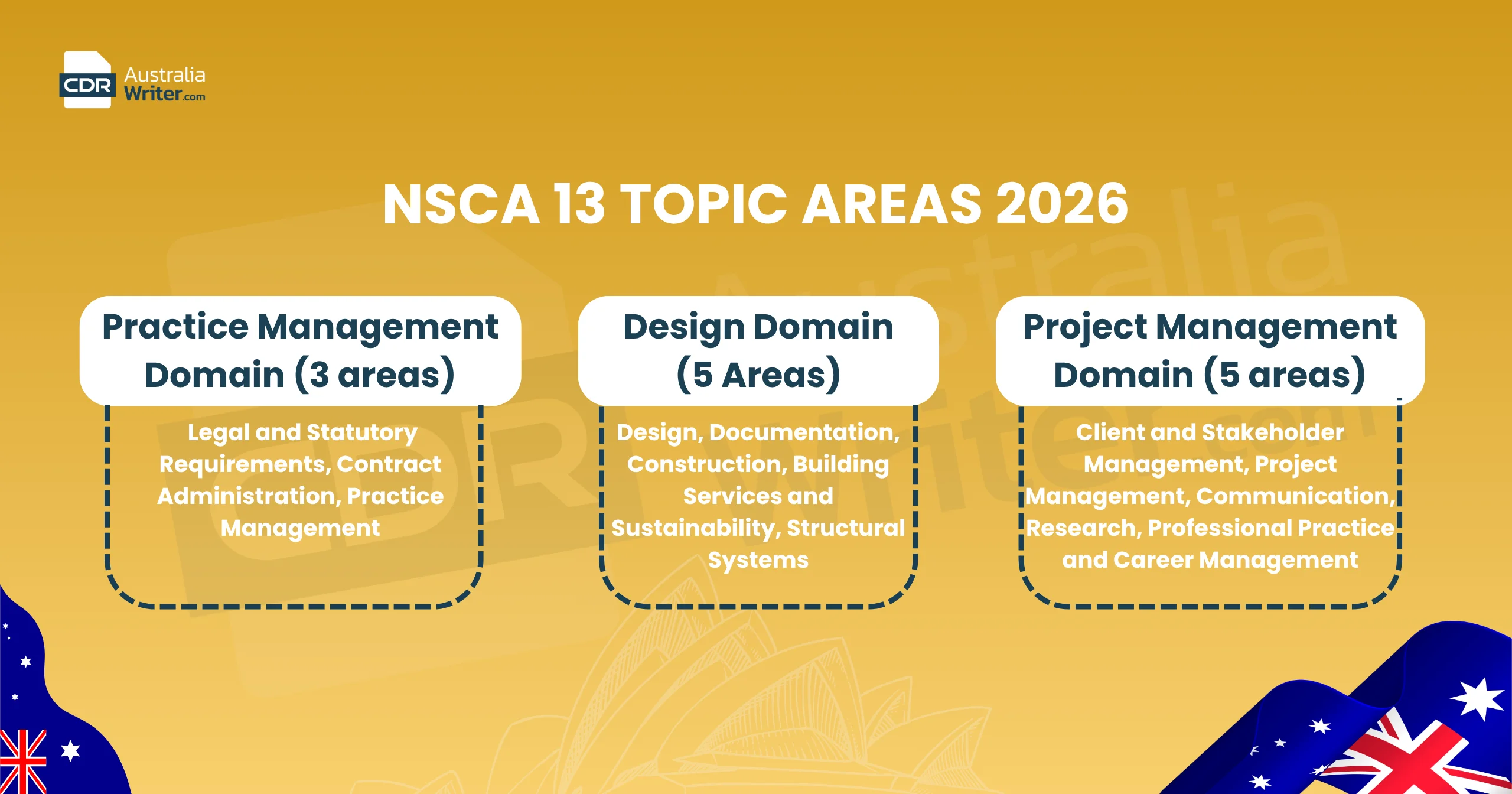
The National Standard of Competency for Architects covers 13 Topic Areas organised across three domains: Design, Documentation and Construction; Practice Management; and Project Management. Each Topic Area contains specific Performance Criteria. Your NSCASummary Statement lists each Performance Criterion for all 13 Topic Areas and identifies the exact Portfolio project or document that demonstrates your competency against it.
Graduate Level Standard: For Stage 2 OQA purposes, AACA assesses competency at a graduate level, not at the level of a registered practising architect. This means your Portfolio and NSCA Summary Statement must demonstrate that you have the foundational competencies required at the point of entering professional practice in Australia, not that you have mastered every criterion across years of independent practice.
Get free consultation
The AACA Stage 2 Overseas Qualification Assessment Process
The NSCA Summary Statement sits within the Stage 2 OQA, which is the second of two assessment stages an overseas architect must complete for skilled migration to Australia. Stage 1 is a document assessment. Stage 2 is the Portfolio and NSCA Summary Statement assessment.
Stage | What It Involves | Outcome |
AACA reviews your academic transcripts and qualification documents to confirm your overseas architecture degree is comparable to an Australian bachelor degree in architecture or higher | Eligibility confirmed, you may proceed to Stage 2 OQA | |
Overseas Qualification Assessment (OQA) | You prepare a Portfolio of architectural projects demonstrating NSCA competencies across all 13 Topic Areas, accompanied by an NSCA Summary Statement mapping each criterion to specific Portfolio evidence | Positive or Negative outcome, positive outcome confirms your qualification is equivalent to a graduate Australian architect |
Registration | After a positive Stage 2 outcome, you can apply for architect registration with the relevant state or territory registration board. Registration requires additional requirements including an interview in some states | Registered Architect, eligible to practise in Australia |
Important:A positive AACA Stage 2 OQA outcome is the mandatory skills assessment outcome required for the Department of Home Affairs before any skilled migration visa application for Architect ANZSCO 232111 can proceed.
Have Any Question?
CDR Australia Writer specialises in high-quality CDR, RPL and VETASSESS reports for engineers. CDR Australia Writer offer low-cost, customized and reliable services in diverse engineering disciplines.
- +61 485 981 327
- [email protected]
The 13 NSCA Topic Areas Covered in the Summary Statement
The NSCA Summary Statement must address all 13 Topic Areas of the National Standard of Competency for Architects 2021. Each Topic Area contains multiple Performance Criteria that your Portfolio must evidence.
Design Domain
Topic Area | What It Covers |
Design | Conceptual design, design development, response to site and context, creative resolution of architectural problems |
Documentation | Technical documentation, construction drawings, specifications, and coordination of building information |
Construction | Understanding of construction materials, methods, systems, and processes, demonstrated through real projects |
Building Services and Sustainability | Environmental systems, energy efficiency, services integration, and sustainable design principles |
Structural Systems | Understanding of structural principles and their integration into architectural design and documentation |
Practice Management Domain
Topic Area | What It Covers |
Legal and Statutory Requirements | Building regulations, planning controls, approvals processes, and compliance obligations in Australia or equivalent |
Contract Administration | Procurement, contract forms, cost management, and administration during construction |
Practice Management | Business management, risk management, professional conduct, and architectural practice in Australia |
Project Management Domain
Topic Area | What It Covers |
Client and Stakeholder Management | Managing client relationships, community engagement, and stakeholder consultation across the project lifecycle |
Project Management | Programme management, resource allocation, team leadership, and delivery of architectural projects on time and within budget |
Communication | Verbal, written, and visual communication in architectural practice, reports, presentations, drawings, models |
Research | Investigative skills applied to architectural problems, precedent study, technical research, site analysis |
Professional Practice and Career Management | Continuing professional development, self-assessment, ethical obligations, and career management as a practising architect |
AACA Overseas Qualification Assessment Portfolio Requirements
The Stage 2 OQA submission requires both the Portfolio and the NSCA Summary Statement. Both must be submitted together as a complete package.
Portfolio Requirements
- Minimum three architectural projects covering different building types, scales, and project stages.
- Projects must demonstrate involvement in both design development and technical documentation at minimum.
- Each project must be clearly presented with drawings, reports, photographs, or other professional evidence of your personal contribution.
- Projects completed as part of academic study may be included alongside professional projects.
- The Portfolio must demonstrate personal contribution, not team outcomes, assessors evaluate your individual competency.
NSCA Summary Statement Format
- CompletedNSCA Summary Statement template as provided by AACA, do not create your own format.
- Each of the 13 Topic Areas listed with all Performance Criteria addressed.
- Project cross-references must match the project numbering and naming used consistently throughout the Portfolio.
- Submitted in PDF format alongside the Portfolio as a complete Stage 2 OQA package.
How to Write the NSCA Summary Statement Correctly
The NSCA Summary Statement is not a narrative essay. It is a structured mapping document. Each row of the Summary Statement corresponds to one Performance Criterion within a Topic Area and identifies the specific Portfolio project or document that demonstrates your competency against that criterion.
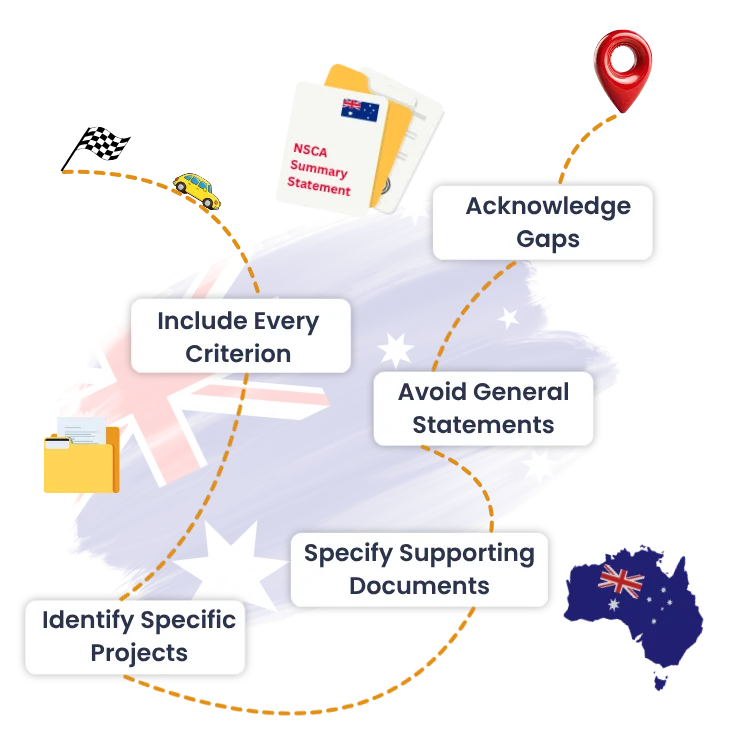
- List every Performance Criterion for each of the 13 Topic Areas in the correct order as published in the NSCA 2021 document.
- For each criterion, identify the specific Portfolio project, by project name and number, where the evidence sits.
- Include the specific section, drawing, report, or design documentation within that project that demonstrates the criterion.
- Do not make general statements, assessors compare your Summary Statement to your actual Portfolio evidence directly.
- Criteria that are not evidenced in your Portfolio must be acknowledged, do not leave them blank or map them to evidence that does not genuinely demonstrate the criterion.
Common Mistake: Mapping the same single project to every criterion. AACA assessors look for a diverse Portfolio demonstrating competency across different project types, scales, and stages. A Summary Statement that maps one building project to all 13 Topic Areas will be found insufficient regardless of the project’s complexity.
AACA Assessment Fees and Processing Times 2026
Service | Fee AUD 2026 | Processing Time |
Stage 1 Eligibility Assessment | Confirm current fee on aaca.org.au | Typically 4 to 6 weeks |
Stage 2 Overseas Qualification Assessment | Confirm current fee on aaca.org.au | Typically 3 to 6 months from complete submission |
Assessment outcome validity | 3 years from positive outcome | Reapply if expired before visa or registration is completed |
2026 Fee Note: AACA fees are updated periodically. Always confirm current fees directly on aaca.org.au before submitting payment. CDR Australia Writer assists with documentation preparation and does not charge any AACAassessment fees on your behalf.
Visa Pathways After a Positive AACA Stage 2 Assessment
A positive AACA Stage 2 OQA outcome opens the following skilled migration visa pathways for Architect ANZSCO 232111.
Visa | Type | Key Requirement |
189 Skilled Independent | Permanent, no sponsor | MLTSSL occupation, Architect 232111 is on MLTSSL, points invitation |
190 State Nominated | Permanent, state sponsor | Occupation on state list, positive AACA outcome, nomination |
491 Skilled Work Regional | Provisional, regional sponsor | Regional nomination, positive AACA outcome |
Permanent, employer sponsored | Employer nomination, positive AACA outcome | |
482 Skills in Demand | Temporary, employer sponsored | CSOL occupation, sponsor required |
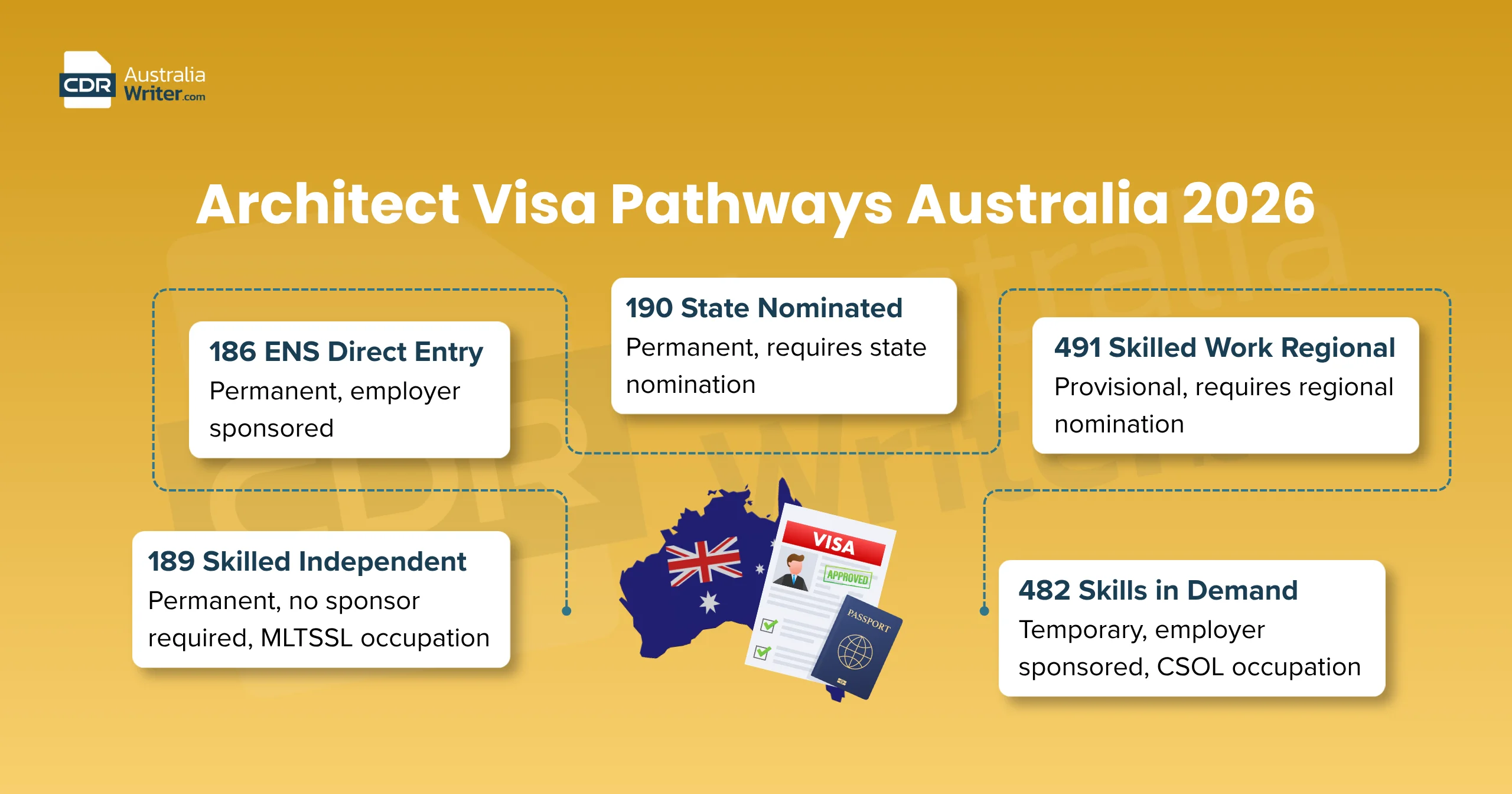
Architect (ANZSCO 232111) sits on the Medium and Long-term Strategic Skills List, qualifying for the 189 independent visa with no employer or state sponsor required. New South Wales, Victoria, and Queensland consistently include architects on their 190 state nomination lists due to sustained demand from residential, commercial, and infrastructure development.
Get Your National Standard of Competency for Architects Documentation Right
The NSCA Summary Statement is the most technically demanding documentation component in any Australian architecture migration pathway. Architects who submit a Summary Statement that mismatches Performance Criteria to Portfolio evidence, relies on a single project for all 13 Topic Areas, or omits criteria entirely consistently receive negative outcomes regardless of the quality of the architectural work itself.
CDR Australia Writer prepares NSCA Summary Statements and AACA Stage 2 OQA Portfolio documentation for overseas architects, structured against the NSCA 2021 Performance Criteria across all 13 Topic Areas, with zero plagiarism and a clear, honest mapping to your actual Portfolio evidence.
Get your NSCA Summary Statement and Portfolio submission right the first time. Contact CDR Australia Writer today.
Get our free consultation
Do you have a question?
Get our free consultation with specialist and experienced counsellors. Explore our CDR writing packages immediately and receive 100% plagiarism free CDR report
Contact us right now! and Get your CDR report ready for approval.

Do you have a question?
We have mentioned common questions asked by our clients regarding CDR report, ACS RPL report, KA02 report, and skill assessment process.
A structured mapping document submitted as part of the AACA Stage 2 OQA Portfolio. It maps your Portfolio evidence against every Performance Criterion across all 13 Topic Areas of the National Standard of Competency for Architects 2021.
13 Topic areas within 3 domains of study; design (5 topics), practice management (3 topics) and project management (5 topics). All 13 topics need to be touched upon in the NSCA Summary Statement.
Yes, AACA tests against graduate competency standards, and your tertiary architectural projects can be presented along with other professional work. The Portfolio must feature a variety of building types, sizes and scales and stages of completion.
Stage 2 processing typically takes 3 to 6 months from a complete submission. Stage 1 Eligibility Assessment typically takes 4 to 6 weeks. Confirm current timeframes on aaca.org.au before planning your migration timeline.
Yes. The skills assessed as the level to Architect, ANZSCO 232111, are on the MLTSSL thuseligible to theSkilled Independent visa(class 189),no employer, and no nomination by state necessary. The prerequisites skill assessment for applying EOI are AACA Stage 2 OQA satisfactory outcome.