

ANMAC Skills Assessment: The Complete Guide for Nurses Migrating to Australia
ANMAC Skills Assessment is an important step for eligible nurses, midwives and certain direct care workers who are planning to migrate to Australia through skilled migration pathways. The assessment examines their relevant qualifications, registration and, where applicable, their professional experience in order to determine whether an applicant meets the requirements for the nominated occupation.
If you’re an internationally qualified nurse or midwife planning to build a career in Australia, then this Skills Assessment is the single most important document standing between you and permanent residency. Without a positive outcome from the Australian Nursing and Midwifery Accreditation Council (ANMAC), you cannot lodge an Expression of Interest (EOI) for a Subclass 189, 190, or 491 skilled visa, no matter how strong your clinical background is. This helps to understand the assessment requirements before submitting an application and can prevent avoidable delays.

ANMAC Skills Assessment: What You Need to Know
An ANMAC is the government-approved authority and a professional skills assessment responsible for evaluating whether the qualifications, registration history, and in some cases their work experience of overseas-trained nurses, midwives, and direct care workers are comparable to Australian standards. This is used in Australia’s skilled migration system for eligible nursing, midwifery and direct care occupations which is separate from a professional registration.
A positive result lets you claim points for your nominated occupation in SkillSelect and move forward with your visa application. Meanwhile, a negative result, or finding of a non-genuine claim, can lock you out of reapplying for two years, so getting the application right the first time matters far more than rushing it.
Understanding the ANMAC Application Process: Step by Step
The ANMAC skills assessment process begins with identifying the correct assessment pathway. This is important because eligibility differs between Modified, Full, GradReady and Direct Care assessments. Skipping this step and guessing which pathway applies is one of the most common and costly mistakes applicants make.
Get free consultation
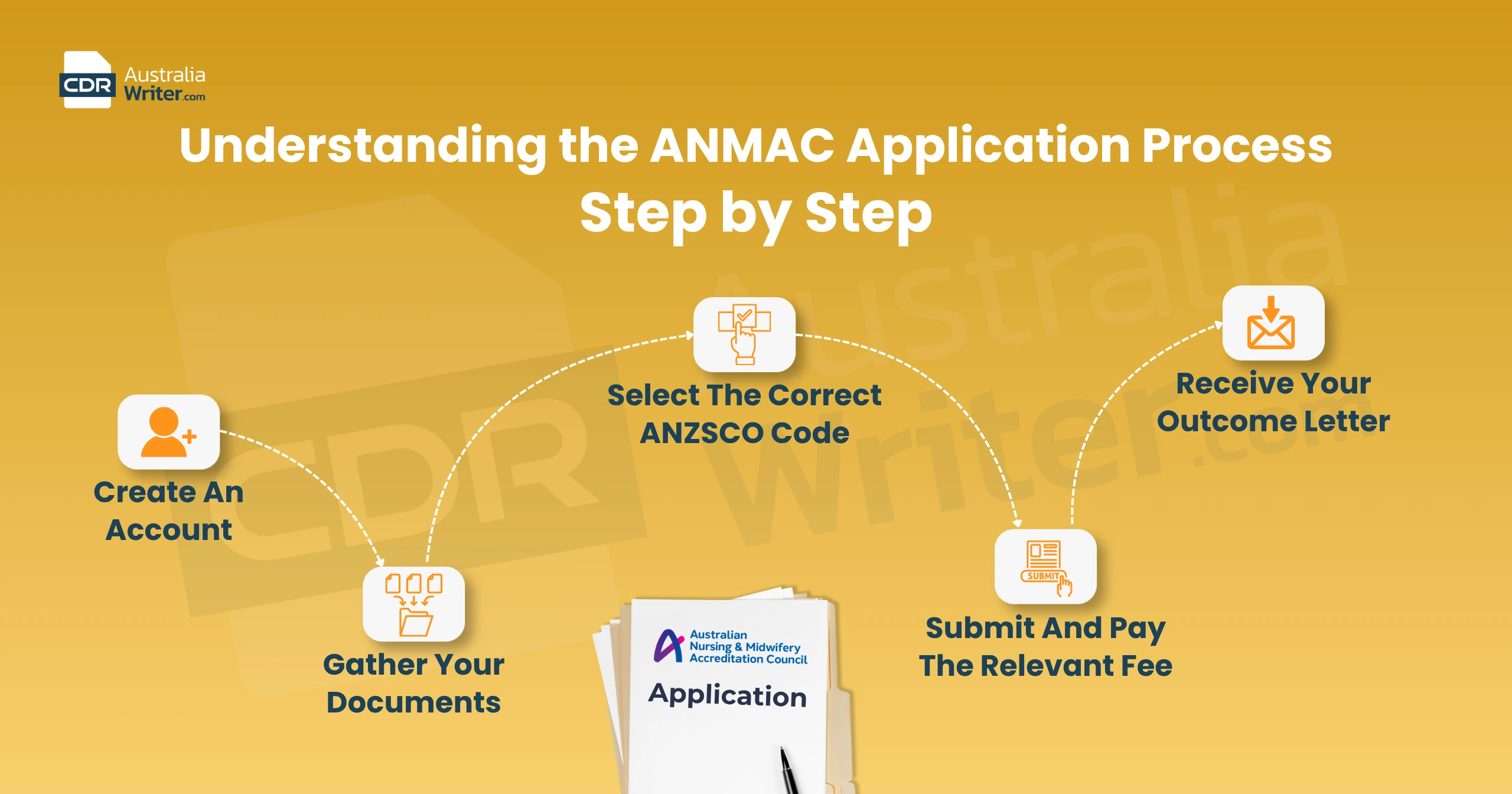
Once you know your pathway, the ANMAC application process generally follows this sequence:
1. Create an account
In the Skilled Migrant Application portal a new email address is required for each new application.
2. Gather your documents
Documents like passport, identity documents, qualification certificates, transcripts, registration verification, and, where required, professional references and English test results.
3. Select the correct ANZSCO code
This determines which nursing or midwifery occupation you’re being assessed against and must align with your actual work experience.
4. Submit and pay the relevant fee
After the payment and submit of the relevant fee then wait for ANMAC to review your file.
5. Receive your outcome letter
This is valid for two years from the date of decision.
It is important to remember that receiving a positive assessment does not itself grant an Australian visa. Applicants must still satisfy the requirements of the relevant visa subclass and other authorities.
Modified vs Full Skills Assessment: Choosing the Right ANMAC Application Process
Almost every nurse ends up in one of two camps here, and picking the right one from the start saves you a lot of hassle down the line. If you’re already registered with the NMBA/Ahpra, the Nursing Council of New Zealand, or the Midwifery Council of New Zealand, you’ll go through the Modified Skills Assessment. Since ANMAC can lean on the verification your regulator has already done, this pathway moves faster and it’s cheaper too, at AUD $395.
The Full Skills Assessment is the one for internationally qualified nurses and midwives who don’t yet hold Australian or New Zealand registration but are currently registered in one of a handful of approved countries:
- Canada,
- Hong Kong,
- Ireland,
- Singapore,
- Spain,
- the UK, or
- the US.
This route asks for more and you’ll need to show at least three months (260+ hours) of paid, relevant work experience from the last five years, along with professional references and English test results. Some applicants, depending on their qualification and where they’re registered, also need to prove at least 1,800 hours of paid practice since 1 January 2017. This assessment solely costs AUD $595.
There are two other routes that are worth knowing about. ANMAC also runs:
- A Direct Care Worker assessment, which supports the Aged Care Industry Labour Agreement and
- Designated Area Migration Agreement, that opens a GradReady stream from time to time for recent graduates of accredited Australian nursing and midwifery programs
This is a much quicker option if you’ve just finished your course. The catch is that GradReady only runs during set windows tied to graduation periods, so don’t assume it’s always open. Check ANMAC’s website for current dates before you plan around it.
Common Mistakes Applicants Should Avoid
A technically eligible applicant can still experience problems if the application is poorly prepared. Several common mistakes are worth avoiding:
Selecting the wrong assessment pathway:
Applicants should first determine whether they require a Modified, Full, GradReady or Direct Care assessment. The eligibility criteria are not interchangeable.
Submitting incomplete documents:
Missing qualification evidence, identity documents or required employment evidence can result in requests for additional information.
Using unsuitable employment evidence:
Professional references should satisfy ANMAC’s requirements and employment claims must be capable of verification. ANMAC specifically states that cash-paid work cannot be assessed.
Ignoring registration verification:
Where work experience is being assessed, registration verification or a certificate of good standing may be required from the relevant authority.
Uploading poor-quality scans:
Documents should be clear colour scans of the originals and meet ANMAC’s stated upload requirements.
Have Any Question?
CDR Australia Writer specialises in high-quality CDR, RPL and VETASSESS reports for engineers. CDR Australia Writer offer low-cost, customized and reliable services in diverse engineering disciplines.
- +61 485 981 327
- [email protected]
How Professional Preparation Can Help
Preparing an ANMAC application is not just simply a matter of uploading documents. It is about making the applicants understand which evidence applies to their assessment pathway and ensuring that the information is consistent, complete and verifiable.
Professional assistance can be useful for applicants who are uncertain about document requirements, employment evidence or the appropriate assessment pathway and helps them in professional preparation. However, applicants should remain responsible for ensuring that all information submitted is genuine and accurate. ANMAC’s assessment framework is designed around evidence, consistency and verification. Its 2024–25 annual report states that the organisation completed 17,392 skills assessments during the year, including assessments for registered nurses, enrolled nurses, nurse practitioners, midwives and direct care applicants.
ANMAC Assessment Documents, English Requirements and Fees
ANMAC Assessment Documents quality is where a surprising number of otherwise-eligible applicants lose time. ANMAC requires:
- Colour copies of original documents (not certified copies), scanned at 600 dpi or higher and saved as PDFs.
- Any document not in English must be submitted alongside a NAATI-certified translation.
- Since 2025, ANMAC has also tightened identity verification, generally requiring a passport biodata page, a recent passport-style photo, and at least two additional forms of official identification.
English proficiency is non-negotiable for the Full Skills Assessment and is assessed against the same standard the NMBA applies for registration. ANMAC accepts:
- PTE Academic,
- OET,
- IELTS, and
- TOEFL iBT
It also allows “clubbing”, i.e. combining scores from two sittings within a 12-month period, provided each individual sitting meets the minimum required score across all four skill areas. For nurses relying on a degree taught entirely in English, some exemptions may apply, but these are assessed strictly.
On fees, expect:
- The Modified Skills Assessment at roughly AUD $395,
- The Full Skills Assessment at roughly AUD $595, and
- The Direct Care Worker assessment at a similar range
Even though ANMAC updates its fee schedule periodically, so always confirm the current amount on the official ANMAC website before submitting payment.
Your Next Step Toward Practising in Australia
Getting your ANMAC Skills Assessment right isn’t just paperwork, but it’s the foundation everything else gets built on. Once you have that positive outcome in hand, then you can move forward with confidence, lodging your AHPRA registration, submitting your EOI through SkillSelect, and then finally turning years of clinical experience into a real career on Australian soil. The applicants who move through this process smoothly are usually the ones who slow down at the start by confirming the right pathway they choose, gathering documents properly, and double-checking every detail before they hit submit. It’s a bit of upfront effort that saves months of back-and-forth later. If you’re just beginning this journey, start with ANMAC’s official eligibility questionnaire to confirm your pathway, and don’t hesitate to reach out to a registered migration agent if your circumstances feel even slightly out of your capability. A little guidance early on can be the difference between a straightforward application and a stressful one.
Get our free consultation
Do you have a question?
Get our free consultation with specialist and experienced counsellors. Explore our CDR writing packages immediately and receive 100% plagiarism free CDR report
Contact us right now! and Get your CDR report ready for approval.

Do you have a question?
We have mentioned common questions asked by our clients regarding CDR report, ACS RPL report, KA02 report, and skill assessment process.
An ANMAC assessment is a professional skills assessment used in Australia’s skilled migration system for eligible nursing, midwifery and direct care occupations. It is separate from professional registration.
Eligible nurses, midwives and certain direct care workers who are seeking Australian skilled migration may need an assessment from ANMAC. The exact requirement depends on the nominated occupation, visa pathway and applicant’s professional circumstances.
ANMAC will tell you which criteria you didn’t meet, but it can’t advise you on how to fix your eligibility; that’s where a registered migration agent or migration lawyer can help. If ANMAC finds your claims weren’t genuine, you’ll face a two-year ban before you can reapply, so accuracy matters just as much as meeting the paperwork requirements.
Requirements vary according to the assessment pathway. Depending on the applicant’s circumstances, documents may include a passport biodata page, identity documents, qualification certificates, academic transcripts, registration verification, professional references and employment evidence. Documents that are not in English may require an appropriate certified translation.
This may be required when relevant employment experience is being assessed. The reference should contain the information required by ANMAC and accurately reflect the applicant’s employment, occupation, duties and period of work.