

189 vs 190 vs 491 Visa: Which Path Fits You?
189 vs 190 vs 491 visa options can help the applicants to understand and decide which pathway could be the best match for your qualifications, work experience, points score and long-term plans. The Subclass 189 visa offers an independent route to permanent residency, the Subclass 190 visa requires state or territory nomination, and the Subclass 491 visa provides a provisional pathway for skilled workers willing to live and work in designated regional areas.
Choosing between the 189 vs 190 vs 491 visa options is one of the biggest calls that you will make in an Australian skilled migration plan. All three run through SkillSelect, all begin with an Expression of Interest (EOI), and all need a positive assessment of your occupation first. Beyond that, they split in ways that affect your points, where you can live, what you will pay, and how quickly you reach permanent residency. Before choosing a visa, it is important to check the current eligibility criteria and understand what each pathway requires.

Subclass 189 Visa: Skilled Independent
The Skilled Independent visa (Subclass 189) is considered as a permanent visa for those eligible skilled workers who have received an invitation to apply. Its points-tested stream does not require state or territory nomination or sponsorship from an eligible relative.
To qualify under the points tested stream, you generally need to:
- Be under 45 when invited.
- Have an occupation on the relevant skilled occupation list.
- Hold a suitable skills assessment.
- Meet the English language requirements.
- Score at least 65 points.
- Submit an EOI through SkillSelect and receive an invitation.
- Meet health, character and other visa requirements.
Reaching 65 points doesn’t guarantee an invitation. Invitations depend on your ranking, your occupation and the number of places available. Because there’s no nomination to help you, the 189 can be quite competitive, so check the official criteria rather than assuming the minimum will be enough.
Subclass 190 Visa: Skilled Nominated
The Skilled Nominated visa (Subclass 190) is a permanent visa for those skilled workers who are nominated by an Australian state or territory government.
Like the Subclass 189 visa, it allows successful applicants to live and work permanently in Australia. The main difference is that you must receive a state or territory nomination before you can be invited to apply.
In general, following things are needed to be considered so, you need to:
- Have an eligible occupation and a suitable skills assessment for this.
- Meet the English and age requirements.
- Score at least 65 points, including nomination points.
- Submit an EOI through SkillSelect.
- Get nominated, then receive an invitation and meet the remaining requirements.
Nomination adds 5 points to your score, though it doesn’t guarantee an invitation or a visa grant. Some states also expect you to show a genuine intention to live and work there. The Subclass 190 visa can suit you well if your occupation matches a state’s priorities, and you get permanent residency at grant, but nomination adds one more hurdle.

Subclass 491 Visa: Skilled Work Regional
The Skilled Work Regional (Provisional) visa (Subclass 491) is designed for eligible skilled workers who want to live and work in designated regional areas of Australia.
Unlike Subclass 189 and Subclass 190, this is a provisional visa rather than a permanent visa. It allows a successful applicants to stay in Australia for five years, and then they comply it with their visa conditions and provided information
Key requirements generally include following things:
- Having an eligible occupation.
- Obtaining a suitable skills assessment.
- Meeting the applicable age and English language criteria.
- Scoring at least 65 points under the relevant points test.
- Receiving state or territory nomination or eligible family sponsorship.
- Receiving an invitation to apply.
- Meeting health, character and other visa requirements.
For those people who are comparing the 189 vs 190 vs 491 visa, Subclass 491 visa can be the way that may be worth considering if regional living suits their lifestyle and their desired career plans. However, applicants should be comfortable with its conditions and also understand that permanent residency is a separate application, not an automatic outcome.
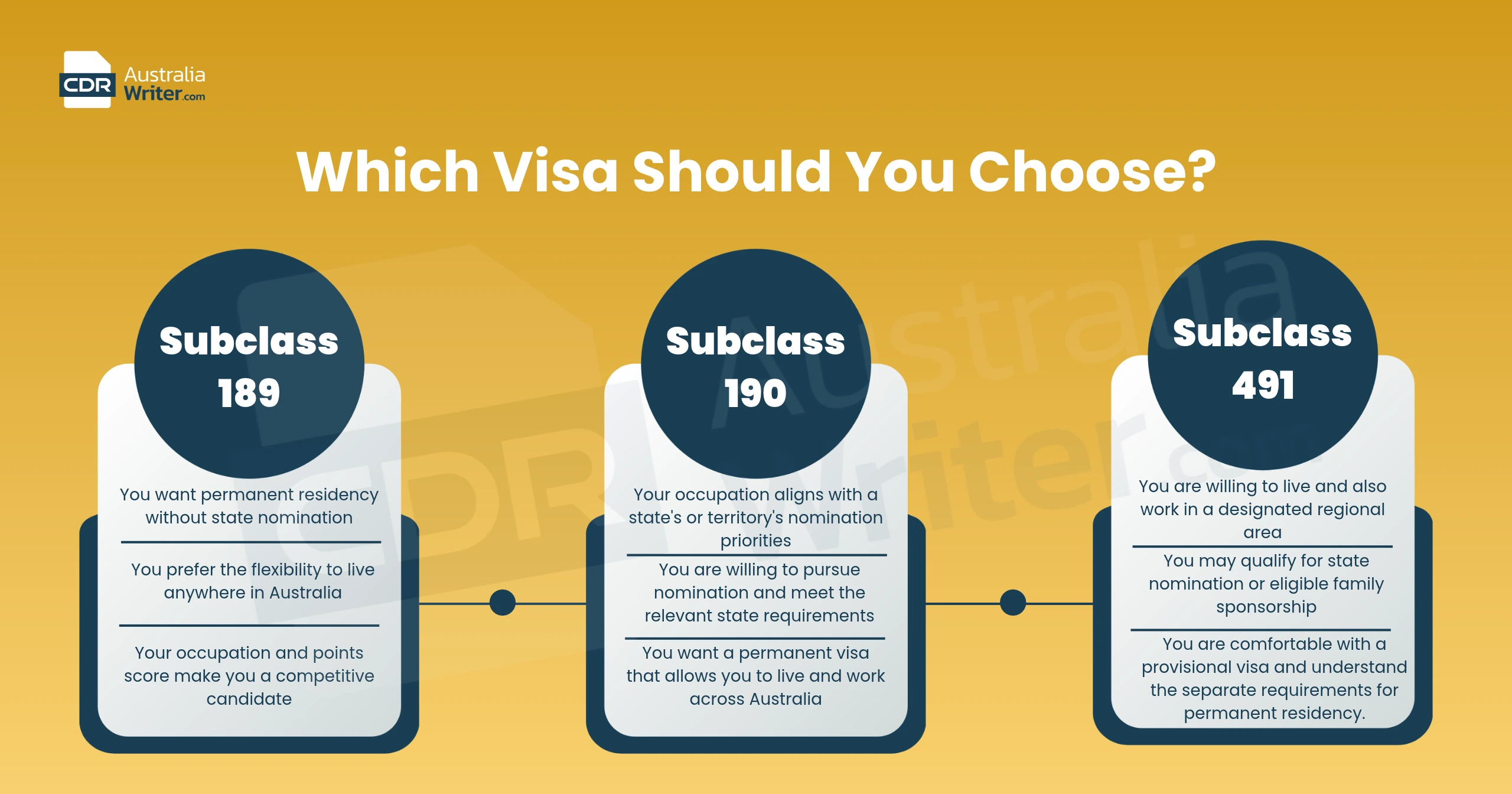
Which Visa Should You Choose?
The right option for you depends on your eligibility, points score, occupation and preferred lifestyle.
Consider the following subclass if:
Subclass 189:
- You want permanent residency without state nomination.
- You prefer the flexibility to live anywhere in Australia.
- Your occupation and points score make you a competitive candidate.
Subclass 190:
- Your occupation aligns with a state’s or territory’s nomination priorities.
- You are willing to pursue nomination and meet the relevant state requirements.
- You want a permanent visa that allows you to live and work across Australia.
Subclass 491:
- You are willing to live and also work in a designated regional area.
- You may qualify for state nomination or eligible family sponsorship.
- You are comfortable with a provisional visa and understand the separate requirements for permanent residency.
Before making a decision, compare the current occupation lists, state nomination criteria and your own supporting documents. Your preferred visa may not be the one you qualify for most easily, so it is worth reviewing more than one pathway.
189 vs 190 vs 491 Visa Differences:
A Quick Comparison
The most important differences between 189 vs 190 vs 491 visa relate to permanent residency, nomination and where you can live.
Feature | Subclass 189 | Subclass 190 | Subclass 491 |
Visa type | Permanent | Permanent | Provisional |
Nomination or sponsorship | Not required for the points-tested stream | State or territory nomination required | State or territory nomination or eligible relative sponsorship required |
Nomination points | 0 | 5 | 15 |
Minimum points threshold | 65 | 65 | 65 |
Invitation required | Yes | Yes | Yes |
Regional living conditions | No specific regional restriction | No specific regional restriction under the visa | Must comply with designated regional conditions |
Initial stay | Permanent | Permanent | Up to 5 years |
Permanent residency | Granted if visa is approved | Granted if visa is approved | May be available later through Subclass 191 if eligible |
Important: The 65-point threshold is a minimum eligibility requirement, not a guarantee of selection. The actual points required to receive an invitation may be higher, and nomination programs can have additional requirements. You always have to check the latest official criteria before making a decision.
Skilled Migration Visa Points Test Australia:
How Does It Work?
The skilled migration points test Australia uses factors such as age, English language ability, skilled employment, qualifications and other eligible circumstances which gives to assess points-tested visa applicants.
For the points-tested streams discussed in this guide, applicants generally need at least 65 points to be eligible for an invitation. However, achieving this score does not mean an invitation will automatically follow.
Your score may change depending on your circumstances. For example, a higher English proficiency result, additional eligible skilled employment or an eligible qualification may affect your total. Nomination also changes the score: Subclass 190 nomination provides 5 points, while Subclass 491 nomination or eligible family sponsorship provides 15 points,
When assessing your potential score, use the official points table for the visa you are considering. Make sure every claim is supported by acceptable evidence, including employment records, qualifications and English test results where applicable.
The skilled migration points test Australia should be treated as one part of the eligibility process. You must also meet the occupation, skills assessment, invitation and other requirements for your chosen visa.
Skills Assessment: Where Every Application Starts
Whichever visa you choose, you can’t submit an EOI without a positive skills assessment for your nominated occupation. Engineers usually go through Engineers Australia, which reviews your qualifications and experience, typically through a Competency Demonstration Report (CDR) made up of career episodes, a CPD list, and a summary statement. Applicants whose qualifications fall under international accords may follow a different route, so check which one applies to you.
Rushed or recycled CDRs are a common reason for delays, requests for more information, or negative outcomes. Take your time, write each career episode in your own words, and back it up with evidence like project documents and reference letters.
Have Any Question?
CDR Australia Writer specialises in high-quality CDR, RPL and VETASSESS reports for engineers. CDR Australia Writer offer low-cost, customized and reliable services in diverse engineering disciplines.
- +61 482 072 465
- [email protected]

Our expert writing team has successfully assisted clients in obtaining approval through professional services for skill assessments and migration needs.
Costs and Processing Times in 2026
Visa charges jumped on 1 July 2026. The primary applicant’s base fee is now $6,135 for the 189 and $6,140 for both the 190 and 491. When budgeting for the 189 vs 190 vs 491 visa routes, remember that’s only part of the bill. Family members add their own charges, and you’ll also pay for English tests, assessment fees, medicals, police checks, and possibly a state fee.
Processing times vary widely. Home Affairs data for the year to 30 June 2026 shows a median of about 12 months for the 190, with some applicants waiting up to 15 months. Another summary of the same period puts the 190 at 5 to 17 months and the 491 at 5 to 18 months. Use the official processing-time tool for current figures rather than trusting a round number from a blog.
Things to Avoid When Applying for a Skilled Migration Visa
A well-prepared application starts with accurate information and a clear understanding of the requirements. Avoid these common mistakes:
- Assuming 65 points guarantees an invitation. It is considered as the minimum threshold, not a promise of selection.
- Choosing a visa based on points alone. Occupation eligibility, nomination and visa conditions also matter.
- Ignoring state nomination criteria. Requirements vary between states and territories and may change.
- Underestimating regional conditions. Check where you must live, work and study if applying for Subclass 491.
- Claiming points without evidence. Ensure your qualifications, employment and other claims can be supported.
- Relying on outdated information. Verify current rules, fees and occupation lists through authorized official government sources.
- Assuming a skills assessment guarantees a visa. A skills assessment is only one part of the migration process.
Careful preparation for 189 vs 190 vs 491 visa, this can help you identify gaps early and also helps you to reduce avoidable errors. If a requirement is unclear, then verify it before submitting an EOI or visa application.
Your Next Steps Towards Australian Skilled Migration
Start by checking that your occupation is eligible, looking at what the skills assessment involves, and working out your likely points score. If state nomination is on your radar, look up the current criteria for each state or territory you’re considering. And if you’re leaning toward the 491, make sure living in a regional area genuinely suits your plans.
Choosing between the 189, 190 and 491 should come down to your eligibility and long term goals, not just your points score. Before you lodge an Expression of Interest or a visa application, read the official information from the Department of Home Affairs. If your situation is complicated, a registered migration agent can help.
A positive skills assessment or a strong points score will help your case, but neither guarantees an invitation or a visa. Knowing the requirements properly is the best place to start.
Get our free consultation
Do you have a question?
Get our free consultation with specialist and experienced counsellors. Explore our CDR writing packages immediately and receive 100% plagiarism free CDR report
Contact us right now! and Get your CDR report ready for approval.

Do you have a question?
We have mentioned common questions asked by our clients regarding CDR report, ACS RPL report, KA02 report, and skill assessment process.
There is no single best option for everyone. Subclass 189 offers an independent permanent residency pathway, Subclass 190 requires state or territory nomination and grants permanent residency, meanwhile Subclass 491 is a provisional regional visa with a potential pathway to permanent residency.
The minimum is 65 to submit an EOI. Invitation scores are usually higher and differ by occupation, so check recent round results for yours.
The 189 and 190 are permanent visas from the day they’re granted. The 491 is provisional and leads to PR through the 191.
Yes, After three years living and working in a designated regional area, and meeting the income requirement, you can apply for the subclass 191.
Applicants generally need a suitable skills assessment for their selected occupation, unless there is a specific exemption or alternative evidence rule applies to it. Check the requirements that are mentioned for your occupation and visa before applying.
Yes, A single EOI can include the 189, 190, and 491, so what you can do is stay in the running for whichever invitation arrives first