

ANMAC Assessment Documents Checklist: What You Need
If you are an overseas-qualified nurse or midwife who is planning to migrate to Australia then working through the ANMAC Assessment Documents Checklist correctly in the first time can help you save months of back-and-forth with the assessing authority. This can help you organise your paperwork before submitting your application and reduce the risk of delays caused by missing or unclear documents.That means the strength of your application depends almost entirely on how your documents are:
- complete,
- accurate, and
- well-organised.
The Australian Nursing and Midwifery Accreditation Council (ANMAC) assesses the skills and qualifications of those eligible nurses and midwives for Australian skilled migration. The ANMAC skills assessment documents you need depends on whether you are applying for:
- Modified Skills Assessment,
- Full Skills Assessment,
- or another ANMAC assessment pathway.
ANMAC also states that it may request additional documentation during the assessment process.
What Is the ANMAC Skills Assessment and
Why Does It Matter?
An ANMAC skills assessment is the migration skills criteria-based assessment used for eligible nurses, midwives and certain direct care roles who are seeking or applying for Australian skilled visas such as subclasses 189, 190, and 491. ANMAC reviews documentation relating to your identity, education, professional registration, work experience and, for a Full Skills Assessment, English language evidence.
Before collecting ANMAC skills assessment documents, first identify which assessment you need:
A Modified Skills Assessment:
This is generally for those applicants who are already registered as a nurse or midwife in Australia or New Zealand.
A Full Skills Assessment
This applies to those eligible applicants who are registered as nurses or midwives in specified overseas countries and meet ANMAC requirements.
The assessment type matters because the document requirements are not identical. There is no interview or practical exam, ANMAC relies completely on the paperwork you submit. A single missing certified copy, a name mismatch, or an unclear transcript can stall your file for weeks.
ANMAC Requirements: Formatting and Certification
Meeting the ANMAC requirements isn’t only about which documents you send. It’s also about how you send them. ANMAC generally expects:
- High-resolution colour scans (aim for at least 600 DPI) rather than photocopies or black-and-white images
- Certified true copies where originals can’t be provided
- Certified English translations for any document not originally issued in English, submitted alongside the original-language version
- Documents grouped and labelled clearly, matching the categories ANMAC lists in its application guide
A complete, well-labelled file is genuinely the single biggest thing you control in this process. Most delays aren’t caused by a weak qualification, they’re caused by a missing certification stamp or an unclear translation.

ANMAC Assessment Documents Checklist:
You Should Prepare
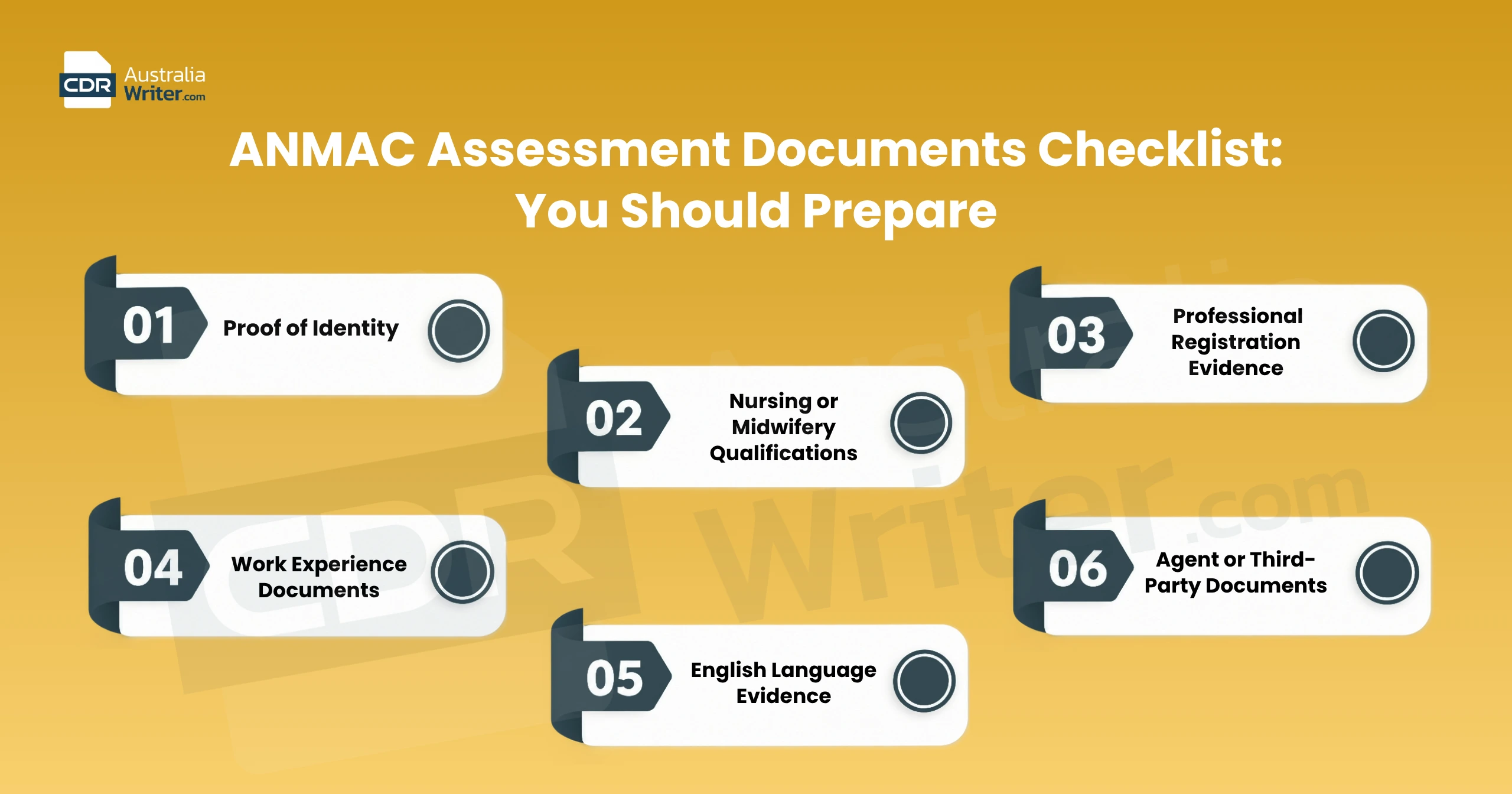
The ANMAC Assessment Documents checklist is required depending on your assessment type and circumstances. Most applicants should prepare the following:
1. Proof of Identity
This one is straightforward, but it trips up more people than you’d expect. ANMAC will want to see:
- Your passport biodata page
- Two other official identity documents
- A recent, passport-style photo of yourself
- Evidence of a name change, if that applies to you
The thing to watch out for here isn’t gathering the documents, but it is about making sure your name and personal details look identical everywhere. A slightly different spelling on your marriage certificate versus your passport is enough to raise a flag, so it’s worth double-checking before you submit anything.
2. Nursing or Midwifery Qualifications
What you need here really depends on which assessment pathway you’re going through, but in most cases you should have ready:
- Your graduation or qualification certificate
- Full academic transcripts
- Documentation of your nursing or midwifery qualification itself
- Proof of your theoretical and clinical hours, where this is required
If you’re going through a Full Skills Assessment, then ANMAC wants to see your qualification documents and transcripts laid out clearly. And if your transcript doesn’t spell out exactly how many theory hours versus clinical hours you completed, be prepared to submit something extra to fill that gap, then ANMAC won’t just take your word for it.
3. Professional Registration Evidence
For nurses and midwives, this is genuinely one of the most important pieces of the puzzle.
If you’re applying under the Full Skills Assessment, your overseas regulator usually needs to send registration verification (or a certificate of good standing) straight to ANMAC themselves, it can’t just come from you. Under the Modified Skills Assessment, ANMAC can check your Australian or New Zealand registration on its own, though if you’re also claiming overseas work experience, you may still need registration proof from that country too.
The safest approach is to follow ANMAC’s submission instructions to the letter here, since registration bodies often have their own timelines for issuing this kind of verification.
4. Work Experience Documents
If you want your work experience counted, ANMAC needs a way to verify it actually happened and that means paperwork covering:
- Who you worked for and what your role was
- Your employment dates and hours worked
- Confirmation that the work was paid
- What your day-to-day duties actually involved
- A reference from someone who supervised you
- Registration evidence that backs up the experience you’re claiming
Here’s something worth keeping in mind that not every job you’ve held will automatically count. What gets recognised depends on the purpose of your assessment and the ANZSCO occupation code you’re being assessed against, so it’s worth checking this early rather than assuming everything you’ve done will be accepted.
5. English Language Evidence
If you’re on the Full Skills Assessment pathway, ANMAC accepts a handful of recognised English tests, including:
- IELTS
- OET
- PTE Academic
- TOEFL iBT
- Cambridge English
Before you sit any of these or send in your results, it’s worth checking ANMAC requirements current score thresholds and how long your results stay valid whereas, these details do shift over time. One thing that often surprises people: if you’re going through the Modified Skills Assessment instead, you won’t need to provide English test evidence at all.
6. Agent or Third-Party Documents
If an agent or authorised third party is handling your application of the assessment, then you may need to provide the relevant Agent Declaration and Third-Party Consent documents. You also need to ensure that these forms are completed correctly and submitted where applicable.
ANMAC Skills Assessment Documents:
A Simple Review
The ANMAC Skills Assessment Documents below can help you organise your files before beginning the application:
Document category | What to check |
Passport | Biodata page is clear and in colour |
Additional ID | Two acceptable identity documents |
Photograph | Recent passport-style photograph |
Name change | Evidence included if applicable |
Qualification | Graduation certificate available |
Transcripts | Relevant academic records included |
Registration | Required verification arranged |
Work experience | Professional references prepared where required |
English test | Required for applicable Full Assessment |
Agent declaration | Included if using an agent |
Translation | NAATI-certified translation for non-English documents |
File quality | Clear colour scans, generally 600 dpi or higher |
This checklist is a practical starting point, but ANMAC advises applicants to follow the detailed assessment requirements for their specific assessment because additional documents may be requested.
Common Mistakes to Avoid
Preparing your ANMAC assessment documents checklist carefully can make the application process more organised. Some common mistakes include:
Uploading unclear scans
Blurry, cropped or incomplete documents can create unnecessary problems. Check every page before uploading.
Providing only translated documents
If your original document is not in English, ANMAC requires the original together with the appropriate English translation.
Ignoring registration verification
Applicants submitting overseas work experience should pay close attention to ANMAC’s assessment requirements for registration verification. In relevant cases, the verification must come directly from the regulatory authority rather than from the applicant’s personal email.
Assuming every assessment has the same requirements
Modified and Full Skills Assessments have different eligibility and documentation requirements. Always check the assessment pathway before collecting your final documents.
Submitting unsupported work experience
ANMAC needs to be able to verify employment claims. Non-genuine claims can result in a negative assessment outcome and may lead to a two-year lock-out period for a new skills assessment.
Forgetting to save uploaded documents
After uploading documents through the ANMAC portal, applicants should follow the submission instructions and save the application so the documents are received by the assessment team.
Have Any Question?
CDR Australia Writer specialises in high-quality CDR, RPL and VETASSESS reports for engineers. CDR Australia Writer offer low-cost, customized and reliable services in diverse engineering disciplines.
- +61 482 072 465
- [email protected]

Our expert writing team has successfully assisted clients in obtaining approval through professional services for skill assessments and migration needs.
A Final ANMAC Assessment Documents Checklist Before Applying
The ANMAC Assessment Documents Checklist should be treated as a preparation tool rather than a substitute for ANMAC’s official requirements. Before submitting your application, check your identity documents, qualifications, transcripts, registration evidence, work references, English test evidence where applicable, translations and agent documents.
Most importantly, check the current assessment requirements directly on the ANMAC website because assessment rules and document requirements can change. Preparing the correct ANMAC assessment documents checklist from the beginning can help make the application more organised and reduce avoidable requests for further information.
Get our free consultation
Do you have a question?
Get our free consultation with specialist and experienced counsellors. Explore our CDR writing packages immediately and receive 100% plagiarism free CDR report
Contact us right now! and Get your CDR report ready for approval.

Do you have a question?
We have mentioned common questions asked by our clients regarding CDR report, ACS RPL report, KA02 report, and skill assessment process.
Processing times vary, but many applicants see assessments commence within roughly 6–8 weeks of a complete submission meanwhile, incomplete files take considerably longer.
Yes, but you will usually qualify for the faster Modified Assessment pathway rather than the Full Assessment.
ANMAC will typically need to issue a request for additional information, pausing your assessment clock until you respond.
Only alongside a certified English translation with original-language-only documents won’t they be accepted on their own.
No, It is one component of your skilled migration application, not an approval to live or work in Australia.
You should prepare all the relevant documents that are required before applying for assessment which includes use of clear colour scans, following the required file formats and resolution given, arranging third-party verification early, and checking all the requirements that are necessary for your specific assessment pathway.