

New Points System for Australia Skilled Migration: What You Need to Know
Australia’s skilled migration system is entering an important period of reform where the New Points System for Australia has become one of the major changes being considered by the Australian Government. The proposed reform is intended to make the points test more effective at identifying skilled migrants who can contribute to Australia’s long-term economic and labour-market needs.
If you’re planning a skilled visa application to Australia, you’ve probably heard that the points test is about to change. The headlines are calling it the biggest shake-up to skilled migration in over a decade, which is, for once, that’s not just marketing spin from a migration agency’s blog. But there’s a gap between what’s actually confirmed and what’s still speculation, and that gap matters the most if you’re deciding whether to submit an Expression of Interest (EOI) now or wait for the new system.
For prospective migrants, understanding both the current Australian immigration points system and the direction of the proposed reform is important for planning a skilled migration pathway.

Australia Points Test: How the Current System Works
The Australia Points Test, it is used to rank eligible candidates who are seeking certain points-tested skilled visas. The current points system applies to subclasses 189, 190 and 491. Applicants first of all must submit an Expression of Interest (EOI) through SkillSelect. The EOI includes information about qualifications, English results, employment experience and other characteristics that contribute to the indicative score. If invited, the applicant can then proceed with the relevant visa application.
The main categories currently include:
- Age: Applicants aged 25 to under 33 can receive the maximum age allocation of 30 points.
- English: Proficient English can attract 10 points; meanwhile, superior English can attract 20 points.
- Overseas employment: Eligible skilled employment experience outside of Australia can provide up to 15 points.
- Australian employment: Eligible skilled employment in Australia can provide up to 20 points.
- Educational qualifications: A doctorate can attract 20 points; meanwhile, a recognised bachelor’s degree can attract 15 points.
- Australian study: Eligible Australian qualifications can also provide additional points.
These categories show why an applicant’s score cannot be assessed simply only by looking at the applicant’s age or education. Several factors need to be considered together.
Skilled Migration Points: Why They Matter for Invitations
Skilled Migration Points are important because meeting the minimum threshold is only the starting point. SkillSelect ranks EOIs according to the applicable invitation process, and higher-scoring candidates can have an advantage over candidates with lower scores. For some invitation rounds, occupation-specific competition can mean that candidates need substantially more than 65 points.
The number of Skilled Migration Points an applicant can claim should therefore be calculated

carefully before submitting an EOI. Incorrectly claiming points for:
- Employment,
- Qualifications,
- English ability or
- Partner circumstances,
can create problems when the Department assesses the visa application. The same principle will remain important if reforms are introduced. Applicants should focus not only on achieving a numerical score but also on ensuring that every claimed point can be supported with appropriate evidence.
Points Test Review: Why Australia Is Considering Reform
The Points Test Review originated from the Government’s broader Migration Strategy, which identified the need to explore a reformed points test capable of better selecting migrants who can contribute to Australia’s long-term prosperity. The points test ranks candidates for Australia’s three points-tested permanent visas,i.e:
- Subclass 189 (Skilled Independent),
- Subclass 190 (Skilled Nominated),
- Subclass 491 (Skilled Work Regional)
which all together make up roughly two-thirds of the country’s permanent skilled intake. The formal discussion paper was released in April 2024, and the consultation period closed in May 2024. Home Affairs reports that the review received 204 submissions. The Government’s concern is not simply that the existing system is difficult to understand. The broader issue is whether the current weighting of factors produces the type of skilled migrants Australia needs in the future.
The discussion paper examined factors including:
- Age,
- English language proficiency,
- Australian and overseas employment,
- Educational attainment,
- Australian study,
- Regional study,
- Specialist education,
- Professional-year experience,
- Community language skills,
- Partner characteristics.
The proposed direction is therefore broader than simply adding or removing a few points. A major theme of the Points Test Review is better identifying characteristics associated with successful employment and long-term economic contribution.
New Points System: What It Could Mean for Skilled Migrants
This Points System could change how applicants approach Australian skilled migration if the Government ultimately implements reforms following the review.
For prospective applicants, the biggest lesson is that migration planning should not focus exclusively on collecting points. A strong application needs a combination of an eligible occupation, suitable skills assessment, appropriate English proficiency, relevant qualifications, acceptable employment history and a realistic invitation strategy. Occupation also remains important because points-tested applicants need to nominate an occupation that is available for their visa pathway. Home Affairs maintains their occupation information and the relevant assessing authorities for skilled migration programs.
Therefore, applicants should consider multiple pathways rather than assuming that subclass 189 is the only option. Regional migration may also remain strategically important as subclass 491 provides an additional 15 points through eligible state or territory nomination or accepted family sponsorship, subject to the relevant requirements.
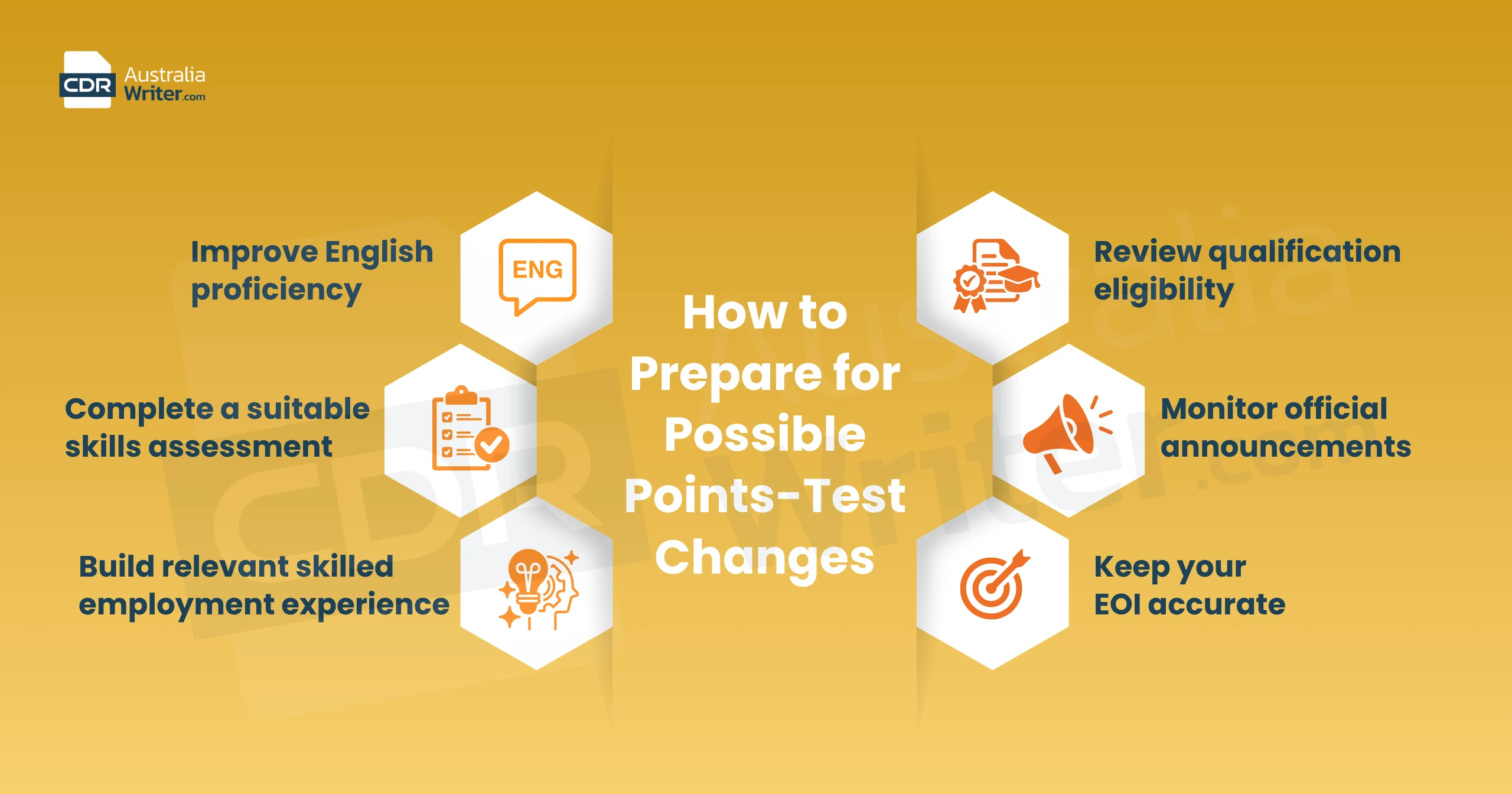
How to Prepare for Possible Points-Test Changes
Even though the final settings of the reformed system should not be assumed, prospective applicants can take practical steps now:
Improve English proficiency
A stronger English result can make a meaningful difference under the current framework which may remain valuable under any future system.
Complete a suitable skills assessment
Applicants should confirm the correct occupation and assess authority before relying on their qualifications or their employment history.
Build relevant skilled employment experience
Employment can contribute to the current points test, particularly when it is closely connected to the nominated occupation.
Review qualification eligibility
Applicants should understand how their highest qualification is treated and whether Australian study or specialist education provisions apply.
Monitor official announcements
Migration policy can change through legislation, legislative instruments and Departmental guidance. Social media posts and unofficial points tables should not be treated as authoritative.
Keep your EOI accurate
Home Affairs allows applicants to update their EOI before receiving an invitation even if the circumstances change.
What Does This Mean for the 189, 190, and 491 Visas in the New Points System?
The Subclass 189 is likely to remain the most points-sensitive visa, since it has no state nomination buffer and relies entirely on the federal matrix which means it will feel any change to age, English, or salary weighting most directly. State and territory governments have been given more autonomy over who they nominate for the 190 and 491, so even if the federal points test tightens, the states will keep prioritising applicants who fill their specific local shortages. This may keep these pathways relatively more accessible for a wider range of occupations and age groups.
If you’re currently sitting in the pool with a competitive score under the existing rules, there’s little reason to delay lodging an Expression of Interest (EoI) while the reform works through consultation and invitations issued under the current framework are set to be honoured.
Have Any Question?
CDR Australia Writer specialises in high-quality CDR, RPL and VETASSESS reports for engineers. CDR Australia Writer offer low-cost, customized and reliable services in diverse engineering disciplines.
- +61 482 072 465
- [email protected]

Our expert writing team has successfully assisted clients in obtaining approval through professional services for skill assessments and migration needs.
What Applicants Should Do Now for Australia Points Test
The safest approach is to plan around the rules that are currently in force while monitoring the Government’s reform process. The existence of a points-test review does not automatically mean that every proposal discussed in consultation will become law. Applicants considering skilled migration should first confirm their nominated occupation, assessing authority, skills assessment requirements, English level, age eligibility and potential points. They should then compare subclasses 189, 190 and 491 based on their circumstances.
It is also important to remember that the minimum 65-point threshold is not an invitation guarantee. Current invitation data demonstrates that competitive scores vary by occupation and invitation round.
Get our free consultation
Do you have a question?
Get our free consultation with specialist and experienced counsellors. Explore our CDR writing packages immediately and receive 100% plagiarism free CDR report
Contact us right now! and Get your CDR report ready for approval.

Do you have a question?
We have mentioned common questions asked by our clients regarding CDR report, ACS RPL report, KA02 report, and skill assessment process.
The New Points System refers to proposed reforms to Australia’s points-tested skilled migration framework where the Australian Government reviews the existing points test to determine how it can better select migrants who can contribute to Australia’s future workforce and economy.
For points-tested skilled visas such as subclasses 189, 190 and 491, applicants generally need at least 65 points to be eligible for consideration. However, reaching 65 points does not guarantee an invitation because invitation outcomes depend on factors such as occupation, competition and available places.
The main areas under review are age point weighting,i.e. favours younger applicants, a stronger emphasis on English proficiency, the introduction of income-based points for high earners, and a possible reduction or removal of bonus points for Australian study, Professional Year, and partner skills.
No. Sixty-five points is generally the minimum threshold for points-tested skilled visas, but it does not guarantee an invitation. Some occupations may require significantly higher scores because of competition and the number of available invitations.
Always check directly with the Department of Home Affairs or consult a registered migration agent (MARA), since points test details are still evolving and unofficial sources can get ahead of what’s actually confirmed.