

Subclass 407 Visa Eligibility: What You Must Prove in 2026
Subclass 407 visa eligibility is important for those professionals, graduates, and skilled workers who want to undertake structured workplace-based training or professional development in Australia. The Training visa, i.e. subclass 407 is a temporary visa which is designed to help people improve their skills in their current occupation, field of expertise, or area of tertiary study. It can allow applicants a stay of up to two years, depending on their approved training program.
Unlike a normal standard work visa, the main purpose of this visa eligibility is training rather than just filling a regular job position. Applicants therefore need to show that the proposed training is:
- genuine,
- relevant to their background, and
- properly structured.
What Is the Training Visa Subclass 407?
The Training visa subclass 407 allows eligible people to come to Australia for workplace-based occupational training or a professional development program.
The training may relate to:
- Improving skills in an eligible occupation
- Meeting registration, membership, or licensing requirements
- Professional development
- Certain capacity-building activities connected with overseas qualifications or government-supported programs
The Department of Home Affairs identifies three broad types of occupational training covered by the visa.
The visa is temporary and may be granted for up to two years. It is not designed as a general employment pathway where an applicant simply performs ordinary duties for an Australian employer. The training itself must be a genuine and central part of the proposed stay.
Subclass 407 Visa Eligibility: Genuine Training Visa Purpose
Another important part of subclass 407 visa eligibility is demonstrating that the proposed training is genuine. This means the training should make sense when compared with your:
- Current occupation
- Qualifications
- Previous experience
- Field of study
- Professional background
- Future professional development needs
The Department assesses the training arrangement rather than simply looking at whether an applicant has a job offer. The purpose of the visa is skills development, so an arrangement that appears to be ordinary employment rather than genuine training can create problems.

Subclass 407 Visa Eligibility: Sponsorship and Nomination
For subclass 407, one of the most essential parts that is considered important is having the correct sponsor and nomination.
Your Australian sponsor generally needs to be an approved Temporary Activities Sponsor. The sponsor is responsible for supporting the proposed training arrangement and, unless the sponsor is an Australian Commonwealth Government agency, nominates the occupational training program.
There is an important difference between sponsorship and nomination:
- Sponsorship relates to the Australian organisation being approved to sponsor temporary activities.
- Nomination relates to the particular applicant and proposed training program.
- Visa application is the applicant’s application to receive the Training visa.
Since 11 March 2026, applicants generally cannot rely on lodging all three stages at the same time. Sponsorship approval and the required nomination approval must be in place before the visa application is lodged. Commonwealth Government agencies remain exempt from the nomination requirement.
This change is particularly important for people already in Australia whose current visa is approaching expiry. Planning the sponsorship and nomination process early is therefore essential.
Training Visa Subclass 407: How the Process Works
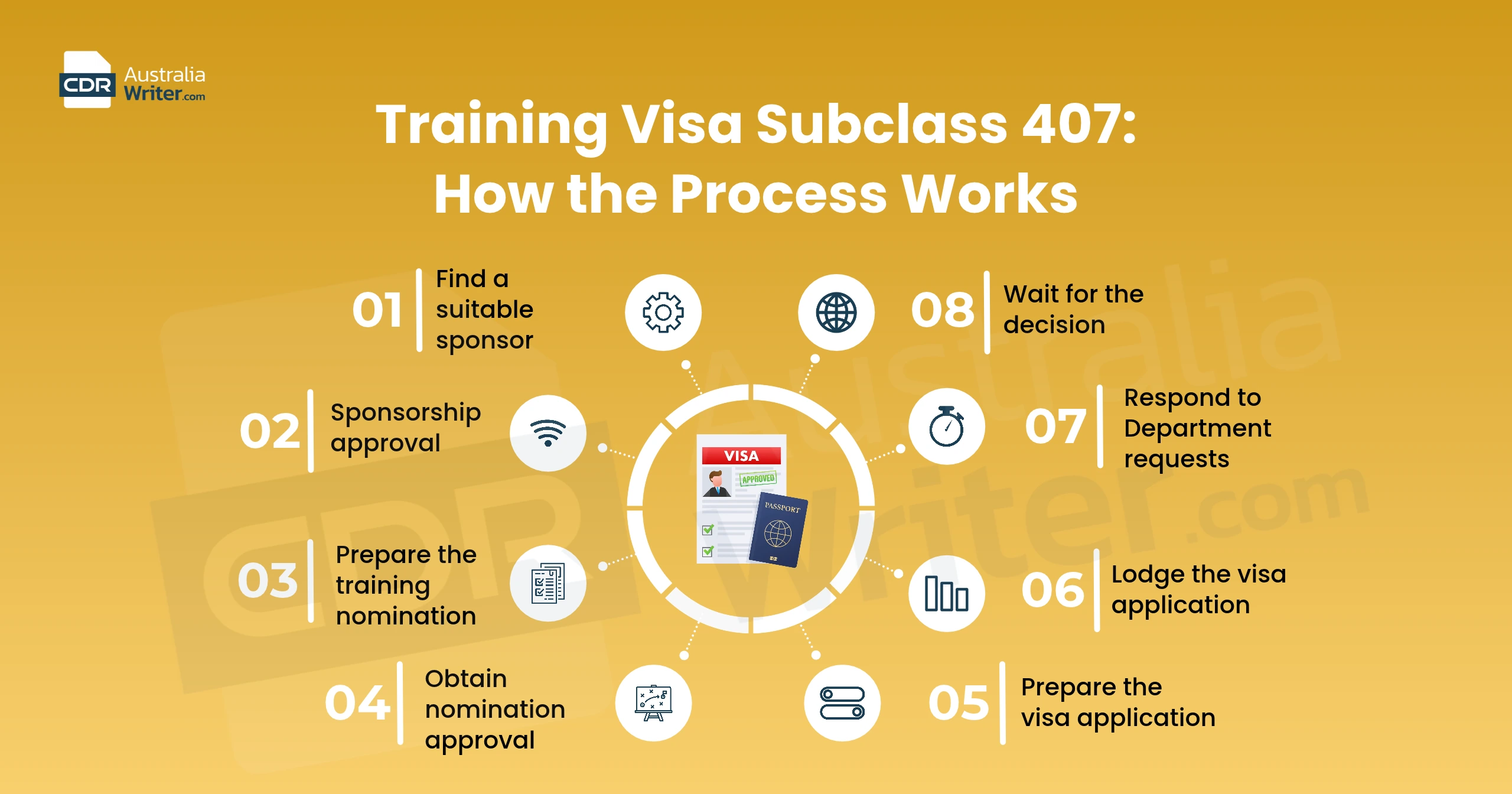
The Training visa subclass 407 process can be understood in a simple sequence:
1. Find a suitable sponsor
An Australian organisation must be willing and eligible to sponsor the proposed training.
2. Sponsorship approval
The organisation must obtain approval as a Temporary Activities Sponsor where required.
3. Prepare the training nomination
The sponsor needs to prepare the nomination describing the applicant, their training purpose, current location, structure and other required vital details.
4. Obtain nomination approval
For most of the applicants, their nomination must be approved way before the visa application is lodged.
5. Prepare the visa application
The applicant gathers identity, English, health, character, financial and training-related evidence.
6. Lodge the visa application
The applicant has to submit the application online at the proper authority with the required supporting documents.
7. Respond to Department requests
Additional information, health examinations or other evidence may be requested.
8. Wait for the decision
Processing times of these documents vary depending on application completeness, case complexity, external checks and its Department workload.
407 Visa Requirements Sponsorship: The First Hurdle
Before anything else, 407 visa requirements sponsorship need to be satisfied by the organisation bringing you to Australia, not by you directly. This is often where applications stall. Your sponsor must:
- Hold approval as a Standard Business Sponsor or Temporary Activities Sponsor
- Lodge a nomination for the specific training activity, supported by a Deed of Agreement outlining the training plan in detail
- Demonstrate the training is genuine and addresses a real skills or development need
- Show the visa isn’t being used to avoid hiring an Australian worker
Since the March 2026 changes, sponsorship approval and nomination approval must both be finalised before the visa application is lodged whereas the days of submitting all three simultaneously are gone. Getting the sequencing wrong is one of the most common reasons applications are deemed invalid or refused outright.
Personal Requirements for Subclass 407 Visa Eligibility
Once sponsorship and nomination are sorted, attention turns to the applicant. Meeting subclass 407 visa eligibility at an individual level generally involves the following:
Age:
Applicants are usually expected to be at least 18 years old at the time of decision, though exceptions exist where the best interests of a minor are considered.
Relevant background:
You need demonstrable skills or experience connected to the nominated training, a training that’s unrelated to your occupation, study area, or professional background won’t satisfy the Department.
Health and character:
Applicants must meet and have standard health examinations and police clearances in order to apply to you and any family members aged 16 or over included in the application.
Health insurance:
Applicants must provide evidence of adequate health insurance for themselves and accompanying family members for the period required by the visa.
Location at application:
You can generally apply from offshore, or onshore if you currently hold a valid substantive temporary visa.
Immigration history:
Previous visa refusals or cancellations may be taken into account, though they don’t automatically rule out eligibility.
Subclass 407 Visa Eligibility: Financial Capacity and Immigration History
Financial capacity is another practical consideration when assessing subclass 407 visa eligibility.
Applicants need to demonstrate that they can financially support themselves while in Australia and support accompanying family members where applicable. The Department’s current subclass 407 guidance specifically states that applicants who are trying for subclass need to be able to financially support themselves and accompany their family members.
Your immigration history can also matter. The Department considers previous visa cancellations and refusals when assessing an application. If you are applying in Australia, additional rules can apply depending on the visa you currently hold or previously held.
Applicants should therefore review their previous Australian visa history before preparing an application rather than discovering a potential issue after documents have been submitted.
Have Any Question?
CDR Australia Writer specialises in high-quality CDR, RPL and VETASSESS reports for engineers. CDR Australia Writer offer low-cost, customized and reliable services in diverse engineering disciplines.
- +61 482 072 465
- [email protected]

Our expert writing team has successfully assisted clients in obtaining approval through professional services for skill assessments and migration needs.
What Documents Are Needed?
A well-prepared subclass 407 training visa application should contain various documents that clearly need to connect the applicant with the proposed training.
Depending on the circumstances, documents can include:
- Passport and identity documents
- Qualifications and academic records
- Curriculum vitae or resume
- Evidence of professional experience
- English-language evidence, where required
- Health insurance evidence
- Registration or licensing documents, where relevant
- Training-related documents
- Sponsor and nomination information
- Financial evidence
- Police or character documents, where requested
For professional development training, Home Affairs also indicates that the supporting material of the applicants may need include a statement from the sponsor confirming that the applicant’s relevant professional or managerial skills and a letter from the applicant’s current manager describing their position and duties.
Non-English documents also need to be translated according to the Department’s requirements.
Common Mistakes to Avoid
When preparing a 407 application, avoid these common problems:
- Don’t submit a generic or vague training plan where case officers expect specific, measurable training outcomes.
- Don’t assume you can lodge sponsorship, nomination, and visa applications together, this changed in March 2026.
- Don’t nominate training unrelated to your actual occupation or study background.
- Don’t treat the visa as a backdoor to ordinary employment and this is where genuineness is closely assessed.
- Don’t leave health and character documentation until the last minute, especially for family members aged 16 and over.
- Don’t rely on outdated blog content like many sources online still reference pre-2026 lodgement rules.
Why Getting Subclass 407 Visa Eligibility Right Matters
Applicants need to understand that the 407 visa requirements are about more than just checking a simple eligibility list. The strongest applications are built around:
- a genuine training purpose,
- an appropriate sponsor,
- an approved training nomination,
- relevant applicant experience and
- complete supporting documentation.
The 2026 approval-first rule of this process makes preparation and timing even more important. Applicants need to confirm the current requirements directly with the Department of Home Affairs before lodging, particularly if they are already in Australia or have an upcoming visa expiry.
A carefully prepared application can make the process more organised, but meeting the published requirements does not guarantee that a visa will be granted.-
Get our free consultation
Do you have a question?
Get our free consultation with specialist and experienced counsellors. Explore our CDR writing packages immediately and receive 100% plagiarism free CDR report
Contact us right now! and Get your CDR report ready for approval.

Do you have a question?
We have mentioned common questions asked by our clients regarding CDR report, ACS RPL report, KA02 report, and skill assessment process.
The visa allows workplace-based training and related activities, but it is not intended to operate as a general employment visa. The purpose must be genuine occupational training or professional development.
No, not directly. It is a temporary visa through which some applicants use the experience gained to strengthen future applications for employer-sponsored or skilled pathways.
For applications under the rules that commenced on 11 March 2026, the required nomination generally needs to be approved before the visa application is lodged, unless the sponsor is an Australian Commonwealth Government agency.
The Department states that you cannot extend the 407 visa itself. If you want to remain in Australia, you need to consider whether you are eligible for another visa.
Most applicants need an average score of around 4.5 across IELTS bands, or the equivalent in another accepted test, unless exempt.
Yes, An approved sponsor is a core part of the subclass 407 training visa process. The sponsor generally needs to be approved as a Temporary Activities Sponsor.