

EA Skills Assessment for Overseas Engineers Migrating to Australia
If you are an overseas engineer preparing for skilled migration, the EA skills assessment is the single most important qualification step in your entire visa journey. Engineers Australia assesses more engineering occupations than any other authority in the Australian migration system. Furthermore, the assessment pathway you choose and how well you prepare your documents for that pathway determines whether you receive a positive or not suitable outcome.
Many engineers delay their application because they are unsure which pathway applies to them. This page explains all three Engineers Australia assessment pathways, what each one requires, and what consistently causes experienced engineers to receive a not suitable outcome despite strong qualifications.
What Engineers Australia does and Why it matters for migration
Engineers Australia (EA) is Australia’s peak professional body for engineers across all disciplines. Furthermore, the Australian Government has formally nominated Engineers Australia as the assessing authority for engineering occupations under the skilled migration program.
Every overseas engineer targeting a skilled migration visa must receive a positive outcome from Engineers Australia before submitting an Expression of Interest through SkillSelect. Moreover, Engineers Australia membership and EA skills assessment are two entirely separate processes. A positive skills assessment does not make you an Engineers Australia member. Furthermore, Engineers Australia membership alone does not satisfy themigration skills assessment requirement. They serve completely different purposes in your professional and migration journey.
The EA skills assessment confirms that your academic qualification and professional experience genuinely meet the standard Australia requires for your nominated engineering occupation. Additionally, Engineers Australia assesses qualifications first. If your qualification does not satisfy the relevant pathway criteria, the application receives a not suitable outcome regardless of how strong your work history is.
Engineering Occupations Covered Under the Skilled Migration Program
Engineers Australia assesses a wide range of engineering occupations under the skilled occupation list for skilled migration. Each occupation carries a specific ANZSCO code and skill level requirement.
Occupation | ANZSCO Code | Skill Level |
Civil Engineer | 233211 | Level 1: Bachelor’s Degree or Higher |
Structural Engineer | 233214 | Level 1: Bachelor’s Degree or Higher |
Mechanical Engineer | 233512 | Level 1: Bachelor’s Degree or Higher |
Electrical Engineer | 232311 | Level 1: Bachelor’s Degree or Higher |
Chemical Engineer | 233111 | Level 1: Bachelor’s Degree or Higher |
Mining Engineer | 233611 | Level 1: Bachelor’s Degree or Higher |
Environmental Engineer | 233915 | Level 1: Bachelor’s Degree or Higher |
233212 | Level 1: Bachelor’s Degree or Higher | |
Industrial Engineer | 233511 | Level 1: Bachelor’s Degree or Higher |
Engineering Manager | 133211 | Level 1: Bachelor’s Degree or Higher |
Furthermore, Engineers Australia also assesses Engineering Technologists and Engineering Associates under separate competency standards. Moreover, always confirm with the Department of Home Affairs that your specific visa pathway requires an EA skills assessment before paying any fees or beginning document preparation.
EA Skills Assessment Pathways: Which One Applies to You
The EA skills assessment uses three distinct pathways. Which one applies to you depends entirely on how you obtained your engineering qualification and your level of professional experience. Furthermore, choosing the wrong pathway wastes both time and money, so confirming your correct pathway before you begin is essential.
Washington Accord Pathway
This pathway is available to engineers who graduated from a program accredited by a Washington Accord signatory body. Furthermore, Australia, the United Kingdom, the United States, Canada, India, and several other countries are Washington Accord signatories. Moreover, graduates of accredited programs from these countries can claim competency through their academic qualification without submitting a fullCDR report.
However, not every engineering degree from a Washington Accord country automatically qualifies. Furthermore, the specific program must hold accreditation, not just the university as a whole. Consequently, always verify that your exact degree program holds Washington Accord accreditation before applying through this pathway.
Competency Demonstration Report Pathway
This is the most common pathway for overseas engineers from non-Washington Accord countries. Furthermore, it is the most document-intensive pathway in the entire EA skills assessment process. Moreover, it requires a full Competency Demonstration Report (CDR), which includes three career episodes, a summary statement, and a continuing professional development list.
The CDR is not a standard resume or work history document. Furthermore, each career episode must demonstrate specific engineering competencies against the Engineers Australia competency standards for your nominated occupation category. Moreover, career episodes must be written in first person, in English, and must describe your personal engineering contribution to specific projects, not the work of your team or organisation as a whole.
Further to this, Engineers Australia screens each CDR document withplagiarism detection software. As a result, any copied content from an online source, another engineer’s report or an AI generated text from an AI writer will result in an ‘unsuitable’ result and this is recorded permanently on your application file.
Temporary Resident Pathway
This visa option is suitable for engineers currently living and working in Australia on a temporary visa. Also it judges the applicant’s engineering employment experience gained in Australia, not by writing a full CDR report. Moreover, this pathway is commonly used by engineers transitioning from a temporary graduate visa or an employer-sponsored visa to a permanent skilled visa.
EA Assessment Documents Required for Each Pathway
The EA skills assessment is entirely documentary. Furthermore, the quality and completeness of what you submit determines your outcome. There is no interview component, which means there is no opportunity to explain or supplement weak written evidence after submission.
Academic Qualifications: All Pathways
- Official academic transcripts showing every subject completed during your engineering program
- Degree certificate confirming the qualification awarded
- Certified English translations for any documents not originally in English
- Course outlines or unit descriptors if Engineers Australia requests curriculum content confirmation
CDR Report: Competency Demonstration Report Pathway Only
- Threecareer episodes: each between 1,000 and 2,500 words, written in first person, describing specific engineering projects
- Summary statement: mapping each competency element to specific paragraphs in your career episodes
- Continuing professional development list: record of engineering-related professional development activities
Employment Evidence: All Pathways
- Employment reference letters on official company letterhead
- Each letter must describe your specific engineering duties, not just confirm your employment dates
- References must be signed by a direct supervisor who can verify your engineering responsibilities
Identity Documents: All Pathways
- Certified copy of your passport biographical page
- Passport-style photograph meeting Engineers Australia specifications
The current EA skills assessment fee for the CDR pathway and Washington Accord pathway is AUD 830 inclusive of GST. Furthermore, a reassessment fee applies if you reapply after a not suitable outcome. Always confirm the current fee on the official Engineers Australia website before submitting.
The EA Assessment Process Step by Step
Understanding the process before you begin saves you from making avoidable mistakes. Furthermore, each step has specific requirements, missing any of them creates delays that Engineers Australia cannot fast-track.
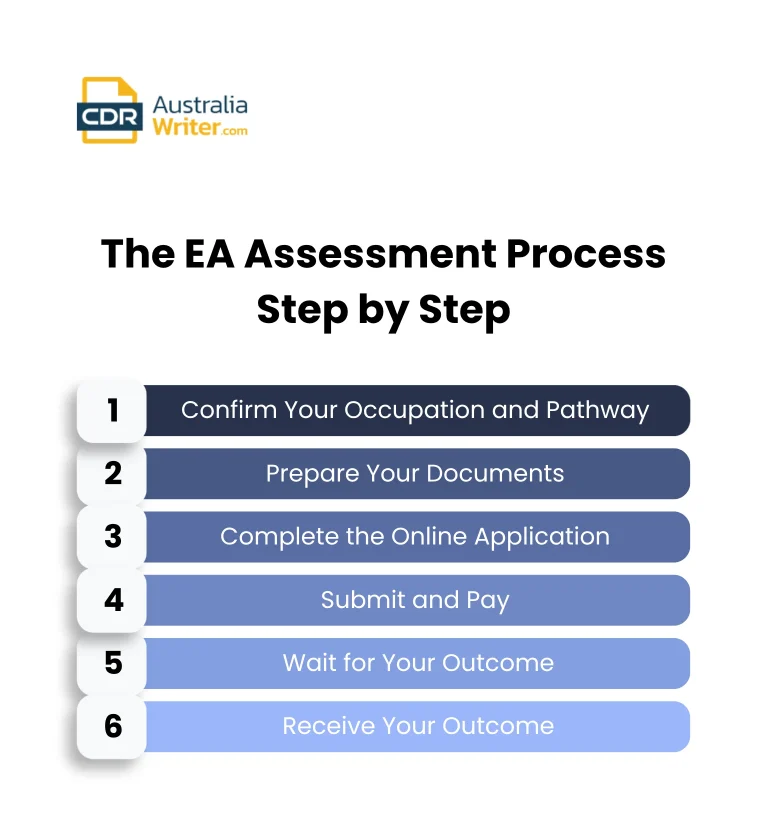
Step 1: Confirm Your Occupation and Pathway
Confirm that your nominated occupation appears on theskilled occupation list with Engineers Australia as the assessing authority. Furthermore, identify which of the three assessment pathways applies to your qualification background.
Step 2: Prepare Your Documents
Collect all necessary documents for your pathway. In addition, if you will be using the CDR pathway, start preparing your career episodes early. It typically takes 4-8 weeks to prepare a good quality CDR.
Step 3: Complete the Online Application
Set up your MyEngineers Australia account, and fill out the online application form. Please ensure to provide all your personal, qualification, and work experience information completely and accurately.
Step 4: Submit and Pay
Lodge the application and pay the assessment fee upon lodgement. Engineers Australia will not commence to process the application before receipt of confirmed payment and all documentation is received.
Step 5: Wait for Your Outcome
The Engineers Australia application is assessed after lodgement. Processing times vary depending on the pathway and workload of applications lodged. Therefore, a complete application prepared early from the start gives you the fastest processing time.
Step 6: Receive Your Outcome
Engineers Australia notifies applicants by email. A positive outcome confirms your qualifications and experience meet Australian standards for your nominated engineering occupation. Furthermore, a not suitable outcome comes with specific written reasons and information about your reassessment options.
Why EA Skills Assessment Applications Receive a Not Suitable Outcome
Most unsuccessful applications share the same avoidable problems. Knowing what these are helps you prepare a far stronger submission from the very start.
Career episodes that describe team work rather than personal contribution:
Engineers Australia requires you to describe your own engineering contribution in first person. Furthermore, career episodes that focus on what the project team achieved rather than what you personally did as the engineer do not demonstrate individual competency. Consequently, this is the single most common reason for a not suitable CDR outcome.
Summary statement references that do not match career episode content:
Each competency element in the summary statement must reference a specific paragraph in one of your three career episodes. Furthermore, vague or incorrect paragraph references tell the assessor that your CDR was not written carefully. Moreover, mismatched references create doubt about the authenticity of your entire submission.
Plagiarism detected in career episodes:
Engineers Australia’s has Turnitin and related software for detecting copied content in every CDR. Content copied from other engineers’ reports, online resources or AI applications will be flagged as a non suitable application, resulting in a permanent record being made against your application.
Washington Accord pathway claimed for a non-accredited program:
Some engineers incorrectly apply through the Washington Accord pathway when their specific degree program does not hold accreditation. Furthermore, Engineers Australia verifies accreditation independently, claiming a pathway you do not qualify for results in a not suitable outcome and delays your migration timeline significantly.
Employment references too vague about engineering duties:
A reference letter confirming you worked as an engineer for five years without describing your specific technical responsibilities tells Engineers Australia nothing about your competency level. Furthermore, references must describe the engineering nature of your work: design, analysis, project management, testing, or commissioning, not just your job title and employment dates.
How Professional Document Support Strengthens Your EA Assessment Result
The EA skills assessment relies almost entirely on written documentation. Furthermore, your CDR report carries the most weight of any document in the entire application, and writing a competency-mapped CDR that satisfies Engineers Australia standards is genuinely difficult without guidance.
Many overseas engineers have strong technical qualifications and years of real engineering experience. However, they struggle to present that experience in the structured, competency-mapped format Engineers Australia expects. Furthermore, a poorly written career episode that describes engineering work without demonstrating individual competency receives a not suitable outcome, regardless of how impressive the underlying project was.
CDR Australia Writer helps engineers prepare complete and competency-mapped CDR reports for their EA skills assessment. We assist with writing all three career episodes, preparing thesummary statement with correctly matched paragraph references, and structuring the continuing professional development list in the format Engineers Australia expects. Moreover, we help engineers identify which competency elements apply to their specific occupation category before they begin writing, so every career episode targets the right standards from the very first draft.
Why Getting Your EA Assessment Right the First Time Matters
A positive EA skills assessment is valid for a limited period. Furthermore, an unsuccessful outcome means starting the entire process again, rewriting career episodes, paying the reassessment fee, and waiting through another full processing cycle. Moreover, some visa invitation rounds through SkillSelect are highly competitive, a delay of even a few months can mean missing an invitation entirely.
Getting your EA skills assessment right the first time protects your migration timeline. Furthermore, it saves you the financial and emotional cost of reapplying from the beginning. Therefore, investing in properly prepared documents before you submit is always the smarter and more cost-effective approach for any serious migration applicant.
Get our free consultation
Do you have a question?
Get our free consultation with specialist and experienced counsellors. Explore our CDR writing packages immediately and receive 100% plagiarism free CDR report
Contact us right now! and Get your CDR report ready for approval.

Do you have a question?
We have mentioned common questions asked by our clients regarding CDR report, ACS RPL report, KA02 report, and skill assessment process.
It depends on your pathway. Standard processing takes around 8–12 weeks for Accord pathways and 10–16 weeks for the CDR pathway. Keep in mind, the clock starts only once your application is complete, so submitting well-prepared documents from day one is the fastest way to get your outcome.
Your assessment letter is valid for an indefinite period with masterminds Australia. still, you will need to check theDepartment of Home Affairs website for how long your letter is valid specifically for migration visa operations. masterminds Australia
Technically you can write a draft, but it’s risky. Engineers Australia assessors are now trained and equipped with advanced detection software to identify the hallmarks of generative AI. When a Career Episode is flagged for generic phrasing or lack of specific technical calculations, the applicant faces outright rejection, and submitting AI-generated work can even lead to a 12-month ban from reapplying. Your CDR must reflect your real, personal engineering experience.
Engineers Australia accepts three testing options, IELTS (both General and Academic), TOEFL iBT, and PTE Academic. These results must be no more than two years old when you submit your application. Make sure your scores meet EA’s minimum requirements before applying.
The new fees, set from 1 July 2026 have increased by 3-4. They are determined by adjusting the fee for changes in the consumer price index, the wages price index, and the retail price index. These changes are approved by Department of Home Affairs. Always keep checking the official Engineers Australia webpage for the latest fee structure prior to lodging your application.