

KA02 Writing for New Zealand Engineers:
A Complete Guide
KA02 Writing for New Zealand is a core part of the professional recognition pathway for engineers whose qualifications fall outside the Washington, Sydney, or Dublin Accords. When a degree isn’t automatically recognised, Engineering New Zealand uses this knowledge assessment to check whether an applicant’s academic and practical understanding matches what’s expected of a New Zealand-trained engineer. It’s a detailed, evidence-heavy process, and because it leaves little room for vague or generic writing, many applicants find it genuinely challenging to get right.
What sets a KA02 submission apart from a basic qualification or employment check is the depth of explanation it demands. Rather than listing subjects studied, job titles held, or projects worked on, a strong report has to show how that knowledge of yours was actually built and applied through real decisions, analysis, design work, and problem-solving on the job. It’s this link between claimed knowledge and demonstrated practice that assessors are really evaluating, which is why the writing itself carries as much weight as the engineering experience behind it.

What Is KA02 Report Writing?
KA02 report writing involves preparing evidence that allows Engineering New Zealand to evaluate an applicant’s engineering knowledge against the relevant knowledge profile. The assessment covers eight broad areas, including natural sciences, mathematics, engineering fundamentals, specialist engineering knowledge, design, engineering practice, engineering in society, and research-based knowledge.
The purpose is to demonstrate equivalent engineering knowledge, rather than simply proving that an applicant has worked as an engineer for a particular number of years.
A useful KA02 submission therefore answers questions such as:
- What engineering knowledge did you develop?
- Where did you gain that knowledge?
- How have you applied it in professional practice?
- What complex engineering problems have you addressed?
- What engineering methods, calculations, models, standards, or research did you use?
- What was your personal contribution?
This distinction is important. Engineering New Zealand specifically advises applicants to write about themselves using “I,” “me,” or “my”, because assessors need to understand the applicant’s individual contribution rather than the work performed by an entire team.
Get free consultation
KA02 Writing for New Zealand : Understanding the Knowledge Profile
The knowledge profile provides the framework for demonstrating whether an applicant has the required breadth and depth of engineering knowledge.
The eight areas include:
- Natural sciences knowledge: scientific principles relevant to the engineering discipline.
- Mathematical knowledge: mathematics, statistics, numerical methods, and other related analytical concepts.
- Engineering fundamental knowledge: theories of fundamental engineering and principles.
- Specialist engineering knowledge: advanced knowledge which is relevant to the applicant’s discipline or their practice area.
- Design process knowledge: knowledge and methods which are used to develop engineering solutions.
- Engineering practice knowledge: practical engineering technologies, processes, and different methods.
- Engineering in society knowledge: professional, ethical, environmental, economic, social, and public-safety related considerations.
- Research-based knowledge: understanding and use of research and technical literature.
When preparing the submission, applicants should avoid treating these elements as eight unrelated essays. Instead, the evidence should show how different areas of knowledge have been developed and applied throughout their education and professional career.
This makes the evidence more meaningful because it demonstrates application, rather than simply claiming knowledge.
KA02 Writing for New Zealand: How to Structure the Evidence
A clear structure makes it easier for an assessor to understand your engineering knowledge and verify your evidence.
Firstly, you can start by identifying the required engineering discipline and the areas of knowledge that you need to demonstrate. Then you need to review your professional history and then select projects which can help you provide and gather the strongest evidence.
For each work sample, explain:
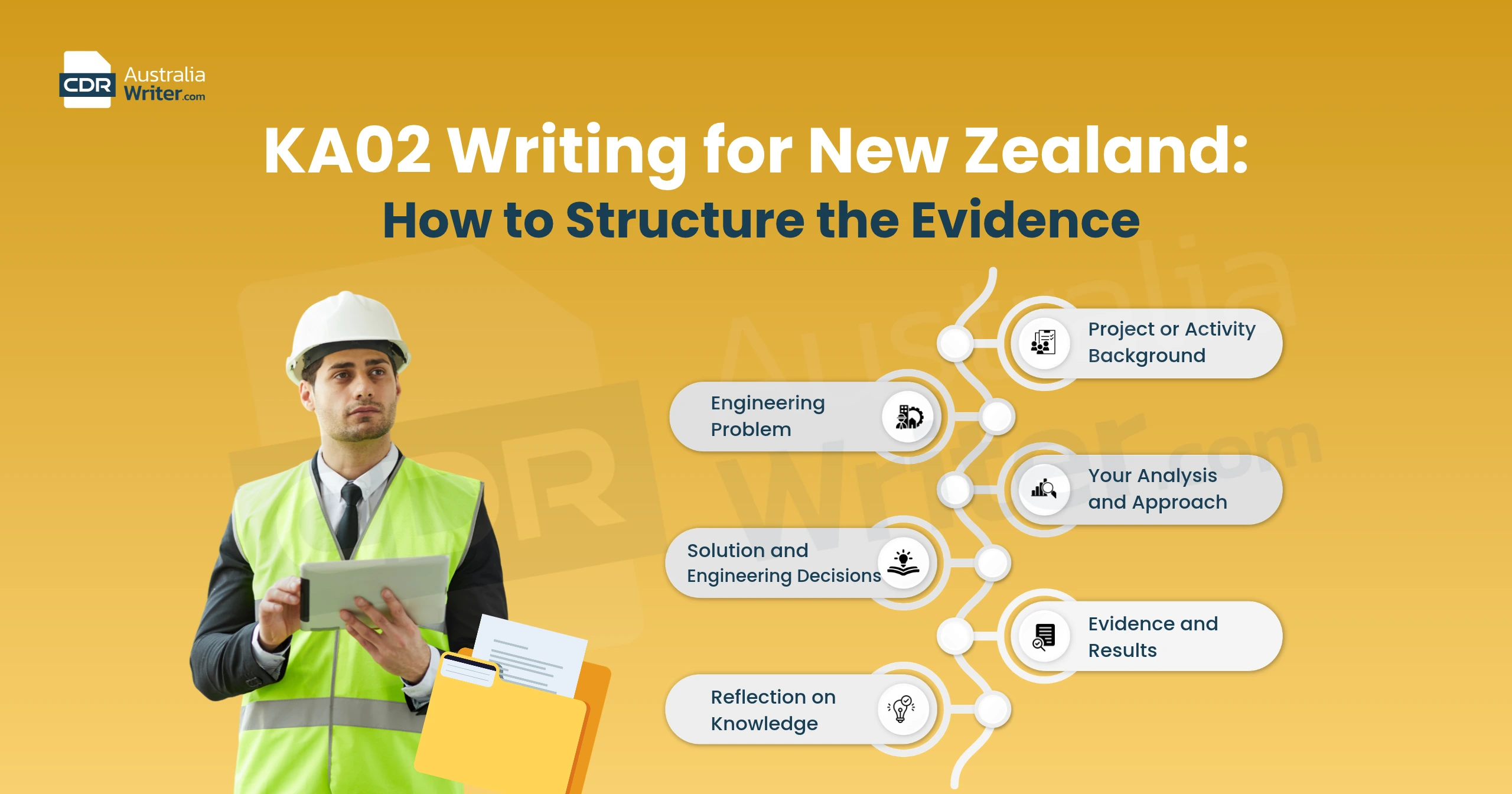
1. Project or Activity Background
Briefly introduce the project, its purpose, your position, and the engineering environment. Avoid spending too much space describing information that does not help demonstrate your knowledge.
2. Engineering Problem
Explain the technical problem you were required to address. You need to make it clear so that it can explain why the situation was complex and what factors needed to be considered.
3. Your Analysis and Approach
This is considered as one of the most valuable sections. Explain what you analysed, which engineering principles you applied, what calculations or modelling you performed, and why you selected a particular approach.
4. Solution and Engineering Decisions
Describe the solution that you have developed, evaluated, or implemented. Also, explain the reasoning behind important technical decisions instead of just simply stating the outcome.
5. Evidence and Results
Connect your explanation to the supporting documents. Engineering New Zealand recommends providing evidence statements that identify the relevant element and explain how the evidence demonstrates the required knowledge.
6. Reflection on Knowledge
Explain what the activity demonstrates about your engineering knowledge and professional development. This helps connect an individual project with the broader knowledge profile.
Good KA02 report writing is therefore less about just making the document sound complicated and more about making the engineering reasoning easy to follow.
What Is Engineering New Zealand and Why It Matters
Engineering New Zealand (formerly IPENZ, now also known as Te Ao Rangahau) is the professional body responsible for accrediting engineering qualifications and registering Chartered Professional Engineers (CPEng) in the country. It’s the organisation every KA02 submission is assessed against, and its standards are benchmarked to a New Zealand-accredited Bachelor of Engineering with Honours.
If your qualification doesn’t automatically meet that bar, Engineering New Zealand uses the Knowledge Assessment process to check whether your education and experience add up to an equivalent level. This is where careful, well-structured KA02 becomes essential, the assessors aren’t reading for general impressions, they’re checking whether each knowledge area is clearly evidenced.
Who Needs KA02 Writing for New Zealand Registration
Not every engineer applying to work in New Zealand needs this report. It’s generally required for:
- Engineers whose degrees are not accredited under the Washington, Sydney, or Dublin Accords
- Applicants pursuing a Skilled Migrant Category visa who can’t rely on automatic qualification recognition
- Engineers working toward Chartered Professional Engineer (CPEng) status
- Professionals seeking recognised membership with Engineering New Zealand
For these applicants, strong KA02 writing is the mechanism that bridges the gap between an overseas qualification and New Zealand’s expected knowledge standard. Without it, there’s no other route to demonstrate equivalence.
How Assessors Review Engineering New Zealand Submissions
Once submitted, your report is reviewed against the Engineering New Zealand knowledge profile, which maps each claim you make to a defined competency area. Assessors are specifically looking for:
- Clear links between your narrative and the supporting documentation
- Evidence of complex problem-solving, not just routine application of codes and standards
- Technical depth appropriate to a four-year accredited engineering degree
- Consistency between your academic claims and your actual project history
Because of how rigorous this review is, a careful KA02 report matters more than volume. A tightly argued, well-evidenced submission will outperform a long one padded with repetition or unsupported claims. It’s also worth noting that a rejected report generally can’t be resubmitted, which makes getting it right the first time especially important.
Have Any Question?
CDR Australia Writer specialises in high-quality CDR, RPL and VETASSESS reports for engineers. CDR Australia Writer offer low-cost, customized and reliable services in diverse engineering disciplines.
- +61 485 981 327
- [email protected]
Supporting Documents You Should Prepare
Your supporting documentation should be organised carefully so that the assessor can understand where each piece of evidence fits.
Depending on what are your current circumstances and the requirements of your application, a relevant documentation can include different types of your academic records, work history information, CPD information, and professional work samples.
For work samples, Engineering New Zealand recommends using your strongest evidence and avoiding unnecessary duplication. Its guidance suggests aiming for no more than four work samples, with up to three files per work sample.
If your original evidence is not in English, the current guidance states that a certified English translation from a professional licensed or certified translator is required.
Another important point is evidence attribution. A collection of anonymous calculations, spreadsheets, or drawings may not be enough. The assessor should be able to determine that the evidence represents your own work.
Common Mistakes to Avoid
Poor KA02 report writing often results from focusing too heavily on general descriptions instead of evidence.
Avoid these common problems:
- Writing about the whole team instead of yourself. Use “I” when describing your personal actions and decisions.
- Listing responsibilities without explaining engineering reasoning. A job description is not the same as evidence of engineering knowledge.
- Choosing routine projects. Select work that helps to demonstrate meaningful engineering complexity.
- Submitting excessive evidence. More documents do not automatically make an application stronger.
- Using unclear or anonymous evidence. The assessor needs to establish your contribution.
- Providing calculations without context. Explain what the calculations were used for and what they demonstrate.
- Relying on academic projects as work samples. Current Engineering New Zealand guidance specifically excludes academic projects completed during study as work samples.
- Copying material from another applicant or online sample. Your submission should accurately represent your own education, knowledge, experience, and professional contribution.
- Ignoring the assessment instructions. Requirements can change, so applicants should always check the latest Engineering New Zealand guidance before submitting.
Why Professional Preparation Matters
A KA02 submission is not simply a writing exercise. It requires an engineer to understand the assessment framework and translate real professional experience into relevant evidence.
A well-prepared document should make it easy for the assessor to identify the engineering problem, your technical knowledge, your personal contribution, the complexity involved, and the evidence supporting your statements.
If you are unsure which projects to select or how your experience relates to the knowledge profile, reviewing the official Engineering New Zealand guidance before beginning the document can save considerable time. The current guidance should always take priority over older templates, examples, or advice published elsewhere.
Get our free consultation
Do you have a question?
Get our free consultation with specialist and experienced counsellors. Explore our CDR writing packages immediately and receive 100% plagiarism free CDR report
Contact us right now! and Get your CDR report ready for approval.

Do you have a question?
We have mentioned common questions asked by our clients regarding CDR report, ACS RPL report, KA02 report, and skill assessment process.
KA01 and KA02 are both knowledge assessment pathways used by Engineering New Zealand, but they apply to different qualification backgrounds. KA02 is generally used by engineers whose degrees fall outside the recognised international accords.
Applicants who do not have an engineering qualification or recognised overseas registration that establishes Washington Accord-equivalent educational knowledge may need to complete a Knowledge Assessment. Engineering New Zealand determines the appropriate pathway based on the applicant’s circumstances.
This varies by applicant, but most engineers need several weeks to compile academic records, project evidence, and well-drafted narratives before submission.
Engineering New Zealand’s current applicant guidance allows a maximum of four work samples. The samples should demonstrate the application of equivalent engineering knowledge to complex engineering problems.
No, A Knowledge Assessment concerns engineering knowledge and professional recognition requirements. It should not be treated as a standalone New Zealand visa application or guarantee of immigration approval. The relevant immigration requirements should be checked separately.
If your qualification isn’t automatically recognised under the Washington, Sydney, or Dublin Accords, a positive knowledge assessment outcome is usually required to support a Skilled Migrant Category application.