
Online
Today

ACS vs EA Skills Assessment for Australian Skilled Migration

ACS vs EA is one of the most searched questions in Australian skilled migration. Both the Australian Computer Society (ACS) andEngineers Australia (EA) assess overseas professionals for skilled migration visas, but they assess completely different occupations and use completely different methods. Choosing the wrong authority delays your application by months and adds thousands of dollars in unnecessary fees. This page tells you exactly which one applies to your occupation, how the two assessments differ, and what to expect from each in 2026.

ACS vs EA

What Is the ACS vs EA Skills Assessment?

ACS vs EA refers to the two separate assessing authorities the Department of Home Affairs relies on to verify skilled migration applicants’ qualifications and experience, the Australian Computer Society (ACS) for ICT professionals, and Engineers Australia (EA) for engineers. Every points-tested and employer-sponsored skilled visa requires a positive outcome from whichever of these two authorities is assigned to your specific ANZSCO occupation code before an Expression of Interest can be lodged.

The two authorities are not interchangeable and do not share applications. If you submit to the wrong one, or prepare the wrong type of supporting document for the one assigned to you, the application is simply returned, restarting the fee, the document preparation, and the processing clock from zero.

    • The Department of Home Affairs does not assess qualifications itself, it delegates that judgement entirely to ACS or EA
    • The outcome letter states your ANZSCO code, the assessment result, and the assessment date
    • ACS and EA update their fees and requirements on separate schedules, so checking the current version before applying matters
    • Applications cannot be transferred between the two authorities once lodged, the correct authority must be confirmed before submission, not after.
Get free consultation


    ACS or EA: Which Authority Assesses Your Occupation?

    The choice between ACS vs EA is not a preference. It is determined by your nominated ANZSCO occupation code. Each occupation code is assigned to one assessing authority only. You cannot choose between them.

    Assessing Authority

    Occupation Types Covered

    Example ANZSCO Codes

    ACS – Australian Computer Society

    ICT professionals including software engineers, database administrators, cybersecurity analysts, ICT project managers, ICT business analysts, network professionals, and multimedia specialists

    261313 Software Engineer, 262112 ICT Security Specialist, 135112 ICT Project Manager, 261111 ICT Business Analyst, 261311 Analyst Programmer

    EA – Engineers Australia

    All engineering occupations including civil, electrical, mechanical, mining, structural, biomedical, environmental, and aerospace engineers, plus engineering managers and engineering technologists

    233211 Civil Engineer, 233311 Electrical Engineer, 233512 Mechanical Engineer, 233611 Mining Engineer, 133211 Engineering Manager

    The Grey Zone: Software Engineer (ANZSCO 261313) and Computer Network and Systems Engineer (ANZSCO 263111) sit on both the ICT and engineering boundary. Both are assessed by ACS, not EA, despite the word ‘engineer’ in the title. If your work is primarily software development or network systems design, ACS is your authority. If your degree is a four-year engineering degree in electrical, computer, or electronics engineering and your work involves traditional engineering practice, confirm your ANZSCO code against both the ACS and EA task descriptions before applying.

    How the ACS Assessment Works in 2026

    ACS assesses ICT professionals through four pathways depending on your qualification level and the relevance of your degree to your nominated occupation.

    • ICT qualification closely related to nominated occupation: 2 years post-qualification experience
    • ICT qualification not closely related: 4 years post-qualification experience
    • Non-ICT qualification: 6 years relevant ICT experience plus ACS RPL report
    • No tertiary qualification: 8 years experience plusACS RPL report

    The RPL (Recognition of Prior Learning) pathway applies when you do not hold an ICT degree. Your RPL report consists of two project reports demonstrating hands-on ICT competency in your nominated occupation and Key Areas of Knowledge (KAoK) responses aligned to the ACS Core Body of Knowledge.

    ACS Experience Deductions: ACS applies experience deductions based on how closely your qualification relates to your nominated occupation. Experience gained before your qualifying degree was completed is generally not counted. This deduction structure means two engineers with identical job titles but different degrees can face very different experience requirements.

    How the EA Assessment Works in 2026

    EA assesses engineers through two pathways depending on whether your qualification is accredited under an international accord.

    Washington, Sydney, or Dublin Accord Pathway

    If your engineering degree is from an institution accredited under theWashington Accord (four-year degree), Sydney Accord (three-year technologist degree), or Dublin Accord (two-year associate degree), and your country held full signatory status at the time of your graduation, you apply through the direct qualification pathway without submitting a CDR. This applies to graduates from Australia, the UK, the USA, Canada, India, China, South Korea, and a number of other full signatory countries.

    CDR Pathway

    If your degree is not from an accredited institution, you submit a Competency Demonstration Report. The CDR consists of three Career Episodes of 1,000 to 2,500 words each, a Summary Statement mapping your paragraph numbers against the 16 Stage 1 competency elements, and a CPD record covering a minimum of three years. EA assesses the CDR against Stage 1 competency standards for your nominated occupational category.

    AI Detection in 2026: Engineers Australia uses Turnitin and AI detection software on all CDR submissions. CDRs with high AI-generation scores are returned as inauthentic and may result in a reapplication ban of up to 12 months. Every Career Episode must reflect your genuine personal project experience.

    ACS vs EA: Side-by-Side Comparison 2026

    Factor

    ACS 2026

    EA 2026

    Who is assessed

    ICT professionals across all ICT ANZSCO codes

    Engineers across all engineering ANZSCO codes

    Primary assessment document

    Skills Assessment application with employment references and RPL report (if non-ICT degree)

    CDR (Career Episodes, Summary Statement, CPD) for non-accredited degrees

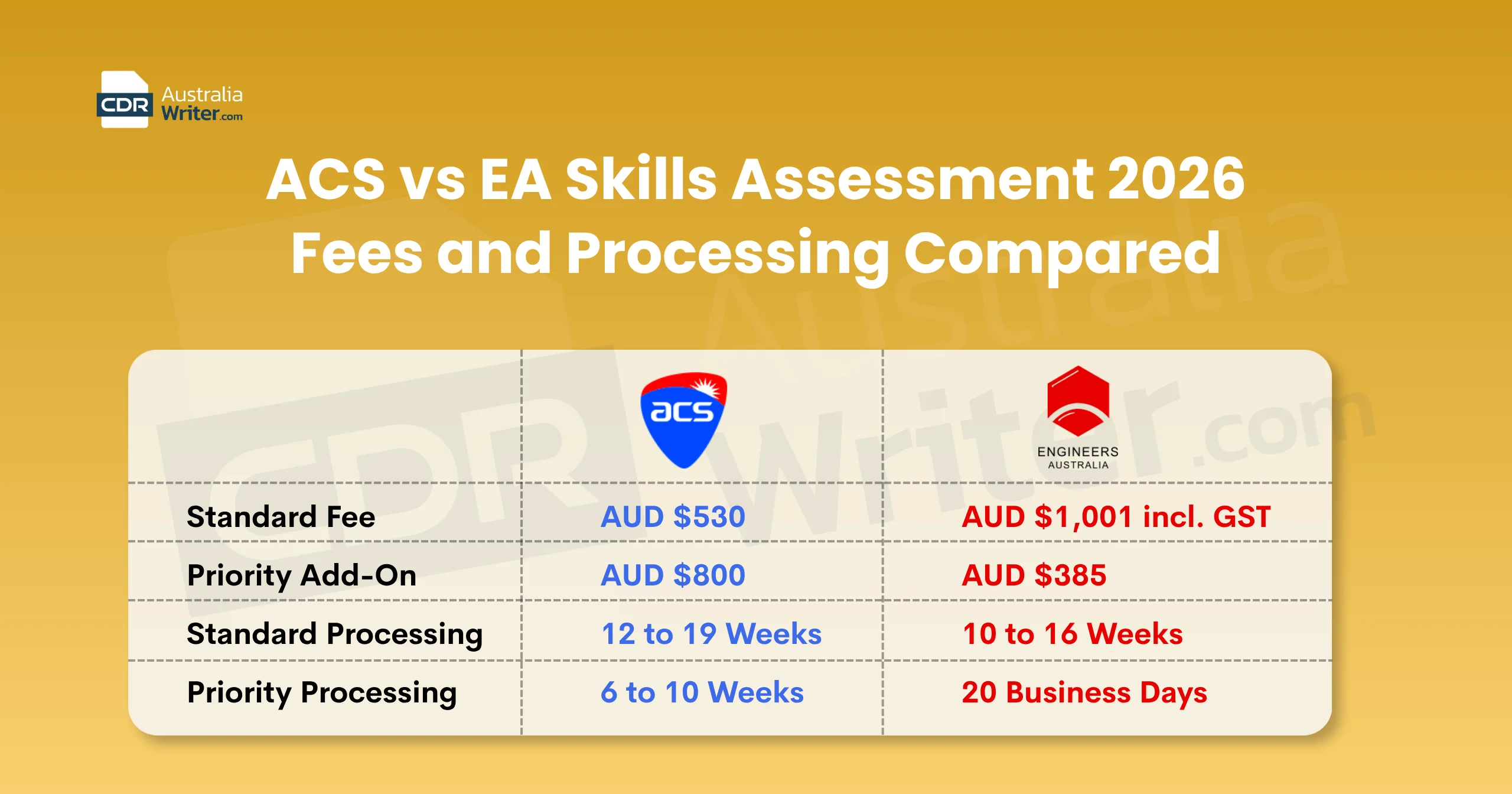
    Standard fee

    AUD 530

    AUD 1,001 including GST (CDR pathway); AUD 270 to AUD 430 (accredited pathway)

    Priority processing fee

    Additional AUD 800

    Additional AUD 385

    Standard processing time

    12 to 19 weeks

    10 to 16 weeks

    Priority processing time

    6 to 10 weeks

    Assessor assigned within 20 business days

    Assessment validity

    3 years from issue date

    3 years from issue date

    AI and plagiarism detection

    Yes – ACS checks submitted documents

    Yes – EA uses Turnitin on all CDRs

    MLTSSL eligibility

    Yes – most ACS-assessed codes onMLTSSL

    Yes – most EA-assessed engineering codes on MLTSSL

    Visa pathways opened

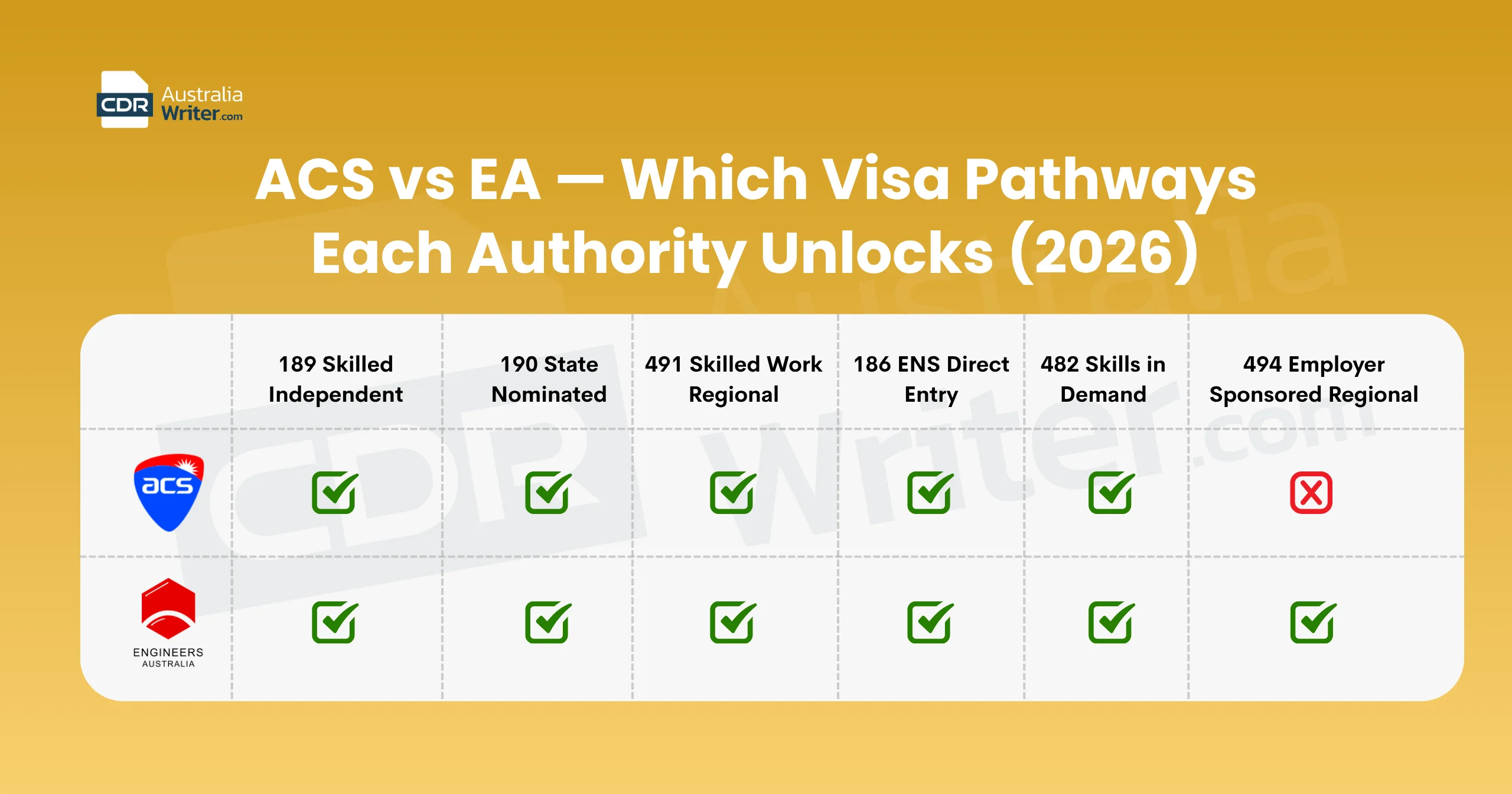
    189, 190, 491, 186, 482

    189, 190, 491, 186, 482, 494

    ACS vs EA skills assessment 2026 fees and processing times compared

    ACS or EA: Which Is Harder to Get?

    Both assessments are rigorous, but they are difficult in different ways.

    ACS is strict about qualification relevance. If you do not have an ICT degree, you have to meet an increased minimum level of experience and prepare an RPL report. Thanks to the experience reduction mechanism, the actual years of experience of most applicants are much lower than they may think. Your reference letters need to demonstrate duties and responsibilities which are consistent with the ANZSCO task description of the relevant occupation.

    EA is stricter about document authenticity. The CDR pathway requires a substantial written portfolio. EveryCareer Episode must describe genuine personal engineering experience in first person, with numbered paragraphs, continuous prose format, and no bullet points. The Summary Statement must map every one of the 16 Stage 1 competency elements to specific paragraph references. A missing element alone can cause a negative outcome.

    Honest Comparison: For applicants without an accredited engineering degree, the EA CDR pathway requires significantly more preparation time than an ACS skills assessment. A well-prepared ACS RPL report with two project reports and KAoK responses typically takes 3 to 6 weeks to prepare. A well-prepared EA CDR typically takes 6 to 12 weeks. Getting either wrong costs 10 to 19 additional weeks in reassessment processing time.

    Which Visa Pathways Do ACS and EA Unlock?

    Both ACS and EA assessments open the same core visa pathways for ICT professionals and engineers respectively.

    Visa

    ACS (ICT Professionals)

    EA (Engineers)

    189 Skilled Independent

    Yes – most ICT codes on MLTSSL

    Yes – most engineering codes on MLTSSL

    190 State Nominated

    Yes – state list inclusion varies

    Yes – state list inclusion varies

    491 Skilled Work Regional

    Yes

    Yes

    186 ENS Direct Entry

    Yes

    Yes

    482 Skills in Demand

    Yes – Core Skills stream

    Yes – Core Skills stream

    494 Employer Sponsored Regional

    Not typically – most ICT codes not on ROL

    Yes – regional engineering roles

    ACS vs EA visa pathways comparison Australia 2026

    Engineering occupations generally have stronger regional visa access than ICT occupations because mining, infrastructure, and civil engineering roles in regional Australia are consistently in shortage. ICT roles are concentrated in metropolitan areas, which limits 494 visa eligibility for most ACS-assessed codes.

    Get the Right Skills Assessment With CDR Australia Writer

    Whether your occupation sits withACS or EA, the documentation quality determines your outcome. CDR Australia Writer prepares ACS RPL reports and project reports for ICT professionals, and CDR Career Episodes and Summary Statements for engineers, both written to 2026 authority standards with zero plagiarism and a 100% approval record.

    Not sure whether you need ACS vs EA? Contact CDR Australia Writer, we confirm your ANZSCO code and correct assessment authority before you prepare a single document.

    Get our free consultation

    Do you have a question?

    Get our free consultation with specialist and experienced counsellors. Explore our CDR writing packages immediately and receive 100% plagiarism free CDR report
    Contact us right now! and Get your CDR report ready for approval.

    CDR Australia Writer for Engineer Australia

    Do you have a question?

    We have mentioned common questions asked by our clients regarding CDR report, ACS RPL report, KA02 report, and skill assessment process.

    It is a collection of specific papers used by Engineers Australia to evaluate an engineer’s competency in engineering skills and knowledge, management, communication, and leadership.

    A draft copy is initially submitted to the customer for evaluation and approval. Following full payment, clients can access the final report.

    Work on the project begins once the client pays a portion/half of the project’s cost.

    Because we are a service-based organization, there is no money-back guarantee or policy for our CDR writing services.

    CDR Australia Writer is a group of highly experienced CDR writers, engineers, and information technology professionals who will assist the clients while preparing CDR . Our team of CDR writing experts work together to guarantee that your CDR  is correct, plagiarism-free, and customized for you so that you receive good feedback from Engineers Australia.