

Australia Skilled Migration Points Test:
Your 2026 Score Guide
Australia skilled migration points test decides who receives an invitation to apply for a skilled visa and who keeps waiting in the pool. If you are planning to migrate to Australia as a skilled worker, then before choosing a visa, it helps to understand how the points system works and which parts of your background may strengthen your application.
Australia skilled migration points test is used to assess eligible applicants for points-tested skilled visas, including the Skilled Independent visa (Subclass 189), Skilled Nominated visa (Subclass 190) and Skilled Work Regional (Provisional) visa (Subclass 491). Points are awarded for factors such as:
- Age,
- English language ability,
- Qualifications and
- Skilled employment experience.
Some applicants may also claim points for eligible partner skills, Australian study or other recognised circumstances.You generally need at least 65 points to be eligible for an invitation under these visa pathways. However, reaching this minimum does not guarantee an invitation. Your occupation, eligibility and the availability of places can also affect the outcome.

How the Points Test Works Across the 189, 190 and 491 Visas
Three visas use a Australia skilled migration points test system: the Skilled Independent (subclass 189), Skilled Nominated (subclass 190) and Skilled Work Regional (subclass 491). Under the Australia skilled migration points test, you need at least 65 points to be invited to apply. Think of 65 as an entry ticket, not a finish line. Home Affairs ranks everyone in the pool and invites the highest scorers first.
Points are only one gate. You also need an occupation on the relevant skilled list and a positive assessment from the right authority. That means Engineers Australia for engineers (usually backed by a well-prepared CDR report), ACS for IT professionals, or CPA Australia for accountants. Without these, your score is purely theoretical.
Australia Skilled Migration Points TestTable:
What Factors Count?
The Australia skilled migration points test table explains how points are allocated across different eligibility factors. If you understand these categories then it can help you estimate your score even before submitting an Expression of Interest (EOI) through SkillSelect.
The main categories include:
- Age: Your age when you receive an invitation and it can affect your score.
- English language ability: Higher recognised English proficiency levels may help you earn additional points.
- Skilled employment: Eligible work experience in Australia or overseas may also contribute to your score.
- Educational qualifications: Your highest recognised qualification can affect your points.
- Australian study: Certain eligible Australian qualifications may provide you with additional points.
- Partner qualifications and skills: You may be able to claim points which are based on your partner’s circumstances.
Not every applicant qualifies for every category. The evidence that the applicants need and the points which are available depend on your circumstances and the current rules.
Before calculating your total, check the official points table and confirm that each claim applies to your nominated visa pathway. The Department of Home Affairs provides the relevant information through its official points table.

Lodging a SkillSelect EOI Without Costly Mistakes
Your SkillSelect EOI is where you claim points. They’re verified later, at the visa application stage. Submitting an expression of interest (EOI) is free, it normally stays active for two years, and you can update it as your situation changes. If you’re invited, you have 60 days to lodge the visa application.
Points are assessed as at the time of invitation, so a score you haven’t actually earned yet won’t help you. Claims you can’t prove with documents can lead to refusal, and that’s a far bigger loss than a few points. Claim what you can evidence today, and be honest about gaps.
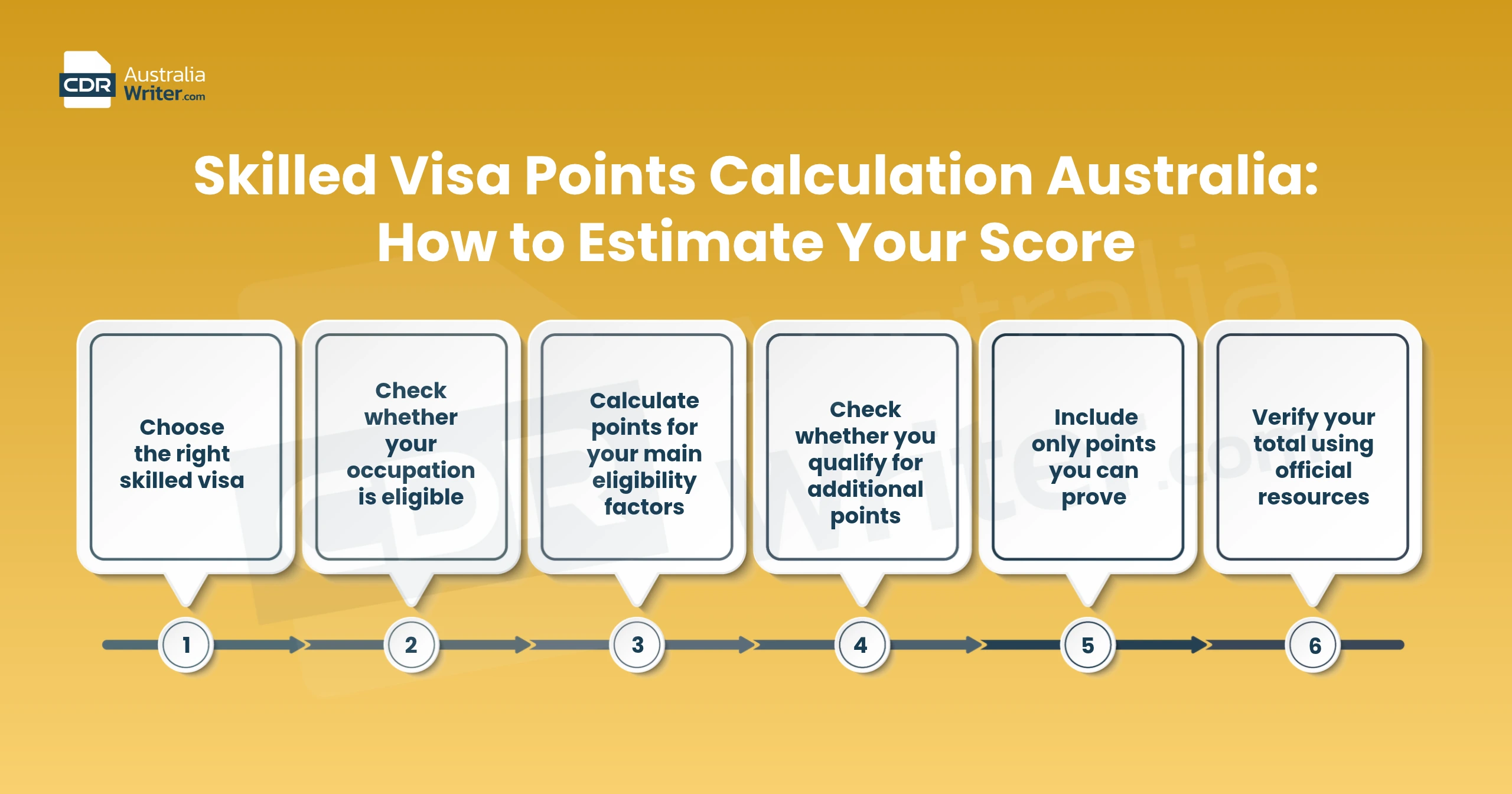
Skilled Visa Points Calculation Australia: How to Estimate Your Score
A skilled visa points calculation Australia applicants can use begins with identifying the points they may claim under each eligible category. You should calculate your score carefully rather than relying on an estimate from an unofficial website.
A practical way to estimate your score is to:
1. Choose the right skilled visa:
You can choose between Subclasses like 189, 190 or 491, by being based on your eligibility and goals. Each visa has a different nomination, sponsorship and living requirements according to its features.
2. Check whether your occupation is eligible:
Applicants need to confirm that your nominated occupation is eligible for your chosen visa and identify the relevant skills assessment authority. Your occupation also should match your qualifications and work experience that you have gained.
3. Calculate points for your main eligibility factors:
You have to check the points that you can claim for your age, English proficiency, qualifications and skilled employment. Your total points depend on the applicable criteria and supporting evidence.
4. Check whether you qualify for additional points:
You may also earn extra points for yourself through eligible partner skills, Australian study, community language credentials or visa nomination. You have to check the specific requirements for each category before claiming points.
5. Include only points you can prove:
You can support each and every claim with your appropriate required documents, which may include your English test results, qualification certificates or employment references. Also, you need to avoid claiming points that you cannot verify properly.
6. Verify your total using official resources:
You may check your score against the latest points table from the Department of Home Affairs. And then remember that meeting the minimum of 65 points does not guarantee an invitation.
The Australia skilled migration points test calculator provides an estimate based on the information you enter. The Department of Home Affairs will assess whether you meet the relevant required requirements and also can support the claims in your EOI.
Remember that the skilled visa points calculation Australia applicants complete is only one part of the process. You must also meet the visa’s other eligibility requirements, including the relevant skills assessment, occupation and invitation criteria.
Australia PR Points Breakdown by Category
Here is how the main factors score. Always cross-check against the current Home Affairs table before you lodge anything.
Factor | Points |
Age 18–24 | 25 |
Age 25–32 | 30 |
Age 33–39 | 25 |
Age 40–44 | 15 |
English: Proficient / Superior | 10 / 20 |
Skilled work outside Australia (3–4 / 5–7 / 8+ years) | 5 / 10 / 15 |
Skilled work in Australia (1–2 / 3–4 / 5–7 / 8+ years) | 5 / 10 / 15 / 20 |
Doctorate | 20 |
Bachelor or Master degree | 15 |
Diploma or trade qualification | 10 |
Specialist education (STEM research degree) | 10 |
Australian study requirement | 5 |
Professional Year | 5 |
Credentialled community language | 5 |
Regional study | 5 |
Partner skills, or single status | up to 10 |
Subclass 190 state nomination | 5 |
Subclass 491 nomination or family sponsorship | 15 |
Two details catch people out. Age peaks at 30 points between 25 and 32, then drops with every bracket, so waiting has a real cost. Also, overseas and Australian work experience share a combined cap of 20 points. Most of these Australia PR points need paperwork behind them, so start collecting evidence early.
Practical Ways to Raise Your Score Before You Lodge
Most applicants can add 10 to 20 points over a year or two if they’re deliberate. In rough order of effort:
- Improve your English. Moving from Proficient to Superior adds 10 points, often the cheapest gain available.
- Count experience correctly. Only work after the date your assessing body considers you skilled in the nominated occupation counts. Check this before you claim years.
- Collect the small wins. A Professional Year, a NAATI credentialled community language (such as Hindi or Mandarin) and regional study are 5 points each.
- Review partner points. Up to 10 points are available if your partner has a positive skills assessment and the required English, or if you’re single.
- Explore nomination. State or regional nomination can swing your position a lot.
Stack small, well-documented Australia PR points rather than chasing one big jump. Even a modest improvement matters in the Australia skilled migration points test, because invitations are ranked, and ties are broken by the date you reached your score. Aim for a buffer above the minimum points required so a lower-than-expected assessment doesn’t knock you out.
Have Any Question?
CDR Australia Writer specialises in high-quality CDR, RPL and VETASSESS reports for engineers. CDR Australia Writer offer low-cost, customized and reliable services in diverse engineering disciplines.
- +61 482 072 465
- [email protected]

Our expert writing team has successfully assisted clients in obtaining approval through professional services for skill assessments and migration needs.
How Do State Nomination and Regional Sponsorship Affect Your Points?
State Nomination can make a quite difference to your points total, particularly if you are considering Subclass 190 or Subclass 491.
For the relevant points-tested pathways:
- Subclass 189: Does not provide nomination points because state or territory nomination is not required for its points-tested stream.
- Subclass 190: Eligible state or territory nomination adds 5 points.
- Subclass 491: Eligible state or territory nomination or sponsorship by an eligible relative adds 15 points.
These additional points can help an applicant to reach the minimum threshold. However, nomination programs can have their own criteria, and meeting the points, i.e does not guarantee selection.
If you are considering state nomination, check the current occupation lists and eligibility requirements for the state or territory you are interested in. For Subclass 491, make sure you also understand the visa’s regional conditions and the requirements for any later permanent residency pathway.
Things to Avoid When Calculating Your Migration Points
An inaccurate points claim can create problems when your application is assessed. Keep these common mistakes in mind:
- Assuming 65 points guarantees an invitation. It is the minimum but not a promise of selection.
- Claiming work experience without sufficient evidence. You need to check that your employment meets the relevant requirements.
- Using an outdated points table. You should always confirm the latest official criteria.
- Overlooking age and timing. Your eligibility and age points can quite depend on when you are invited.
- Claiming English points too early. You have to make sure that your results meet the accepted test and score requirements.
- Double-counting points. Follow the rules for each category and any applicable limits.
- Ignoring other visa requirements. A strong points score does not replace occupation eligibility, a suitable skills assessment or an invitation.
For applicants, careful preparation can help you understand your position before submitting an EOI and helps to reduce the risk of making claims you cannot support.
Your Next Steps Towards Skilled Migration
You can start by confirming that your selected occupation is eligible for the visa that you are considering. Then you can review your skills assessment requirements, calculate your potential points score and gather documents in order to support each claim.
The Australia skilled migration points test can help you to understand how your qualifications, age, English proficiency and employment history may contribute to your application for migration. However, your score should also always be considered alongside the other visa requirements and the likelihood of receiving an invitation.
You also have to use the latest information from the Department of Home Affairs before submitting your EOI. If you are unsure whether your selected employment, qualifications or other circumstances qualify for points, then you can consider seeking advice from a registered migration agent.
A carefully calculated score, accurate supporting evidence and a clear understanding of the process can help you prepare a more informed skilled migration application.
Get our free consultation
Do you have a question?
Get our free consultation with specialist and experienced counsellors. Explore our CDR writing packages immediately and receive 100% plagiarism free CDR report
Contact us right now! and Get your CDR report ready for approval.

Do you have a question?
We have mentioned common questions asked by our clients regarding CDR report, ACS RPL report, KA02 report, and skill assessment process.
For the Australia skilled migration points test Subclass 189, 190 and 491 pathways discussed in this guide, the general minimum threshold is 65 points. Meeting it does not guarantee an invitation, and the score needed to receive an invitation may be higher.
It’s possible in less competitive occupations, but rare in popular ones. Check recent invitation rounds for yours.
Points peak at 30 for ages 25–32, then fall with each bracket. People aged 45 and over score zero for age.
5 points for a subclass 190 nomination and 15 for a subclass 491 nomination or eligible family sponsorship.
No, an EOI submitted through SkillSelect EOI expresses your interest in applying for a skilled visa. It is not a visa application and it also does not guarantee an invitation.
Possibly, but no start date has been announced. The current rules for this apply until new legislation takes effect.