

Engineering Jobs with Visa Sponsorship:
A 2026 Guide to Working in Australia
Engineering jobs with visa sponsorship remain one of the most reliable routes for those skilled engineering professionals who want to build a long-term career in Australia. Australia offers opportunities for skilled engineers across construction, infrastructure, manufacturing, energy, mining, and technology. For international engineering professionals hoping to build their careers overseas, engineering jobs with visa sponsorship can provide a possible route to working in Australia. It helps to know what the employer is really looking for, check that your occupation is eligible, and have your documents ready so your skills and experience speak for themselves.
With an ongoing infrastructure boom, an ageing domestic workforce, and chronic shortages across civil, electrical, mechanical, and mining disciplines, employers are actively sponsoring overseas engineers through the Skills in Demand (subclass 482) and Employer Nomination Scheme (subclass 186) visas. Whether you are a civil, mechanical, electrical, or software engineer, knowing where to search and how Engineering jobs with visa sponsorship works then it can help you to approach your job search with greater confidence.

Why Australia Needs Skilled Engineering Professionals?
Skilled Engineering professionals contribute to projects that involve transport networks, residential developments, renewable energy, industrial systems, and essential infrastructure. These projects create opportunities for people with relevant qualifications and practical experience.
Australia’s infrastructure pipeline such as rail, roads, renewable energy, and mining expands, these has outpaced local graduate numbers for years. Most engineering occupations sit on the Medium and Long-term Strategic Skills List (MLTSSL), which gives them priority access to sponsored visa pathways. Civil, structural, electrical, and mining engineers are particularly short-staffed in New South Wales, Victoria, Queensland, and Western Australia, with regional employers often sponsoring at higher rates than metro firms because the shortages there are more acute. For those candidates who are searching specifically for engineering jobs with visa sponsorship, then this sustained demand means genuine, ongoing opportunities rather than a one-off hiring spike.
How to Find and Apply for Sponsored Engineering Roles
Searching effectively matters as much as being qualified for this. A few practical steps:
- Use precise search terms. Try phrases like “visa sponsorship” and “482 visa” along with your specific occupation code. These tend to surface genuine listings rather than generic ads.
- Target known sponsors. Mining companies, engineering consultancies, and major infrastructure contractors sponsor regularly, and they often say so directly in their job ads.
- Check Standard Business Sponsor status. Australia has thousands of approved sponsors, and many of them mention this on their careers pages.
- Build your CDR before applying. Having your skills assessment underway or complete shows employers you are ready, which matters when they are weighing up sponsorship costs and timelines.
- Tailor every application. Match your resume and cover letter to the role, and point out the skills and projects that fit the position.
- Read each listing carefully. Look for the visa subclass, the location, and any conditions attached to sponsorship, so you know exactly what is being offered before you apply.
- Go to the source. Do not rely only on third party aggregator sites. Check the employer’s official careers page or contact the recruiter to confirm that sponsorship is genuinely available.
Genuine engineering jobs with visa sponsorship almost always specify the visa subclass and whether the role is eligible for state nomination, so read listings carefully rather than relying on third-party aggregator sites alone.

Engineering Jobs in Australia for Foreigners
International applicants can explore opportunities across several engineering specialisations. The most suitable roles for foreigners will depend on what are their qualifications, experience, technical skills, and the requirements of individual employers.
Engineering opportunities in Australia span a wide range of industries. Depending on your qualifications and experience that you have gained, these are some of the roles you may want to explore:
- Civil Engineers: Plan and deliver infrastructure projects such as roads, bridges, buildings, drainage systems, and other construction developments.
- Mechanical Engineers: Design, develop, and maintain machinery, industrial equipment, and manufacturing systems.
- Electrical Engineers: Work on power generation, electrical networks, renewable energy systems, and industrial equipment.
- Structural Engineers: Design and assess building structures to make sure they meet safety and engineering standards.
- Mining Engineers: Support mining operations through mine planning, resource extraction, and safety measures.
- Environmental Engineers: Tackle environmental challenges through waste management, water treatment, pollution control, and sustainable engineering solutions.
- Software and Systems Engineers: Develop software, improvement of technical systems, and work on automation or digital infrastructure, depending on their specialisation and the requirements of the role.
When you are researching for engineering jobs in Australia for foreigners, then you need to pay attention to the actual responsibilities listed in each advertisement. A job title alone does not establish whether your occupation qualifies for a particular visa.
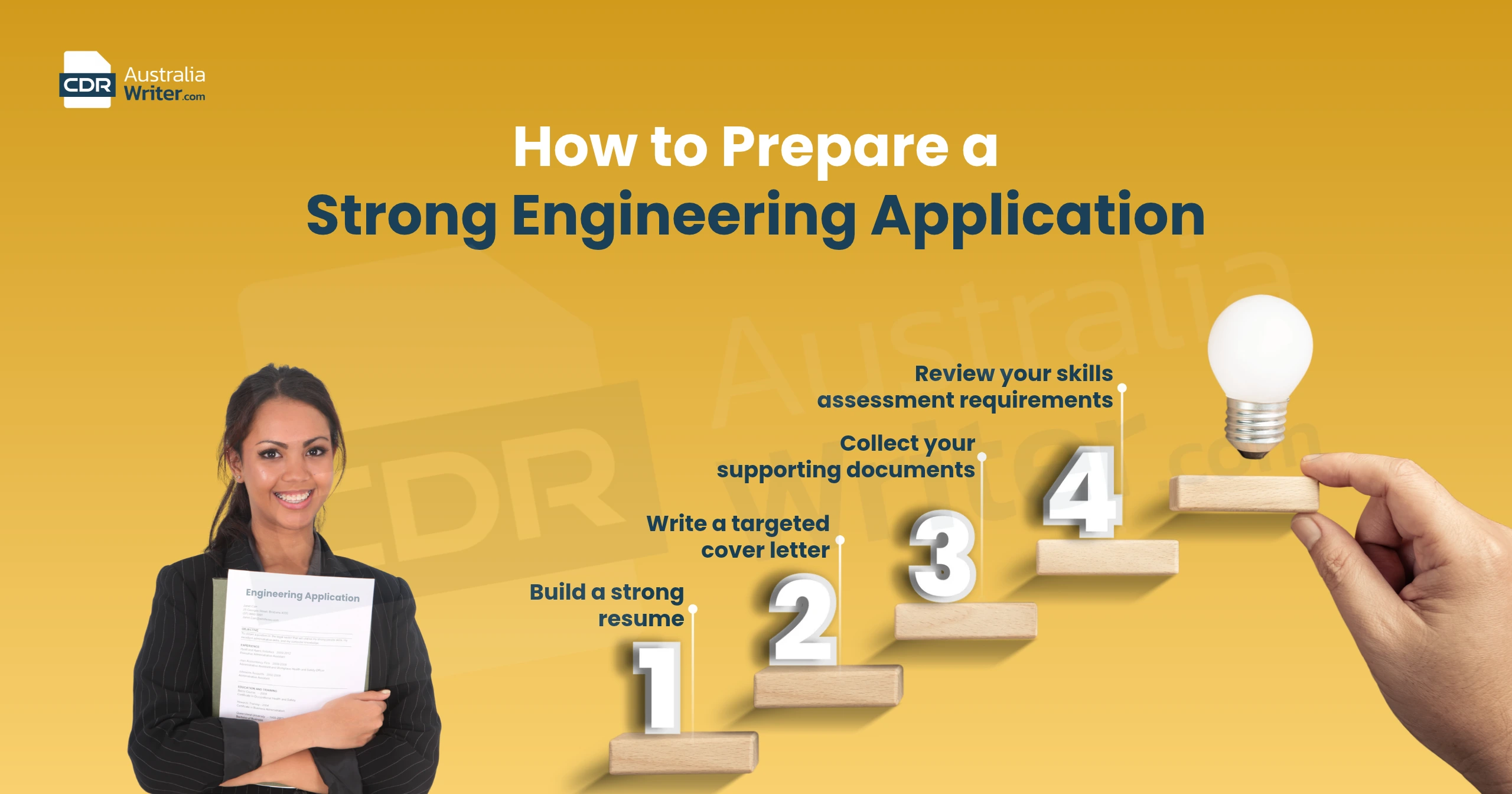
How to Prepare a Strong Engineering Application
Employers need to understand what you can contribute to their projects. A well-organised engineering application should connect your experience with the responsibilities and technical requirements of the advertised role.
1. Build a strong resume:
You have to highlight your engineering qualifications, relevant work history, software knowledge, technical skills, and standout projects that you have worked for. Then, write in clear, simple language, and focus on what you achieved instead of only listing your responsibilities.
2. Write a targeted cover letter:
You should explain why your background suits the desired position and what you can bring to the employer. You have to avoid sending the same generic letter to every company, because a letter written for the role always lands better.
3. Collect your supporting documents:
You need to keep your degree certificates, academic transcripts, employment references, project records, and any other relevant evidence that you have gathered in an organised manner in one place. Also, make sure that your employment dates, job titles, and responsibilities match across all your documents, since inconsistencies in this can raise questions during assessment or nomination.
4. Review your skills assessment requirements:
Engineers Australia is the designated assessing authority for many engineering occupations used in skilled migration. Depending on your qualification and circumstances, you may need a migration skills assessment. Applicants with qualifications that are not recognised through an applicable accredited pathway may need to consider the Competency Demonstration Report (CDR) pathway.
If you are exploring employer-sponsored engineering roles, remember that professional registration or licensing may also be necessary for certain positions. Check the requirements of the role and the relevant state or territory before assuming your qualifications are sufficient.
Engineers Australia Skills Assessment: Your First Step
Before any employer can lodge a nomination, most applicants need a positive Engineers Australia skills assessment. This involves submitting a Competency Demonstration Report (CDR) that maps your qualifications and work history against the required competency standards. Processing can take several weeks to a few months, so starting early ideally before you begin actively job hunting puts you in a stronger position once an employer makes an offer. A well-prepared Engineers Australia skills assessment is often the single biggest bottleneck in the entire Engineering jobs with visa sponsorship process, so getting it right the first time matters more than rushing it.
Visa Pathways: Australian Engineering Visa Requirements
Before applying for a sponsored position, learn which visa pathway may suit your circumstances. The visa pathways requirements can differ between various visa subclasses, occupations, and individual applicants.
The main options to investigate include:
Subclass 482 (Skills in Demand visa):
This is considered as the primary temporary sponsorship visa. Under this, the Core Skills stream makes your employer nominate you for an eligible occupation that you desire, and a positive skills assessment which is typically mandatory before the nomination is lodged. This is the entry point for most engineering jobs with visa sponsorship advertised today.
Subclass 186 (Employer Nomination Scheme):
This is a permanent residency pathway. Many engineers reach it after a period on the 482 visa, while employers can also apply for it directly for senior engineers. State nomination can add points and speed up processing for engineers in regional areas.
Subclass (494 Skilled Employer Sponsored Regional visa):
This provisional visa lets eligible employers in designated regional areas sponsor skilled engineers. You have to meet the requirements that are for your occupation and visa stream, this may include your relevant work experience in that field and a skills assessment, unless there is an exemption which is applied.
Check the requirements before you rely on them. When you review the visa requirements for engineers, always check the latest information from the Department of Home Affairs. Meeting the requirements for one visa does not mean you qualify for another. Keep in mind, too, that an employer’s willingness to hire you does not automatically make you visa eligible. The position, the salary, the sponsorship arrangements, and your own circumstances all have to satisfy the relevant rules.
Salary Expectations and Top Sponsoring Employers
A sponsored engineering salary may vary by discipline and seniority, but civil engineers in 2026 are commonly seeing offers from different ranges roughly $100,000 AUD upward, with mining and electrical engineers often higher depending on the location type and what the project scale is. There are large resources like companies, government infrastructure contractors, and mid-sized consultancies which are considered as the most consistent sponsors, whereas frequently advertising visa support directly within their job listings rather than just requiring candidates to ask.
Have Any Question?
CDR Australia Writer specialises in high-quality CDR, RPL and VETASSESS reports for engineers. CDR Australia Writer offer low-cost, customized and reliable services in diverse engineering disciplines.
- +61 482 072 465
- [email protected]

Our expert writing team has successfully assisted clients in obtaining approval through professional services for skill assessments and migration needs.
Things to Avoid When Applying
A few slip-ups can slow down an otherwise strong application. Here are the ones worth watching for:
- Sending generic applications. Tailor your resume and cover letter to each role you apply for. Employers can tell when a document has been copied and pasted.
- Ignoring occupation eligibility. Check the relevant occupation list and visa requirements before you rely on any pathway.
- Exaggerating your experience. You have to keep your employment details accurate and back them up with proper required evidence.
- Assuming sponsorship is guaranteed. An interview or even a job offer does not automatically mean a visa will be granted.
- Overlooking regional opportunities. If you are open to living outside the major cities, then the regional roles can open doors that metro searches can miss.
- Paying for promises. You have to be careful with anyone who guarantees a job, sponsorship, or visa approval in exchange for money.
- Relying on outdated information. Some information such as: visa rules, occupation lists, fees, and salary, these can change with time, so you have to recheck official sources before you apply.
Your Next Steps Towards an Engineering Career in Australia
Finding a suitable sponsored position takes a lot more of the preparation, research, and patience for the selected field. You have to first start by identifying engineering roles that match your qualifications and experience, then check the relevant visa requirements before approaching employers.
You also should also prepare a targeted resume, organise your supporting documents, and have to investigate whether you need a professional skills assessment. Most importantly, you have to use official immigration sources in order to verify current requirements rather than just relying on assumptions or recruitment promises.
A clear understanding of your options will help you make informed decisions and help to approach your Australian engineering job search with realistic expectations.
Get our free consultation
Do you have a question?
Get our free consultation with specialist and experienced counsellors. Explore our CDR writing packages immediately and receive 100% plagiarism free CDR report
Contact us right now! and Get your CDR report ready for approval.

Do you have a question?
We have mentioned common questions asked by our clients regarding CDR report, ACS RPL report, KA02 report, and skill assessment process.
Yes, Eligible employers can sponsor overseas engineers when both their position and the applicant meet the required visa requirements. Also whether it works for you or not can totally depend on your occupation you have chosen, the employer, your qualifications, experience that you have gained, and the immigration rules in that certain place at the required time.
The Skills in Demand visa (subclass 482) is the main temporary employer sponsored option. Depending on your circumstances, you might also look at the subclass 186 permanent visa or the subclass 494 regional visa.
It depends on the visa and the occupation. For most Core Skills stream nominations, a positive Engineers Australia skills assessment is needed before an employer can lodge your nomination. Other pathways for this may ask you to show your qualifications and experience in different ways, so you always have to check the requirements for your nominated occupation and visa.
It can be a little harder for those individuals without professional experience, since some of the sponsored pathways may require relevant work history. Graduate opportunities do exist, but eligibility comes down to the role, the employer, and the visa pathway.
You have to begin with established job platforms, professional networks, recruitment agencies, and the careers pages of employers that you admire. You should use targeted searches, and confirm directly with the recruiter or employer that sponsorship is actually on offer for the role.
For most Core Skills stream nominations, yes because a positive skills assessment is required before an employer can lodge your nomination.