

CDR Report Requirements: What Engineers Australia Expects
CDR report requirements are the first real hurdle for most overseas engineers planning a move to Australia, and they trip up more applicants than almost any other step. The good news is that the rules are far less mysterious once you see them laid out. Preparing a Competency Demonstration Report (CDR) is considered as an important step for those engineers who are planning or seeking a migration skills assessment through Engineers Australia. The application requires more than academic certificates and employment records. You also need to show how you have gained the selected engineering knowledge, professional experience and technical abilities that meet the set relevant competency standards.
If you are aware of CDR report requirements even before you start, then you can arrange all your documents properly, then draft your career episodes and avoid common mistakes that may occur in application.Whether you are a fresh engineering graduate or an experienced professional, a well-prepared application should clearly and genuinely reflect your engineering abilities. Each document serves a particular purpose and all the information has to be accurate and consistent.
What Is a Competency Demonstration Report (CDR) and Who Needs One?
A Competency Demonstration Report (CDR), is the set of documents that you send to Engineers Australia in order to show that your engineering skills meet all the required Australian standards. It’s used for a Migration Skills Assessment, which comes before a skilled visa application and an Expression of Interest in SkillSelect. Not everyone has to write one. If you hold an accredited Australian engineering degree, you usually follow a different pathway. Most applicants with overseas or non-accredited qualifications use the CDR pathway instead.
Engineers Australia assesses four occupational categories: Professional Engineer, Engineering Technologist, Engineering Associate and Engineering Manager. Your CDR report requirements have to match the category you’re aiming for. Always confirm your pathway in the latest Migration Skills Assessment Booklet before you write a single word.
Engineers Australia Skills Assessment Requirements: Choosing the Correct Pathway
Not every engineering applicant needs to submit a CDR. The assessment pathway depends mainly on the applicant’s qualifications, accreditation status and nominated engineering occupation.
Engineers Australia recognises several assessment pathways, including:
- Australian qualification pathway.
- Washington Accord pathway.
- Sydney Accord pathway.
- Dublin Accord pathway.
- Competency Demonstration Report pathway.
Applicants with recognised accredited qualifications may be eligible for an applicable accredited qualification pathway. Those with non-accredited qualifications or qualifications that do not align with the relevant occupational category may need to use the CDR pathway.
Engineers Australia assesses applicants across four occupational categories: Professional Engineer, Engineering Technologist, Engineering Associate and Engineering Manager. Before choosing a pathway, check whether your qualification is recognised under the relevant accreditation agreement and whether it matches your intended occupation.
The Engineers Australia skills assessment requirements should be reviewed carefully because selecting an unsuitable pathway can lead to additional work, costs or delays.

Engineers Australia CDR Documents: What Do You Need?
Before preparing your CDR report, the requirements are that you need to collect all the documents which are needed for your chosen assessment pathway. Applicants must provide evidence of their identity, education, work history and engineering competencies to Engineers Australia.
Typical main documents include:
- Passport: Coloured scan of the passport’s biographical page in high resolution (valid passport).
- Academic certificates: Degree certificate and complete academic transcript.
- Curriculum Vitae: A long CV that details your qualifications, work history and professional experience.
- English language evidence: You will be asked to provide test results or other evidence as required by the applicable criteria.
- Continuing Professional Development: You must provide a written record of professional development activities undertaken in relation to the position.
- Career Episodes: You will need to write three descriptions of your engineering projects or work experience that you have gained.
- Summary Statement: You require a document which helps in linking the paragraphs of your career episode to the elements of competency you require.
- Registration or licence documents: Professional registration certificates where applicable.
- Change of name documents: Supporting evidence if your current name is different to the name on your academic or identity documents.
Under Engineers Australia’s CDR report requirements, if your documents are not in English, you must provide the original documents and translations by an authorized translator.
Before applying online you need to collect and check these Engineers Australia CDR documents. Missing or vague evidence may cause needless delays or requests for further information.
Essential Components of an Engineers Australia CDR
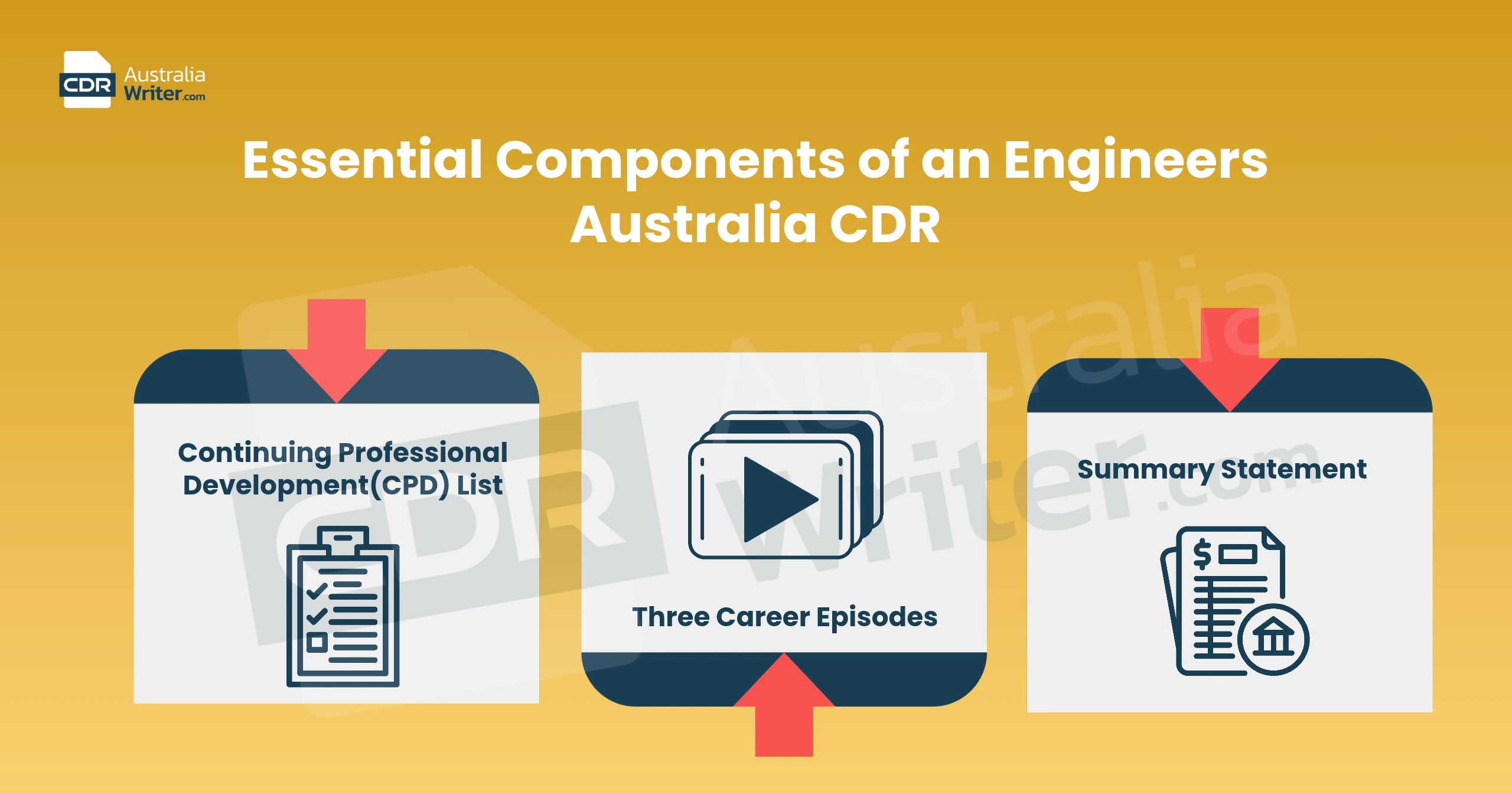
A Competency Demonstration Report is based on three key components. Each of these serves a different purpose of demonstrating your engineering knowledge and professional experience. Knowing these CDR report requirements before you begin can help you to plan your information, prepare your documents correctly and avoid unnecessary revisions.
1. Continuing Professional Development (CPD) List:
The CPD list is a snapshot of how you have kept and extended your engineering knowledge throughout your working life. It may include technical training, workshops, seminars, conferences, professional courses, independent study and other learning activities of a relevant nature. Details of activity name, date, duration and provider/venue if relevant. The information should be about real activities that have contributed to your professional development.
2. Three Career Episodes:
Career episodes are detailed narratives of your personal engineering experience. You will have to prepare three separate episodes based on three different projects, academic activities or periods of professional work. They should describe the engineering work you did, the technical problems you faced, the choices you made, and the approaches you took to solve problems. Most importantly, make your individual contribution clear instead of focusing on what the overall team achieved.
3. Summary Statement:
The Summary Statement connects your career episodes to the required competency elements of Engineers Australia. It is usually presented in a structured table where you identify the relevant competency elements and refer to the numbered paragraphs in your career episodes that illustrate them. Each reference should provide clear evidence of your engineering knowledge, professional skills and ability to apply them in practical situations.
Together, these pieces tell the assessor who you are as an engineer, what you’ve actually done, and how it lines up with the standard.
CDR Career Episode Requirements: How Many Episodes Are Needed?
The career episodes are the heart of the CDR, they are where you can show how you have applied your engineering knowledge in real life. Engineers Australia generally requires three separate career episodes for applicants using this pathway.
Each episode should focus on a specific engineering project, activity or period of professional work. You can use academic projects or professional experience, provided the examples demonstrate the relevant competencies for your nominated occupational category.
A career episode generally contains four sections:
- Introduction: You have to provide basic information about your project with its duration, location, organization, and your position.
- Background: You need to provide the background of your project with its objectives, technical environment, organisational structure and your responsibilities.
- Personal Engineering Activity: What sort of engineering work have you done? Include your calculations, technical choices, methods, challenges and solutions.
- Summary:Explain what came out of your work, and what was your role in the project.
One important requirement is to demonstrate your individual contribution. Instead of describing what your entire team accomplished, explain what you personally designed, calculated, investigated or improved.
The three CDR career episodes must collectively demonstrate all 16 Stage 1 competency elements relevant to your nominated occupational category at least once. Paragraph numbering is also important because it allows assessors to locate the evidence referenced in your Summary Statement.
CDR Summary Statement Requirements: Mapping Your Competencies
The Summary Statement connects your career episodes with the competency standards used by Engineers Australia. It helps assessors identify where you have demonstrated the required engineering knowledge and professional abilities.
You must use the appropriate Summary Statement template for your nominated occupational category. Engineers Australia recognises four main categories:
- Professional Engineer
- Engineering Technologist
- Engineering Associate
- Engineering Manager
The competency elements and template differ depending on the selected category.
When preparing your Summary Statement, identify each required competency element and refer to the numbered paragraphs in your career episodes that demonstrate it. You should also provide a brief explanation of how the referenced experience supports that competency.
The CDR summary statement requirements are not satisfied by simply listing paragraph numbers. Your references must be to real evidence that supports the competency that you are asserting.
CDR CPD Requirements: Showing Your Professional Development
Continuing Professional Development (CPD) shows how you have maintained and developed your engineering knowledge following completion of your qualification.
Engineers Australia requires applicants following the CDR pathway to submit a written statement of relevant professional development activities. Such activities might include:
- Professional development and technical training.
- Workshops and seminars on engineering.
- Industry conferences and professional events.
- Further academic study or learning
- Engineering and technical meetings.
- Technical reading and professional research.
- Other activities related to building your engineering knowledge.
When completing your CPD record, you must supply accurate details of the activities you completed. Give details of the activity title, date, duration and venue or provider, where appropriate. Your CPD should show real learning and professional development.” Do not add activities just to make the document longer. A clear and honest record is more useful than a long list of unsubstantiated claims.
Completing the CDR CPD requirements can assist you to show that you have kept your knowledge up to date and kept abreast of relevant engineering practice.
Have Any Question?
CDR Australia Writer specialises in high-quality CDR, RPL and VETASSESS reports for engineers. CDR Australia Writer offer low-cost, customized and reliable services in diverse engineering disciplines.
- +61 482 072 465
- [email protected]

Our expert writing team has successfully assisted clients in obtaining approval through professional services for skill assessments and migration needs.
Engineers Australia CDR Guidelines on Format and Originality
The Engineers Australia CDR guidelines are strict about originality. CDR report requirements are checked for plagiarism, and copied or heavily templated content can lead to refusal and a ban on reapplying. Relying on a generic sample or auto-generated text to fill the gaps is risky, because the assessor may ask you to clarify your work. Write everything in your own words, from your own experience.
Format matters too. Use clear headings, consistent paragraph numbering, and stay within the word limits. Meeting these CDR report requirements on formatting is simple, but ignoring them gives the assessor an easy reason to delay your file. Because rules, fees and processing times change, treat the current Engineers Australia CDR guidelines and booklet as the final word.
Common Mistakes to Avoid When Preparing a CDR
Even applicants with strong engineering qualifications can face difficulties if their documentation is incomplete or their experience is not clearly explained.
Avoid these common mistakes:
- Copying another applicant’s career episodes: Your report should reflect your own engineering experience and your own original work.
- Using vague technical descriptions: You have to describe the techniques, calculations and choices that you make in your engineering practice.
- Overusing the word “we”: When you talk about projects done by a team you have to be specific about who is responsible for which duty.
- Ignoring competency mapping: You need to provide evidence that must be appropriate to each of the competency elements which are required.
- Providing inconsistent information: Your documents need to be consistent in all the requirements on employment dates, qualifications and project details.
- Incomplete documents submitted:Check the official checklist before submitting your application.
- The belief in guaranteed approval promises:No consultant or service provider can guarantee a positive outcome.
A quick glance at your paperwork can help you avoid errors and make your application easier to read.
Your Next Steps Towards a Successful CDR Assessment
Real engineering evidence, good understanding of the assessment criteria and a comprehensive plan are a must for CDR application. First, check that you are eligible and select the appropriate occupation category. Then collect your academic and professional documents before preparing your CPD, career episodes and Summary Statement.
The CDR report requirements should guide your preparation from the beginning. You have to ensure that your career episodes reflect your own engineering contributions and your competency references are accurate. Finally, check the application against Engineers Australia’s recent instructions before submitting.
A well-organized application will help assessors understand your engineering background and assess your competencies. Please be aware that the final decision on the assessment is made by Engineers Australia and that meeting the documentation requirements of the CDR report does not guarantee a successful outcome.
Get our free consultation
Do you have a question?
Get our free consultation with specialist and experienced counsellors. Explore our CDR writing packages immediately and receive 100% plagiarism free CDR report
Contact us right now! and Get your CDR report ready for approval.

Do you have a question?
We have mentioned common questions asked by our clients regarding CDR report, ACS RPL report, KA02 report, and skill assessment process.
No, Graduates of accredited Australian engineering programs usually follow a different pathway. Most applicants with overseas or non-accredited degrees submit a CDR. Check the current Migration Skills Assessment Booklet for your case.
Three, each should cover a different project or work period, and each is typically 1,000 to 2,500 words.
It’s best to avoid this. Three distinct projects show wider competence. If you have limited experience, you can describe different phases of one large project, but each part must stand alone and show different skills.
It can be refused, and you may face a waiting period before you can apply again. Always write from your own experience in your own words.
It varies with workload and whether Engineers Australia asks for more information. Check the official site for current timeframes and fees, as these change.
Yes, you can use university projects, internships and early-career work if they show real engineering activity. Be honest about your role.