

Chartered Engineer vs Professional Engineer: Which Path Fits You?
Chartered Engineer vs Professional Engineer looks like a simple either-or a question, but it really isn’t. These two credentials come from different countries which follow different rules and carry different legal weight. If you are an overseas engineer who has Australia on your mind then mixing them up can only cost you your time, money and a lot of unnecessary stress.
In simple terms, Professional Engineer is one of the recognised occupational categories used by Engineers Australia, meanwhile Chartered Professional Engineer (CPEng) is a professional credential that demonstrates an engineer has reached the independent practice level. Understanding this difference is particularly important if you are planning:
- professional registration,
- career progression, or
- an Australian engineering skills pathway.

What Is a Chartered Engineer
in Australia?
A Chartered Engineer in Australia is an engineer who has achieved a Chartered credential through Engineers Australia. For the professional engineer occupational category, the credential is known as Chartered Professional Engineer (CPEng).
CEng is awarded by the Engineering Council in the United Kingdom through licensed bodies such as:
- the Institution of Civil Engineers,
- the IMechE and
- the IET.
It’s respected across the UK and many Commonwealth countries. To earn it, you generally need an accredited master’s-level qualification, or a bachelor’s degree plus further learning. You will also need several years of structured work experience and a professional review. That review is an interview where assessors test your technical judgement, leadership and commitment to ethics.
Think of CEng as a badge of competence. It tells employers and clients that your peers have independently checked your standard. What it isn’t is a licence. In the UK, you can often practise engineering without it.
What Is a Professional Engineer in Australia?
A Professional Engineer in Australia is an occupational category rather than a separate credential like CPEng. Engineers Australia identifies three main engineering occupational categories:
- Professional Engineer
- Engineering Technologist
- Engineering Associate
The Professional Engineer category covers engineers whose work involves applying engineering knowledge to complex engineering problems and professional engineering activities. An engineer can therefore be a professional engineer without automatically being Chartered. Chartered status represents an additional professional credential demonstrating competency at the independent-practice level.
This distinction is important because people sometimes use “professional engineer” and “Chartered engineer” as if they are interchangeable. They are not. Engineers Australia explains that independent-practice competencies are used for Chartered and National Engineering Register (NER) credentials.

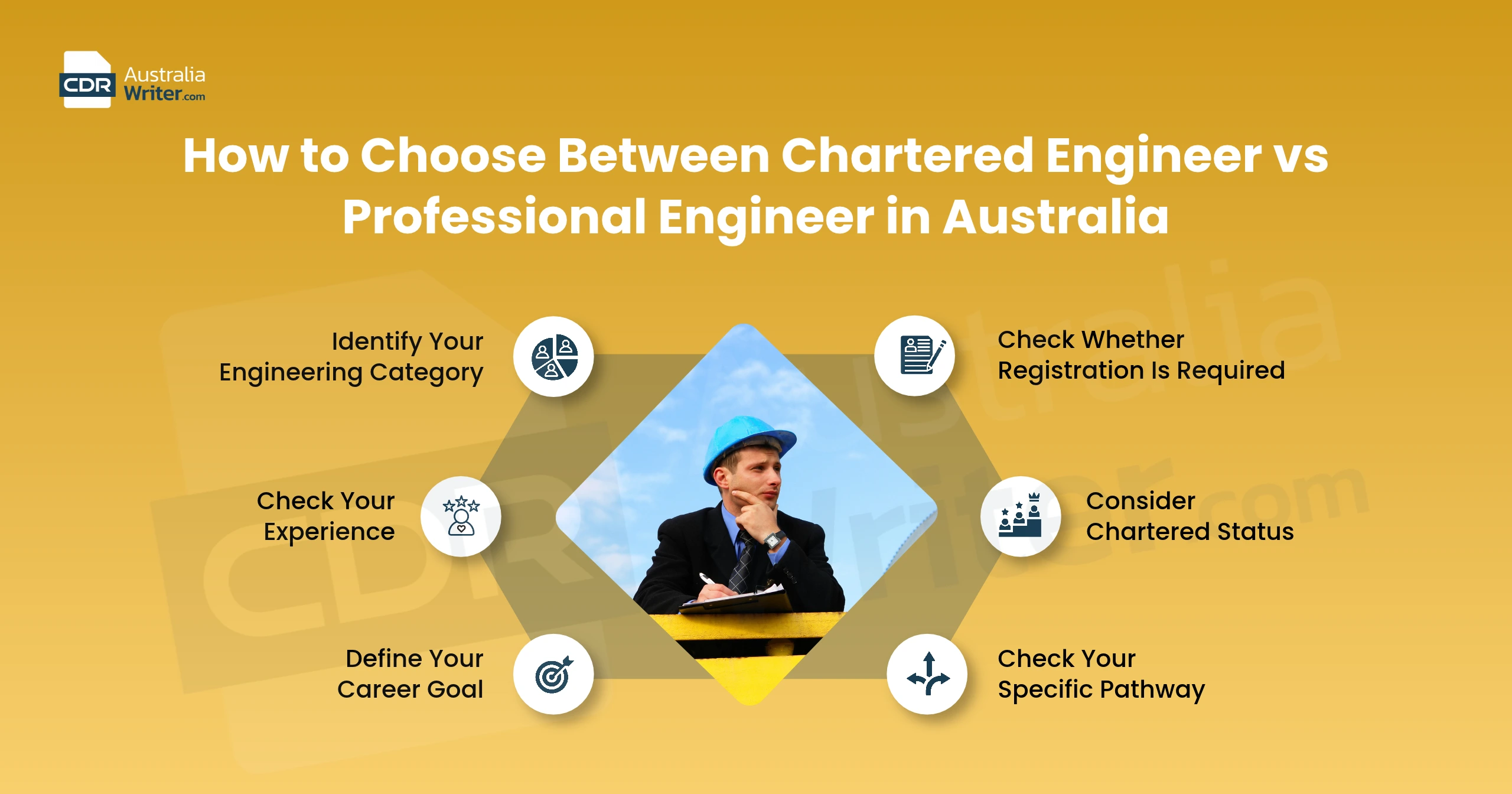
How to Choose Between Chartered Engineer vs Professional Engineer in Australia
Choosing between the Chartered Engineer vs Professional Engineer depends mainly on your:
- career stage,
- experience,
- professional goals and
- registration needs.
Also remember that “Professional Engineer” is an occupational category, meanwhile Chartered Professional Engineer (CPEng) is a professional credential.
1. Identify Your Engineering Category
Firstly, you need to check whether you fall under the Professional Engineer occupational category based on your qualifications and engineering background. Engineers Australia generally recognises a four-year accredited or a recognised professional engineering degree for this category.
2. Check Your Experience
You need to look at the relevance of how much engineering experience you have. According to Engineers Australia, the current requirement is at least five years of engineering experience is needed to apply for Chartered status.
3. Define Your Career Goal
If your immediate goal is to establish your professional engineering category or meet an entry-to-practice requirement, then focus on the relevant Professional Engineer in Australia pathway. If you want formal recognition of an independent professional practice, then Chartered Engineer in Australia may be relevant.
4. Check Whether Registration Is Required
You have to find out whether your state or territory requires engineering registration for the work you plan to perform. Registration rules vary according to different places across Australia, so check the specific requirements for your specific location and area of practice.
5. Consider Chartered Status
If you have sufficient experience and want to demonstrate independent professional competence, then you can consider applying for CPEng. Chartered assessment uses independent-practice competencies covering areas such as:
- technical proficiency,
- workplace value and
- professional responsibility.
6. Check Your Specific Pathway
Finally, you need to check the exact requirements that are required for your situation. Some of the different processes are:
- Migration skills assessment,
- professional credentialing and
- state registration,
so one credential should not automatically be assumed to replace another.
Chartered Engineer vs Professional Engineer: Key Differences
When comparing between Chartered Engineer vs Professional Engineer, the main difference is the meaning of the terms:
Area | Professional Engineer | Chartered Professional Engineer |
Meaning | An engineering occupational category | A professional credential |
Organisation | Engineers Australia recognises the category | Engineers Australia awards the credential |
Competency level | Can refer to entry-to-practice or professional engineering classification | Independent practice level |
Post-nominal | No CPEng designation simply from being in the category | |
Experience | Depends on the relevant pathway | Demonstrated professional experience and competency are required |
Assessment | May be assessed for membership, migration or other purposes | Chartered competency assessment |
Registration | Requirements depend on the state or territory | Can support certain registration pathways, subject to requirements |
The distinction between Chartered Engineer vs Professional Engineer becomes particularly very important when dealing with Australian state registration. Engineers Australia states that holding a Chartered or NER credential can mean that an engineer does not need some other additional competency assessments for particular state registration pathways, although extra requirements can apply depending on the jurisdiction and area of practice.
Chartered Engineers Requirements
The Chartered Engineers requirements depend on the applicant’s experience and pathway.
- At least 5 years of postgraduate engineering experience for the standard Chartered pathway.
- Complete a self-assessment against the required engineering competencies.
- Provide real examples of your engineering work, decisions, responsibilities and professional skills.
- Have your competency evidence reviewed by an appropriate industry professional.
- Maintain evidence of continuing professional development.
- Complete the required interview to demonstrate your professional competence.
- Submit relevant reports, drawings, calculations, risk assessments, models or other evidence of your own engineering work.
- Engineers with different levels of experience may follow different Chartered pathways.
Professional Engineer Registration
Professional Engineer registration is another area where terminology can become confusing.
- Registration requirements differ between Australian states and territories.
- Demonstrate the engineering competencies required by the relevant regulator.
- Obtain any required competency or registration assessment through the appropriate pathway.
- Additional requirements may apply depending on your engineering discipline or area of practice.
- CPEng or NER, these credentials may support some registration pathways but do not automatically replace every state requirement.
- Always check the requirements of the specific state or territory before applying.
Have Any Question?
CDR Australia Writer specialises in high-quality CDR, RPL and VETASSESS reports for engineers. CDR Australia Writer offer low-cost, customized and reliable services in diverse engineering disciplines.
- +61 482 072 465
- [email protected]

Our expert writing team has successfully assisted clients in obtaining approval through professional services for skill assessments and migration needs.
Things to Avoid When Comparing Chartered and Professional Engineer Status
Preparing your ANMAC assessment documents checklist carefully can make the application process more organised. Some common mistakes include:
Treating the terms as synonyms:
A Professional Engineer is an occupational category, while CPEng is a credential. Do not use the terms interchangeably without considering the context.
Assuming experience alone guarantees Chartered status:
Years of employment do not automatically make someone Chartered. The relevant competencies must be demonstrated through the assessment process.
Assuming CPEng automatically means state registration:
State and territory registration requirements can differ. Always check the regulator’s current requirements.
Using unrelated work as competency evidence:
Evidence should demonstrate your own engineering activities and the relevant competencies. Engineers Australia specifically requires appropriate evidence during the Chartered process.
Confusing migration assessment with professional credentialing:
A migration skills assessment and a Chartered credential serve different purposes. Check which assessment or credential your particular pathway requires.
What This Means for Engineers
The difference between a Chartered Engineer vs Professional Engineer is mainly about category versus credential.
A Professional Engineer in Australia is an occupational category recognised within Australia’s engineering competency framework, while CPEng is a Chartered Engineer in Australia credential that demonstrates competency at the independent-practice level.
If you are planning registration, professional development or an Australian migration pathway, identify the exact requirement first. Your engineering category, experience, area of practice, state or territory and migration pathway can all affect which assessment or credential is relevant.
Get our free consultation
Do you have a question?
Get our free consultation with specialist and experienced counsellors. Explore our CDR writing packages immediately and receive 100% plagiarism free CDR report
Contact us right now! and Get your CDR report ready for approval.

Do you have a question?
We have mentioned common questions asked by our clients regarding CDR report, ACS RPL report, KA02 report, and skill assessment process.
No, A Chartered Engineers requirements hold a UK professional title based on peer review. A Professional Engineer registration holds a US state licence based on exams and supervised experience.
You can mention the credential on your CV as evidence of experience. Australia’s own post-nominal is CPEng, and some states require local registration for certain work.
It can support certain state registration pathways, but the exact requirements depend on the state or territory, area of practice and type of engineering work. Engineers Australia provides specific assessment pathways for jurisdictions including Queensland, Victoria, ACT and Western Australia.
Usually not, provided your degree is accredited under the accord. If it isn’t, a CDR is the standard route. Always confirm the current requirements with Engineers Australia.
Yes, Some engineers hold both, particularly those working across the UK and US, though each has its own fees and CPD expectations.
Chartered engineers in Australia have ongoing professional responsibilities, including maintaining professional competence and meeting relevant CPD requirements.