

Competency Assessment for Engineers: Stage 1, Stage 2 and P.Eng
Competency Assessment for engineers is the structured evaluation process used by engineering regulators and assessing bodies to confirm that an engineer’s knowledge, skills, and professional judgment meet the standard required for recognised practice in their jurisdiction. In Australia, Engineers Australia applies competency assessment across all CDR-based migration skills assessments (Stage 1) andChartered Professional Engineer applications (Stage 2). In Canada, provincial engineering bodies apply a Competency-Based Assessment (CBA) framework for P.Eng licensing. Both systems evaluate genuine engineering competency demonstrated through real project experience, not just years on the job or paper qualifications.

What Is Competency Assessment for Engineers?
A competency assessment evaluates whether an engineer can independently apply engineering knowledge and judgment to real-world technical problems at the standard expected of a practising professional in the relevant jurisdiction. It is distinct from a qualification assessment, which only evaluates your degree. A competency assessment evaluates what you can actually do with that qualification, the decisions you made, the standards you applied, the technical problems you solved, and the outcomes you delivered.
Every major engineering jurisdiction has adopted competency assessment because experience alone, measured in years, does not reliably predict engineering capability. Two engineers with five years of experience can perform at very different levels. A competency assessment reveals the difference by requiring structured, evidence-based demonstration of specific capability indicators mapped against a defined professional standard.
Get free consultation
Stage 1 Competency Assessment for Engineers Australia
Stage 1 competency assessment is the standard applied by Engineers Australia to evaluate CDR submissions forMigration Skills Assessment. It confirms that an overseas engineer’s knowledge and skills are equivalent to a graduate-level Australian engineer ready to enter professional practice under supervision.
Who Needs Stage 1 Competency Assessment
Every overseas engineer applying to Engineers Australia for a Migration Skills Assessment through the CDR pathway must demonstrate Stage 1 competency across three Career Episodes and a Summary Statement. This applies to engineers from countries that do not hold full Washington, Sydney, or Dublin Accord signatory status, and to engineers whose specific program is not on the Engineers Australia accredited programs register.
The 16 Stage 1 Competency Elements
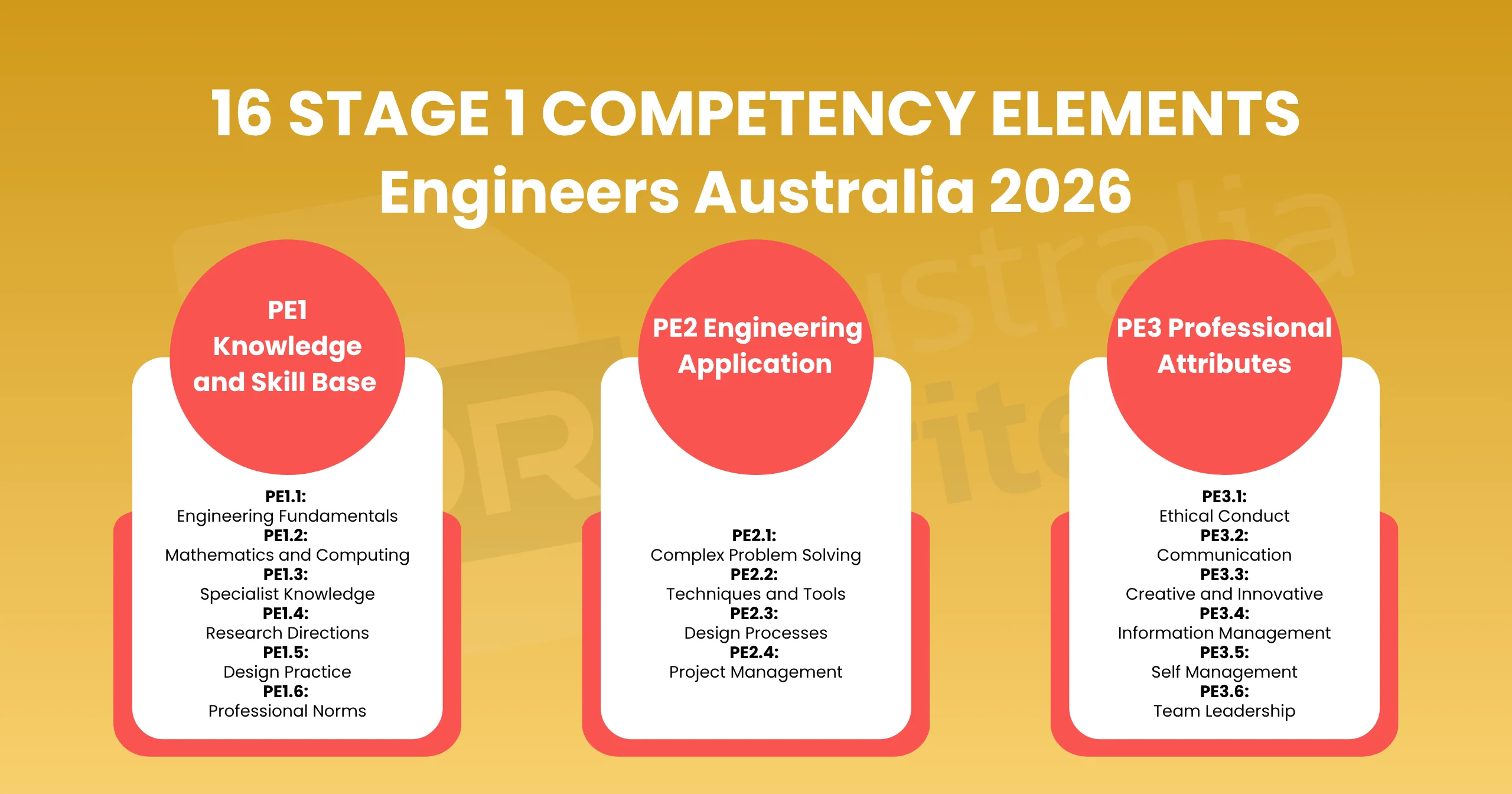
Stage 1 competency is organised across three categories and 16 elements.
Category | Elements | What Assessors Look For |
PE1: Knowledge and Skill Base | PE1.1 to PE1.6 – 6 elements | In-depth understanding of engineering fundamentals, specialist bodies of knowledge, mathematical and computational sciences, design practice, contextual factors, and norms of professional practice |
PE2: Engineering Application Ability | PE2.1 to PE2.4 – 4 elements | Application of established engineering methods to complex problems, fluent use of engineering techniques and tools, application of design processes, and management of engineering projects |
PE3: Professional and Personal Attributes | PE3.1 to PE3.6 – 6 elements | Ethical conduct, effective communication in professional and lay domains, creative and innovative approach, professional use of information, orderly self-management, and effective team membership and leadership |
Every element must be mapped to at least one specific paragraph in your Career Episodes in theSummary Statement. A blank element alone causes a negative outcome. The mapping does not have to be exhaustive, but every element must have evidence.
Stage 1 Competency Assessment Documents
- Three Career Episodes of 1,000 to 2,500 words each, written in first person singular with numbered paragraphs.
- Summary Statement mapping each numbered paragraph to the 16 PE1, PE2, and PE3 elements.
- CPD record in tabular format covering a minimum of 3 years, maximum one A4 page.
- CV of maximum 3 A4 pages verified by a current Engineers Australia member or fellow.
- Academic transcripts and degree certificate with authorised English translations where required.
Have Any Question?
CDR Australia Writer specialises in high-quality CDR, RPL and VETASSESS reports for engineers. CDR Australia Writer offer low-cost, customized and reliable services in diverse engineering disciplines.
- +61 485 981 327
- [email protected]
Stage 2 Competency Assessment for CPEng and NER
Stage 2 competency assessment is the standard applied by Engineers Australia for engineers applying for Chartered Professional Engineer (CPEng) status or inclusion on theNational Engineering Register (NER). It confirms that an engineer has maintained current, active engineering competency at a level sufficient for autonomous professional practice.
Who Needs Stage 2 Competency Assessment
Engineers who hold MIEAust membership and have at least 5 years of post-qualification engineering experience at a professional level are eligible for Stage 2 assessment. Stage 2 is the gateway to CPEng, which in turn is required for NER registration and for state-based engineering registration such as RPEQ in Queensland.
Stage 2 Assessment Options
Option | Who It Suits | Key Requirements |
Experienced Assessment Pathway | Engineers with significant experience who can demonstrate current, autonomous practice | Expanded CV, self-assessment form, referee reports, and evidence of current competency in a nominated area of practice |
Professional Development Program (PDP) | Engineers with 4 plus years of experience who are working towardCPEng readiness | Structured development plan, supervisor agreement, competency demonstrations over 2 to 4 years, peer review |
Senior Experienced Assessment | Senior engineers at principal or director level | Portfolio of leadership, technical contribution, and professional impact evidence across career |
Provisional CPEng | Engineers who nearly meet all criteria but need structured support | Mentoring arrangement, specific competency gaps addressed over defined period |
P.Eng Licensing in Canada: CBA Framework and Requirements
Canadian provincial engineering regulators use a Competency-Based Assessment (CBA) framework for P.Eng licensing that parallels the Engineers Australia Stage 1 process in structure but differs in the number of competency indicators, the SAO narrative format, and the Canadian experience requirements. The CBA is now the standard across PEO Ontario, APEGA Alberta, EGBC British Columbia, and most other provincial associations.
Engineers AustraliaStage 1 competency assessment does not transfer directly to Canadian P.Eng licensing. Each provincial regulator in Canada runs its own independent assessment against its own competency framework. Engineers who hold a positive Engineers Australia Migration Skills Assessment still need to complete a full provincial CBA to obtain a P.Eng licence in Canada.
Item | Engineers Australia Stage 1 | P.Eng CBA Canada |
Primary purpose | Migration Skills Assessment for Australian skilled migration visa | Provincial engineering licence for professional practice in Canada |
Competency framework | 16 elements across PE1, PE2, PE3 | 25 to 35 competency indicators varying by province |
Document format | Career Episodes, Summary Statement, CPD | SAO (Situation, Action, Outcome) narrative entries |
Regulator | Engineers Australia (national) | Provincial bodies: PEO, APEGA, EGBC, APEGS and others |
Experience minimum | No fixed minimum – CDR quality determines outcome | 2 to 4 years depending on province and graduation type |
Outcome | Positive or Negative Migration Skills Assessment | P.Eng licence granted or assessment for resubmission |
How CDR Australia Writer Prepares Your Engineering Evidence
CDR Australia Writer preparescompetency assessment documentation for engineers across both the Australian and Canadian frameworks. Our services cover Stage 1 Career Episodes and Summary Statements for Engineers Australia migration, Stage 2 assessment portfolios and expanded CVs for CPEng and NER applications, and P.Eng CBA SAO narratives for PEO, APEGA, and EGBC applications in Canada.
Every document is written by a practising engineer who understands the specific competency framework being assessed, the occupational category being demonstrated, and the evidence standards the assessor is applying. Zero plagiarism, zero AI generation, 100% genuine project-based content.
Get your competency assessment documentation right the first time. Contact CDR Australia Writer today.
Get our free consultation
Do you have a question?
Get our free consultation with specialist and experienced counsellors. Explore our CDR writing packages immediately and receive 100% plagiarism free CDR report
Contact us right now! and Get your CDR report ready for approval.

Do you have a question?
We have mentioned common questions asked by our clients regarding CDR report, ACS RPL report, KA02 report, and skill assessment process.
A structured, evidence-based evaluation of an engineer’s ability to apply engineering knowledge and judgment at a professional standard. In Australia, Engineers Australia applies Stage 1 competency assessment to CDR submissions for migration and Stage 2 for CPEng and NER. In Canada, provincial bodies apply a Competency-Based Assessment (CBA) for P.Eng licensing.
Stage 1 confirms graduate-level competency for entry into professional practice, required for Engineers Australia migration skills assessment.Stage 2 confirms autonomous, current, practising-level competency, required for CPEng and NER registration. Stage 1 is the starting point; Stage 2 is the career milestone.
16 Stage 1 elements across PE1 (6 elements), PE2 (4 elements), and PE3 (6 elements). Every element must be demonstrated in at least one Career Episode and mapped in the Summary Statement. A blank element alone produces a negative outcome.
No. A positive Engineers Australia Stage 1 assessment confirms your qualification is equivalent for Australian migration purposes. Canadian provincial regulators conduct their own independent competency assessments for P.Eng licensing. The two frameworks are separate processes.
Stage 1 CDR assessment takes 10 to 16 weeks standard processing from a complete application. Fast-track costs an additional AUD 385 and assigns an assessor within 20 business days. Stage 2 CPEng assessment timelines vary by pathway and are confirmed directly with Engineers Australia.