

Engineering Project Arrangement: Get It Right in Your CDR
Engineering Project Arrangement is an important part of preparing engineering documentation when a project needs to be selected, organised, and presented clearly for a Competency Demonstration Report (CDR). A well-arranged project gives an engineer a practical foundation for explaining their technical work, personal contribution, engineering decisions, problem-solving process, and project outcomes.
If you are preparing a report for Engineers Australia, preparing a CDR for Engineers Australia, choosing and presenting a suitable engineering project requires more than simply describing a project. Engineers Australia states that each Career Episode should be based on a project or piece of work and should explain the project and the applicant’s own role in it.
What Is Engineering Project Arrangement?
Engineering Project Arrangement is the process of organising an engineering project so that its purpose, activities, technical challenges, responsibilities, methods, and results can be explained logically.
The project may come from professional employment, an internship, university study, research, or another genuine engineering activity. For applicants with limited professional experience, Engineers Australia also allows relevant academic projects to be used. If a project was completed as part of a group, then the applicant needs to explain what their individual contribution was rather than just describing the entire team’s work as their own.
A properly arranged project should make it easy to answer questions such as:
- What was the project about?
- What was the main objective of the project you worked for?
- What was my role in the project?
- What engineering problem did I investigate?
- What methods or principles did I use in the project?
- Why did I choose those methods?
- What solution did I develop?
- What was the result?
- What did I learn from the project?
The purpose is not to make a project sound more complicated than it really was. Instead, the project should provide enough genuine engineering detail to demonstrate how knowledge and skills were applied.
Get free consultation
Engineering Project Planning: Where Should You Start?
Engineering Project Planning begins with understanding the project before you attempt to write about it. You should then first start by collecting basic information about your project such as the project title, duration, location, organisation or university, project objectives, and your specific responsibilities.
Engineers Australia currently asks applicants to include the title of the engineering activity or project, dates, geographical location, and employer or company at the beginning of each Career Episode. Academic projects should also include relevant supervisor and subject information.
A useful planning structure is:
- Project background: Explain why the project was undertaken.
- Project objective: State what the project was intended to achieve.
- Your role:Clearly identify the work you personally performed in the project.
- Engineering problem:Explain what are the main technical issues or challenges that occurred.
- Investigation:Describe how you collected and analysed information.
- Engineering approach:Explain all the principles, methods, tools, or techniques you applied.
- Solution:Describe all the solutions that you developed or recommended.
- Outcome: Explain what happened as a result of your work.
- Learning: Identify relevant knowledge or skills gained.
Good Engineering Project Planning also helps prevent a common CDR problem: spending too much space describing the company, project background, or general theory while giving too little attention to personal engineering activity.
Your planning should therefore focus on what you actually did. Engineers Australia specifically emphasises explaining personal engineering work and using the first person in Career Episodes.
Project Selection for CDR:
Choosing the Right Engineering Project
Project Selection for CDR should focus on choosing a project that genuinely reflects your engineering knowledge and experience. The project does not have to be large or highly complex. Even a project that you have done in university or workplace can work well if you can clearly explain your own engineering contribution.
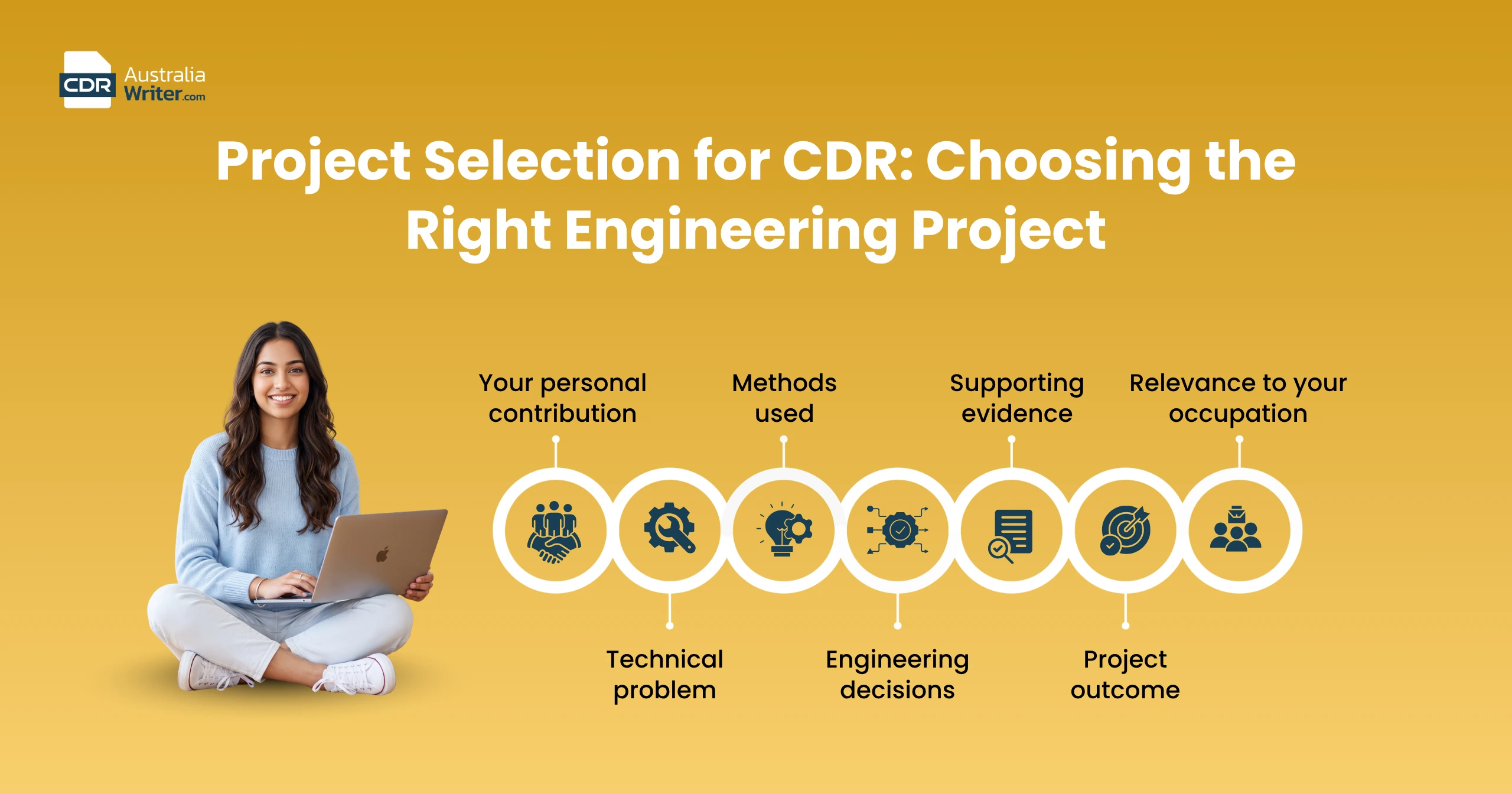
When choosing a project, you should consider these following points:
1. Your personal contribution:
You should choose a project where you perform different meaningful engineering tasks rather than just only participating as a team member.
2. Technical problem:
You need to make sure you can clearly explain what the engineering problem or challenge you worked on.
3. Methods used:
You should be able to describe the engineering methods, tools, calculations, or techniques you applied.
4. Engineering decisions:
Choose a project where you can properly explain what are the decisions that you made and why you selected a particular approach.
5. Supporting evidence:
Check whether you have relevant calculations, drawings, designs, data, reports, or other project information to support your explanation.
6. Project outcome:
You should be able to explain the result of your work and how your solution addressed the problem.
7. Relevance to your occupation:
The project should relate to your nominated engineering occupation and help demonstrate relevant engineering competencies.
Engineers Australia expects Career Episodes to focus on your personal engineering activities and demonstrate the required competency elements across the three episodes. All 16 competency elements must be demonstrated at least once across the three Career Episodes.
Therefore, Project Selection for CDR should not be based only on how impressive a project sounds. Choose projects that give you enough genuine engineering experience to demonstrate your knowledge, analysis, problem-solving, decision-making, and technical skills clearly.
Engineering Project Planning and Technical Evidence
Engineering Project Planning should also consider what evidence is available to support the project description.
Engineers Australia identifies diagrams, calculations, designs, data, and similar engineering evidence as useful supporting material for Career Episodes.
Depending on the project, relevant evidence that the project may include:
- Engineering calculations
- Design drawings
- Technical diagrams
- Project specifications
- Data analysis
- Simulation results
- Testing results
- Software outputs
- Tables and measurements
- Academic project reports
- Relevant standards or technical references
However, evidence should support the explanation rather than replace it. Simply inserting a complicated calculation or technical drawing does not demonstrate competency unless you explain what it represents, why it was required, and how you used the result.
The same principle applies to software. Mentioning software such as AutoCAD, MATLAB, SolidWorks, Civil 3D, ETABS, or other engineering tools is not enough. Explain how you used the tool and how the output influenced your engineering work.
What a CDR Career Episode Expects From Your Project Setup
A CDR career episode is a focused story about one period or piece of your engineering work. Engineers Australia asks for three, and each one has to show what you personally did rather than what your team or company achieved. The assessor reads with a simple question in mind: does this person’s role match the competencies of the occupation they are claiming?
To answer that, the assessor needs context. Was this a two-person design job or a large infrastructure build? Were you leading the work, or a junior engineer taking direction from a senior? Your description of the setup answers those questions before anyone has to guess.
Episodes usually follow four parts: introduction, background, personal engineering activity and summary. Most of the setup detail belongs in the background. Word guidelines can change between versions, so check the current Migration Skills Assessment booklet before you start drafting.
Career Episode Background: What to Include
The career episode background is where your project setup lives. The usual guidance for this section asks you to explain the nature and objectives of the overall project, describe your work area and duties, and provide an organisation chart that highlights your position. In practice, that means covering:
- Project name, location and duration
- The client and the purpose of the project
- The full scope, and the portion you were responsible for
- Team size and reporting lines
- Your job title and main duties
Think of these points as your engineering project arrangement in a nutshell: the who, what, where and how of the job, written so a stranger can follow it in about a minute. Keep the career episode background factual and lean. Calculations, problem-solving and design decisions can wait for later sections, where they actually earn marks.
Have Any Question?
CDR Australia Writer specialises in high-quality CDR, RPL and VETASSESS reports for engineers. CDR Australia Writer offer low-cost, customized and reliable services in diverse engineering disciplines.
- +61 485 981 327
- [email protected]
Things to Avoid in Engineering Project Arrangement
When preparing an engineering project for CDR documentation, avoid:
- Choosing a project simply because it sounds impressive.
- Claiming responsibilities you did not personally perform.
- Copying another applicant’s Career Episode.
- Using generic descriptions without technical evidence.
- Writing the entire project from a team perspective.
- Adding unnecessary technical theory.
- Including confidential company information.
- Inventing calculations, results, or project outcomes.
- Focusing only on the final result and ignoring the process.
- Treating keyword usage as more important than factual accuracy.
Your documentation should remain truthful, personal, and based on your own engineering experience.
What You Should Know
A good Engineering Project Arrangement is not about making a project appear bigger or more technical than it was. It is about organising a genuine engineering experience so that the reader can clearly understand the project, your personal role, the problem you addressed, the engineering methods you used, the decisions you made, and the outcome.
For a CDR, the strongest project is generally one that gives you enough genuine engineering activity to explain your competencies clearly. Engineers Australia’s current guidance places particular emphasis on the engineering activity undertaken, personal contribution, project details, problem-solving, engineering methods, and supporting evidence.
If you are unsure which project to use, compare your available academic or professional projects against these factors before starting the Career Episode. A clear project structure at the beginning can make the writing process much easier later.
Get our free consultation
Do you have a question?
Get our free consultation with specialist and experienced counsellors. Explore our CDR writing packages immediately and receive 100% plagiarism free CDR report
Contact us right now! and Get your CDR report ready for approval.

Do you have a question?
We have mentioned common questions asked by our clients regarding CDR report, ACS RPL report, KA02 report, and skill assessment process.
Engineering Project Arrangement is the process of selecting, organising, and structuring an engineering project so its objectives, technical activities, personal responsibilities, engineering decisions, and outcomes can be clearly explained.
Mostly in the background section. You can refer back to it in the personal engineering activity section when it helps explain a decision.
Engineers Australia currently states that each Career Episode should be between 1,000 and 2,500 words.
Yes, but use role titles instead of names, then leave out sensitive data, and also check with your employer if you are unsure.
Yes, where appropriate. However, you should clearly distinguish your personal contribution from the work performed by other team members.
Only briefly, for context. The assessor wants to know what you did, so use “I” for your work.