

AACA Overseas Qualification Assessment (OQA):
A Complete Guide for Architects
Overseas Qualification Assessment is the pathway provided by the Architects Accreditation Council of Australia (AACA) for assessing eligible overseas architectural qualifications. If you have completed your architecture qualification outside Australia and want to work towards becoming an architect or plan to migrate to Australia as an architect, then your overseas qualification may need to be assessed.
AACA uses this assessment in order to determine whether an overseas academic qualification is comparable to a current Australian accredited qualification in architecture. The assessment also considers whether an applicant can demonstrate whether their competencies are expected under the 2021 National Standard of Competency for Architects (NSCA). It is important to understand that this is not just simply a check of your university degree. The process can involve qualification assessment, a portfolio, competency statements and a Competency Assessment Interview.
What Is the Overseas Qualification Assessment?
Overseas Qualification Assessment is an assessment program for people who hold eligible architectural qualifications awarded outside Australia. AACA assesses qualifications obtained through coursework where the qualification allows a graduate to proceed towards architect registration in the country where it was awarded.
In March 2022, the previous Stage 1 and Stage 2 structure was changed for new applicants. New applicants complete the relevant qualification and competency components through one comprehensive application. Applicants who had already successfully completed Stage 1 before March 2022 may have a separate Stage 2 pathway.
The assessment is therefore designed to look beyond the name of a degree. AACA wants evidence that your education and professional capabilities align with the competencies expected of architects in Australia.
Get free consultation
Who Needs an Overseas Qualification Assessment?
Overseas qualification assessment for architecture is generally relevant to applicants whose architectural qualification was awarded outside Australia and who need AACA to assess that qualification. The pathway can be relevant for two major purposes:
Architect registration:
A suitable OQA outcome can provide a pathway towards the Architectural Practice Examination (APE), subject to the relevant eligibility requirements. The APE and subsequent registration are separate steps.
Skilled migration:
Applicants who successfully complete the required OQA assessment can receive a Skilled Migration Assessment for the occupation Architect when requested for migration purposes. AACA currently identifies Architect under OSCA code 241131, previously ANZSCO 232111.
However, not every overseas-qualified architect automatically needs OQA. For example, applicants with an accredited architecture qualification from Australia, New Zealand, Hong Kong or Singapore may have access to AACA’s separate verification pathway, depending on their circumstances.
How Does the AACA OQA Assessment Process Work?
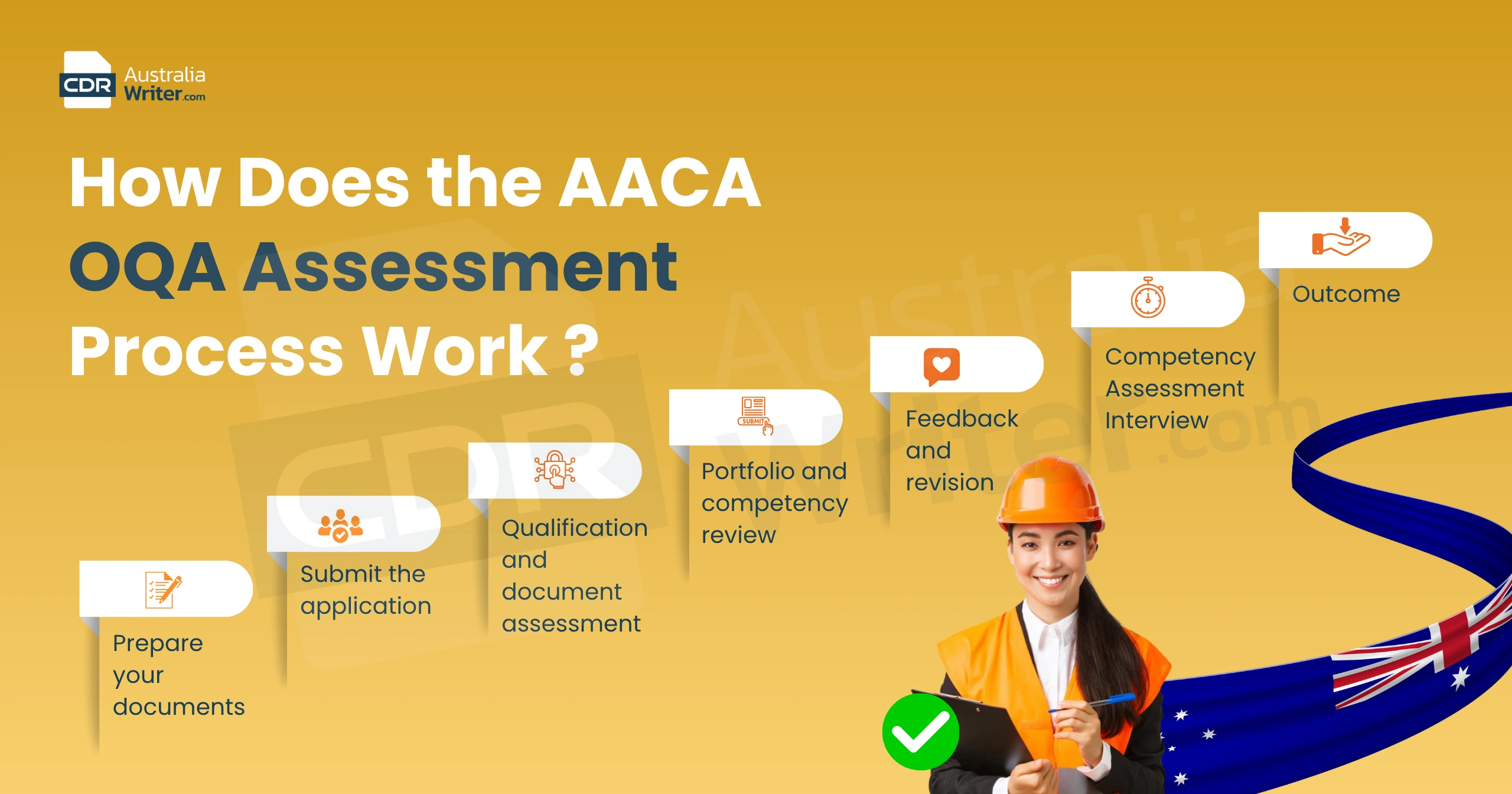
The AACA overseas qualification assessment process involves several important stages, which are as follows:
1. Prepare your documents
Start by reviewing the current AACA OQA guide and focus on determining which evidence applies to your circumstances.
2. Submit the application
The application and supporting documentation are submitted through the relevant AACA application process. The required fee that is mentioned must also be paid.
3. Qualification and document assessment
AACA reviews your submitted information and helps to determine whether the qualification and supporting evidence can satisfy the OQA requirements of the assessment.
4. Portfolio and competency review
Applicants provide their architectural projects and written competency statements. The evidence should demonstrate how their education and professional experience relate to the NSCA competencies.
5. Feedback and revision
AACA states that applicants receive one feedback opportunity before proceeding to the Competency Assessment Interview. Applicants may need to revise and resubmit documents within the specified timeframe.
6. Competency Assessment Interview
The interview gives applicants an opportunity to demonstrate their knowledge, skills and understanding of architectural practice.
7. Outcome
A suitable outcome can support progression towards the APE and, where requested and applicable, provide a Skilled Migration Assessment for migration purposes. An unsuccessful outcome explains areas where the applicant was considered deficient and may include recommendations for upgrading competencies.
AACA OQA Requirements Eligibility
Before starting an AACA Overseas Qualification Assessment application, applicants should carefully check the current eligibility OQA requirements and applicant guide.
AACA only assesses eligible architectural qualifications obtained through coursework. The qualification must be one that permits a graduate to proceed towards registration as an architect in the country where the qualification was awarded.
This is particularly important for internationally qualified applicants because having a degree with “Architecture” in its title does not automatically mean it will meet AACA’s requirements.
AACA also considers applications on a case-by-case basis. It does not provide a definitive assessment of whether an individual qualification will be accepted before receiving a complete application, supporting documentation and the required fee.
Applicants should therefore avoid relying only on what happened to another graduate from the same university. Your qualification, documents, professional evidence and competency demonstration are assessed as part of your own application.
Documents Required for the OQA Assessment
Preparing the documentation correctly is one of the most important parts of an Overseas Qualification Assessment.
Applicants should follow the latest AACA applicant guide and submission checklist because document requirements can change. Depending on the application, evidence may include academic qualification documents, academic transcripts, identity documents, evidence relating to professional experience, English-language evidence where required, and other supporting material.
The portfolio is particularly important for the competency component. AACA requires a portfolio containing three to four architectural projects, together with written summary statements addressing the relevant NSCA competencies. A Competency Assessment Interview is also part of the process.
AACA states that applications must be complete when submitted. Applicants should not assume that they can simply lodge an incomplete application and send important documents later.
This is why applicants should review every document before submission, check formatting requirements and make sure names and information are consistent across their evidence.
How Long Does the Assessment Take?
According to AACA, applications are generally finalised within approximately 7 weeks from lodgement when the required documentation is complete. Where documentation is incomplete, assessment may generally take around 12 weeks from lodgement. These timeframes do not include scheduling of the Competency Assessment Interview and may increase during peak periods or holiday shutdowns.
Applicants should therefore avoid planning their migration or registration timeline around the minimum estimated processing period.
AACA no longer offers a standard priority processing service for an additional fee. However, documented extenuating circumstances may be considered for expedited processing at no additional cost.
Have Any Question?
CDR Australia Writer specialises in high-quality CDR, RPL and VETASSESS reports for engineers. CDR Australia Writer offer low-cost, customized and reliable services in diverse engineering disciplines.
- +61 485 981 327
- [email protected]
What Happens After a Successful OQA Assessment?
A successful Overseas Qualification Assessment can open the next stage of the professional pathway, but it does not by itself make someone a registered architect in Australia.
For registration, a suitable OQA assessment outcome can make an applicant eligible to apply for the APE, subject to the relevant eligibility OQA requirements, including practical experience requirements. The APE consists of further assessment steps before registration with the relevant state or territory Architect Registration Board.
For migration, a suitable Skilled Migration Assessmentmay be used as evidence of the required skills assessment when applying through an applicable skilled migration pathway. Visa eligibility itself is determined under Australian migration law and by the Department of Home Affairs.
This distinction matters because qualification assessment, skills assessment, professional registration and visa approval are related but separate processes.
Common Mistakes to Avoid
When preparing an AACA OQA application, there are several mistakes that can create unnecessary problems.
Submitting incomplete documents:
AACA requires applications to have complete documents at submission. Because missing any of the evidence can result in a delay in assessment.
Using an unsuitable portfolio:
Your projects should provide meaningful evidence of your architectural knowledge and competency rather than just simply showcasing attractive designs.
Ignoring the NSCA competencies:
Your written statements should clearly mention what your experience and project evidence were and whether it connects with the relevant competency requirements.
Submitting too many projects:
AACA states that the portfolio can contain a maximum of four projects.
Treating the assessment as only a degree check:
OQA also involves different documents such as competency demonstration, including portfolio evidence and an interview.
Assuming another applicant's result guarantees yours:
AACA assesses applications individually and does not confirm eligibility based on another person’s experience.
Confusing migration with registration:
A positive migration assessment does not automatically give you the right to use the title “Architect” or practise as a registered architect in Australia.
What You Need to Know
The AACA skills assessment process can be an important step for overseas-qualified architects planning a professional or migration pathway in Australia. The key is to understand that OQA is more than a qualification check. Applicants need to present their proper academic background, architectural projects, and competency evidence in a way that helps to demonstrate alignment with the Australian professional standard.
Before applying, always check the latest AACA applicant guide, document requirements, fees and processing information. Careful preparation can help you avoid preventable delays and give your application a much clearer foundation.
For applicants who have a complex academic or professional history, getting qualified guidance before submission may also help them identify documentation gaps and improve the overall presentation of the application.
Get our free consultation
Do you have a question?
Get our free consultation with specialist and experienced counsellors. Explore our CDR writing packages immediately and receive 100% plagiarism free CDR report
Contact us right now! and Get your CDR report ready for approval.

Do you have a question?
We have mentioned common questions asked by our clients regarding CDR report, ACS RPL report, KA02 report, and skill assessment process.
Timelines vary by individual case since AACA assesses applications case-by-case, factoring in document review, one round of feedback, and scheduling the competency interview.
You can complete AACA’s specified additional study, then resubmit evidence. If approved, an amended outcome letter is issued without additional cost. You can also appeal the decision.
No, the appropriate pathway depends on the qualification and the applicant’s circumstances. Some accredited qualifications from Australia, New Zealand, Hong Kong or Singapore may use AACA’s verification pathway instead.
Yes, A suitable OQA outcome can be accompanied by a Skilled Migration Assessment when requested for the purpose of migration under the applicable skilled migration program.
No, a successful assessment can provide a pathway towards the APE, but registration is a separate process handled through the relevant state or territory Architect Registration Board.
Only if your qualification isn’t on AACA’s accredited program list. Accredited programs from these countries instead use the Verification of Australian Qualification pathway.