

Portfolio Assessment: Your Complete Guide to Success
Portfolio Assessment is likely the single most important step in your journey. If you are an overseas-qualified architect who is planning to migrate to Australia or work toward architectural registration, then the Portfolio Assessment can be an essential part of the Overseas Qualifications Assessment (OQA). Unlike many other skills assessment processes that rely purely on document verification, the Architects Accreditation Council of Australia (AACA) wants to see what is the real evidence of your design and technical ability. Also, all that evidence comes through your portfolio.
A strong portfolio is not just simply a collection of attractive architectural drawings. It needs to demonstrate your architectural knowledge, professional skills and ability to meet the relevant requirements of the 2021 National Standard of Competency for Architects (NSCA). This is why project selection, documentation and the way you explain your contribution matter so much.

What Is the AACA Portfolio Assessment?
The AACA Portfolio Assessment forms part of the competency assessment for applicants undertaking the OQA which is designed for eligible applicants with overseas architectural qualifications and assesses both their qualification and competency against the Australian standard.
Applicants are required to submit three to four architectural projects as part of their portfolio. AACA states that one complex project must be included. A final architectural thesis or similar academic project is recommended because it can provide useful material for discussion during the Competency Assessment Interview.
The purpose of this is not just to determine whether your projects look impressive. Instead, the assessment looks at whether your education and experience have helped you develop competencies relevant to architectural practice in Australia.
Your portfolio should therefore tell a clear story:
- What was the project?
- What was your role?
- What decisions did you make?
- What architectural knowledge did you apply for?
- What are the problems that you identified and solved during the assessment?
- How did you contribute to the project?
- Which NSCA performance criteria can your work demonstrate?
This makes the portfolio both a visual presentation and an evidence-based explanation of your architectural competency.
Get free consultation
Who Needs to Complete This Assessment?
If you qualify as an architect outside Australia and want to work or register as an architect here, you’ll generally need to go through AACA’s Overseas Qualifications Assessment (OQA) pathway, which includes the portfolio component. This applies whether you’re applying from overseas or already living in Australia. The assessment also feeds into the broader skills assessment required for certain skilled migration visa categories, so getting it right matters both professionally and for your visa application.
How to Prepare an AACA OQA Portfolio
Portfolio Assessment requires preparing an AACA OQA Portfolio more than putting drawings into a PDF. Your projects should be organised so an assessor can quickly understand the project, your responsibilities and the evidence supporting your competency. Start by choosing your projects based on evidence.
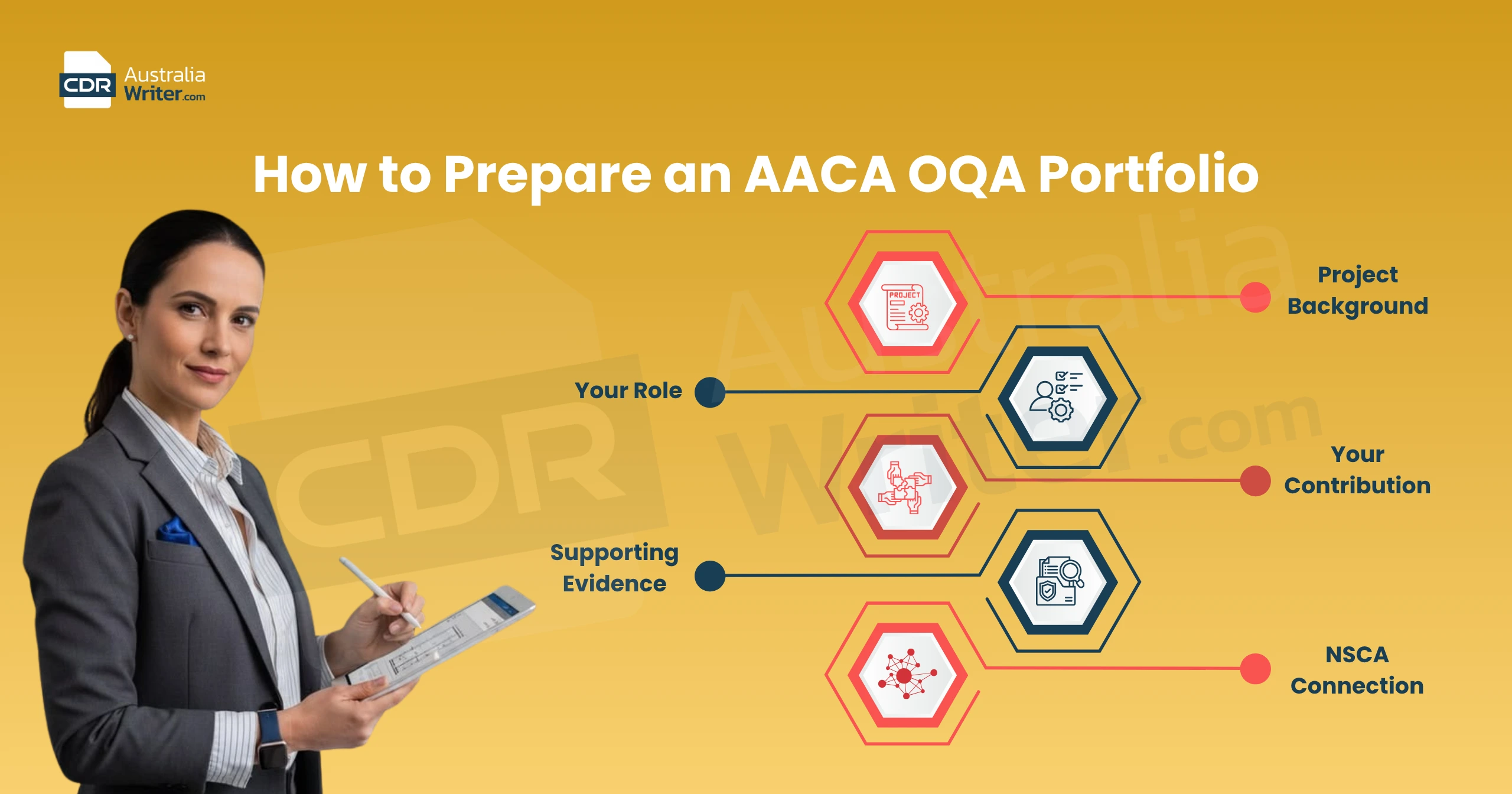
For each of the project, it is necessary to identify:
1. Project background
You need to briefly explain your project type, with its location, purpose, scale, and stage of development.
2. Your role
You have to clearly explain whether you were responsible for the concept development, documentation, coordination, site work, design development or other tasks.
3. Your contribution
Explain the decisions you personally made and the problems you helped solve.
4. Supporting evidence
Use appropriate plans, sections, elevations, diagrams, sketches, details, photographs or other project material to support your explanation.
5. NSCA connection
Connect your project evidence to the relevant NSCA performance criteria rather than simply listing criteria without explanation.
The 2021 NSCA identifies the skills, knowledge and capabilities expected in architectural practice and is used as the framework for AACA assessment programs. It includes professional capabilities, competency profiles, units of competency and performance criteria. A good portfolio should therefore make the connection between project evidence and competency easy to understand.
Avoid filling pages with drawings without explaining why they matter. Assessors need evidence of your understanding and application of architectural knowledge, not just visual presentation.
AACA Portfolio Requirements You Need to Know
For Portfolio Assessment, understanding the AACA Portfolio Requirements before selecting projects can save considerable time later. AACA currently requires a portfolio containing between three and four architectural projects for the OQA competency assessment. More than four projects are generally not accepted for AACA.
The projects should provide enough evidence to demonstrate your competency across the relevant NSCA criteria. AACA also requires written NSCA Summary Statements addressing the specified topic areas and relevant performance criteria. These statements need to be supported by drawings, sketches or other documentation connected to the projects in your portfolio.
A useful portfolio may include a combination of:
- A complex architectural project
- A final-year or thesis project
- A substantial professional project
- Another project that provides evidence for competency areas not adequately demonstrated elsewhere
Your project selection should be strategic rather than based only on the project’s size or visual quality. The important question is: Does this project help demonstrate the competencies AACA needs to assess?
You should also clearly distinguish your own contribution from the work completed by your team. If you worked within a larger architectural practice, explain what you personally did rather than presenting the entire project as your individual work.
Choosing Projects for Architecture Portfolio Assessment Australia
When preparing for Architecture Portfolio Assessment Australia, project selection deserves careful attention because you have a limited number of projects to demonstrate your competency.
AACA recommends including one complex project. It also helps to recommend including a student project such as a final design thesis, although applicants can submit their professional projects only.
Consider the following when comparing potential projects:
Project factor | Why it matters |
Complexity | Gives you opportunities to demonstrate broader architectural knowledge |
Your personal involvement | Helps establish what you actually contributed |
Technical content | Can support evidence beyond conceptual design |
Project development | Shows how ideas progressed into architectural solutions |
Professional experience | Can demonstrate application of knowledge in practice |
Documentation | Provides tangible evidence for competency statements |
Variety | Helps cover different competency areas across the portfolio |
Do not select a project simply because it has the best renderings. A project with clear evidence of your decision-making may be much more useful than a visually impressive project where your role was limited.
If you worked on a project as part of a team, be transparent. Explain your responsibilities and distinguish your work from the contributions of other architects, consultants or designers for Architecture Portfolio Assessment.
How to Build a Strong AACA Portfolio Assessment Submission
A strong AACA Portfolio Assessment submission goes beyond attractive drawings. Assessors are specifically looking for evidence mapped against the NSCA elements, so your written statements matter just as much as your visuals.Here is what tends to separate successful submissions from unsuccessful ones:
Map every project to specific competency elements:
Do not assume that an assessor will infer your skills from images alone. You need to explicitly connect your work to the NSCA criteria in your written statements for the assessment.
Choose projects that show range:
A mix of different types of project and scales like: residential, commercial, institutional helps to demonstrate that you have a broader capability than four similar projects.
Be honest about your role:
List all the activities which are supposed to be undertaken during the program. Depending on the occup
If you have worked within a team, then you need to clearly state what work you were personally responsible for. Because overstating your contribution in the company can be a common reason for “Not Suitable” outcomes.
ation, these activities may involve:
- Supervised practical activities
- Technical workshops
- Workplace observation
- Mentoring sessions
- Project participation
- Professional development sessions
- Technical documentation
- Performance reviews
- Industry-specific training
The above listed activities should match with the stated objectives.
Keep it concise and well-structured:
So, arranging your portfolio with proper, clear headings, detailed labelled drawings, and a logical flow can help you make your portfolio easier to evaluate fairly.
Use professional guidance where needed:
Many applicants work with migration or architecture documentation specialists to ensure their Portfolio Assessment meets the exact format and competency-mapping expectations AACA requires.
Have Any Question?
CDR Australia Writer specialises in high-quality CDR, RPL and VETASSESS reports for engineers. CDR Australia Writer offer low-cost, customized and reliable services in diverse engineering disciplines.
- +61 485 981 327
- [email protected]
Competency Assessment Interview
The portfolio is only one part of the competency assessment. Applicants also participate in a Competency Assessment Interview. AACA states that the assessment includes the project portfolio, written summary statements addressing the NSCA and the interview.
The interview means you should know your portfolio thoroughly. You may need to explain:
- Why you selected a particular design approach
- What your personal contribution was
- How you responded to project constraints
- How technical decisions were developed
- How you worked with other professionals
- What challenges occurred during the project
- What you learned from the experience
Do not prepare your portfolio and interview as two completely separate tasks. Your portfolio should become the foundation for your interview preparation. AACA may provide feedback on submitted documents and may request further information or revisions before the interview.
Things to Avoid in Your Portfolio Assessment
- Don’t submit generic project descriptions. Vague statements that don’t reference specific NSCA elements can make your case significantly weak.
- You don’t need to overload your portfolio with too many projects. You have to just stick to the required number and go deeper rather than going wider.
- It is recommended to not ignore formatting guidelines. Exceeding page limits or submitting disorganised layouts can create a poor impression before assessors even read the content.
- Don’t treat the interview as optional preparation. Walking into the Competency Assessment Interview without rehearsing your project explanations is one of the most common and avoidable mistakes.
- Don’t wait until the last minute. The portfolio takes genuine time to prepare properly because rushed submissions tend to lack the depth assessors are looking for.
Making Your Application Stronger
A successful AACA portfolio is not about showing the largest number of drawings or the most beautiful projects. It is about presenting clear, credible and relevant evidence of architectural competency.
For applicants who are using the OQA pathway, the portfolio for them should contain three to four carefully selected projects, which includes a complex project, supported by NSCA Summary Statements and relevant project evidence. The best approach for them is to select projects strategically, explain what were your personal contributions honestly, connect evidence to the 2021 NSCA and prepare thoroughly for the Competency Assessment Interview.
Remember that AACA assesses applications individually, so applicants should always check the latest AACA guides, templates and submit AACA Portfolio requirements before preparing or lodging an application.
Get our free consultation
Do you have a question?
Get our free consultation with specialist and experienced counsellors. Explore our CDR writing packages immediately and receive 100% plagiarism free CDR report
Contact us right now! and Get your CDR report ready for approval.

Do you have a question?
We have mentioned common questions asked by our clients regarding CDR report, ACS RPL report, KA02 report, and skill assessment process.
Typically three to four architectural projects are required, though applicants should always confirm current AACA Portfolio requirements directly with AACA.
Not necessarily. AACA recommends including a student project, such as a final architectural design thesis, because it can provide useful material for the Competency Assessment Interview. However, professional projects can also be submitted.
Yes, many applicants include a mix of academic and professional projects, as long as each one clearly demonstrates the required NSCA competencies.
You’ll receive feedback on deficiencies and generally have the opportunity to address them and resubmit evidence rather than reapplying from the beginning.
No, The competency assessment also includes written NSCA Summary Statements and a Competency Assessment Interview.
Yes, AACA states that one complex project must be included in the OQA portfolio.