

Competency Assessment for Migration
Are you planning a move to Australia on a skilled visa? A competency assessment for migration is considered as the very first hurdle that you will face and it is that one assessment that can make or break your entire application before you even get to the visa stage. If you’re an engineer, IT professional, tradesperson, or nurse hoping to build a life in Australia, understanding this assessment process properly will help you save months of delay and provide you with a fair amount of money.
For engineers, Engineers Australia is the authority that is authorised by the Australian Government to assess qualifications, skills and experience for migration purposes. A successful migration skills assessment provides an outcome letter that can be used as part of your visa application process. The exact assessment pathway depends on factors such as your qualification, i.e:
- where you studied,
- whether your program is accredited, and
- the engineering occupation you want to nominate.
Knowing this in the beginning helps you put together stronger documents from day one, instead of scrambling to fix gaps later.

What Is a Competency Assessment for Migration?
For Migration, Competency Assessment is an independent check carried out by a designated authority of Australia to confirm that your qualifications and work experience genuinely match with the Australian standards for your nominated occupation. The Department of Home Affairs doesn’t assess your skills directly, instead it relies on these following authorities to do that job first.
Each occupation has its own assessing body:
- Engineers Australia: engineers that include civil, mechanical, electrical, structural, and many more.
- ACS (Australian Computer Society): IT and software professionals
- VETASSESS: a broad range of professional occupations not covered elsewhere
- TRA (Trades Recognition Australia): trades such as electricians, chefs, and mechanics
- ANMAC: nurses and midwives
- CPA Australia / CA ANZ: accountants
Without a positive result from these above relevant bodies, you simply cannot just lodge an Expression of Interest (EOI) for the major points-tested visas, i.e. subclasses 189, 190, and 491.
Why This Step Matters More Than People Realise
A lot of applicants treat the competency assessment for migration as just a paperwork formality, which it isn’t. The outcome of this assessment directly affects:
Visa eligibility
There will be no positive assessment and also the application can be considered as invalid.
Points score
The assessing bodies often deduct years of experience that don’t meet their criteria, which can lower your points tally.

Occupation classification:
An incorrect ANZSCO code choice at this stage of assessment can derail everything downstream, including your invitation chances.
Getting this stage wrong doesn’t just cost you time but, in many cases it costs you a full reassessment fee and another 6–12 weeks of waiting.
Who Needs a Competency Assessment?
Not each and every engineer will follow exactly the same assessment process.Your pathway may depend on whether your qualification is:
- An Australian-accredited engineering qualification
- Recognised through the Washington Accord
- Recognised through the Sydney Accord
- Recognised through the Dublin Accord
- Provisionally accredited
- Not accredited or otherwise requires competency demonstration
Engineers Australia currently provides several migration assessment pathways, including Australian qualification, Washington Accord, Dublin Accord, Sydney Accord and the Competency Demonstration Report pathway.
If your qualification is not accredited, or you need assessment for an engineering occupation that differs from your accredited qualification title, the CDR pathway may be relevant. This is why applicants should not automatically assume that every overseas engineering graduate needs to prepare a CDR. Your qualification and circumstances should be checked first.
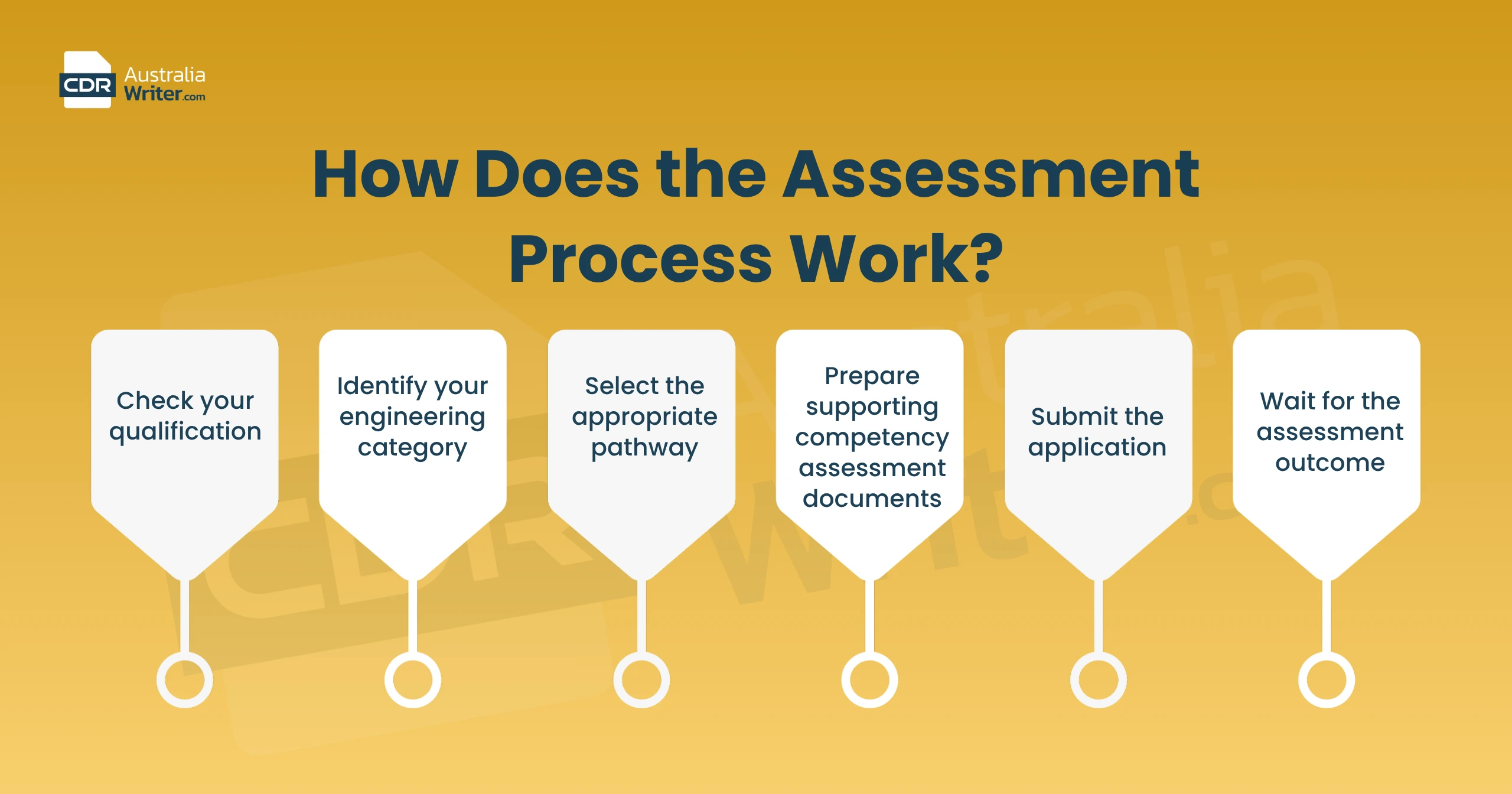
How Does the Assessment Process Work?
The Competency assessment for migration process becomes much easier to understand when broken into different assessment process:
1. Check your qualification
Start by determining whether your engineering qualification is recognised and which pathway applies according to that qualification. Engineers Australia considers factors including the country where the qualification was obtained, the qualification type and whether it is accredited.
2. Identify your engineering category
You need to determine whether your background aligns with professional engineer, engineering technologist, engineering associate or engineering manager. Your nominated occupation also matters because the assessment needs to establish an appropriate occupational outcome.
3. Select the appropriate pathway
Once you understand your qualification and occupation, it helps you select the assessment pathway that applies to your circumstances. For applicants who are using CDR, the assessment focuses on demonstrating their engineering knowledge, skills and competency rather than just simply relying on recognition of an accredited qualification.
4. Prepare supporting competency assessment documents
Documentation can include:
- qualification evidence,
- academic transcripts,
- identification documents,
- English-language evidence where required,
- CV information and
- other material relevant to the selected pathway.
For a CDR application, applicants generally need to prepare Career Episodes and a Summary Statement that helps you demonstrate the required competencies. Engineers Australia also provides you with detailed preparation guidance for migration skills assessment applicants.
5. Submit the application
Applications are lodged through the Engineers Australia online portal. Applicants select their assessment pathway, then upload the required documents and submit the competency assessment application.
6. Wait for the assessment outcome
Engineers Australia reviews the application and may request additional information if necessary. The organisation currently states that standard migration skills assessment applications generally take around 15 weeks to be assigned to an assessor, although this does not mean the final outcome will necessarily be received within that period.
Competency Assessment Documents You'll Typically Need
The exact competency assessment documents depend on your pathway, but applicants should generally expect to provide evidence that establishes their identity, education and professional background. Common requirements may include:
- Passport or identification evidence
- Engineering qualification certificates
- Academic transcripts
- Detailed CV
- English-language evidence where applicable
- Employment evidence, where relevant
- Career Episodes for applicable CDR pathways
- Summary Statement for applicable CDR pathways
- Additional documents requested by the assessing authority
A thorough competency assessment for migration application is built on precision, vague employment letters or inconsistent dates are among the most common reasons for delays or negative outcomes.
If you’re currently sitting in the pool with a competitive score under the existing rules, there’s little reason to delay lodging an Expression of Interest (EoI) while the reform works through consultation and invitations issued under the current framework are set to be honoured.
Things to Avoid During The Assessment for migration
Before submitting your competency assessment application, avoid these common mistakes:
Choosing the wrong pathway
Submitting through an unsuitable pathway can create unnecessary complications. Your qualification and accreditation status should be checked before you begin preparing competency assessment documents.
Generic Career Episodes
This is one of the most common CDR pitfalls. It’s not enough to describe what the project was about where assessors want to seeyour engineering thinking. What decisions did you make? What problems did you personally solve? A Career Episode that reads like a project summary, without your own reasoning and judgement coming through, makes it hard for an assessor to credit you with the competencies you’re claiming.
Inconsistent Information
Small mismatches add up. If your CV says one thing, your employment reference says another, and your academic transcript tells a slightly different story, assessors notice and it raises doubts about the accuracy of the whole application, even when the inconsistency is innocent.
Poor Competency Mapping
Some applicants list off plenty of engineering tasks and responsibilities but never quite connect the dots back to the specific competencies being assessed. Activity isn’t the same as evidence where each competency element needs to be clearly and deliberately demonstrated, not just implied.
Plagiarism or Copied Material
Your CDR needs to reflect your own education, experience, and engineering judgement , nothing borrowed. Lifting content from someone else’s CDR or from material online is a serious risk, and assessing bodies actively check for it. It’s simply not worth it, however tempting a “template” might look.
Ignoring Official Instructions
Rules move. Engineers Australia, for instance, has recently tightened its stance on certain advanced diploma and associate degree qualifications , a non-accredited qualifications in these categories are now often directed toward the CDR pathway instead of alternative routes. Skimming the guidelines instead of reading them properly is an easy way to submit an application that’s already out of step with current requirements.
The goal should be to present accurate evidence of your real engineering education, skills and experience.
Have Any Question?
CDR Australia Writer specialises in high-quality CDR, RPL and VETASSESS reports for engineers. CDR Australia Writer offer low-cost, customized and reliable services in diverse engineering disciplines.
- +61 482 072 465
- [email protected]

Our expert writing team has successfully assisted clients in obtaining approval through professional services for skill assessments and migration needs.
Tips to Strengthen Your Competency Assessment Application
A good competency assessment application starts with planning rather than writing.
- Start with the correct ANZSCO occupation code
- Choose Career Episodes that show diverse competencies such as design, analysis, problem-solving, and project management
- Be specific in your CPD entries and avoid vague one-liners
- Keep all documents consistent, i.e. job titles, dates, and duties should align across your CV, references, and Career Episodes
- Have someone unfamiliar with your work review your CDR for clarity, since assessors read hundreds of these
Professional assistance can help with structure, proofreading and competency mapping, but the underlying experiences and technical work should remain genuinely yours.
What Happens After the Assessment?
If your application of competency assessment for migration is successful, Engineers Australia issues a migration skills assessment outcome letter. The outcome confirms your occupational category but just with this letter alone won’t get you a visa.
What comes next depends on your chosen assessment pathway, and typically involves other requirements such as English proficiency, points, nomination, or an invitation.
Get our free consultation
Do you have a question?
Get our free consultation with specialist and experienced counsellors. Explore our CDR writing packages immediately and receive 100% plagiarism free CDR report
Contact us right now! and Get your CDR report ready for approval.

Do you have a question?
We have mentioned common questions asked by our clients regarding CDR report, ACS RPL report, KA02 report, and skill assessment process.
For engineers, a suitable migration skills assessment is generally an important part of applicable skilled migration pathways. The exact requirement and assessing authority depend on the nominated occupation and visa pathway
Most assessments take between 6 and 12 weeks, depending on the authority and application volume. Engineers Australia and VETASSESS can run longer during peak periods.
Most of the assessments hold up for three years, but it is not universal. Here, each authority sets its own validity period, so it’s worth confirming this directly with the body that assessed you.
You can, most assessing authorities allow for a review or reassessment, though there’s usually a fee involved, and you’ll need to directly address whatever reasons were given for the negative outcome where a resubmission without changes rarely helps.
Not on its own. This assessment helps you confirm that your occupation and experience meet the required standard, but you will still need to clear other hurdles such as points, an invitation, health checks, character requirements, and whatever else applies to your specific visa.
The major points-tested visas such as 189, 190, and 491, generally do require competency assessment. That said, some employer-sponsored pathways work differently, so it’s always worth checking the exact requirements for your visa subclass before assuming.