

VETASSESS Processing Time 2026: What to Expect at Every Stage
The VETASSESS processing time can decide whether you make a state nomination round or miss a visa invitation window entirely, so getting the current number right matters. VETASSESS replaced its old, unpredictable processing windows with a fixed 7-week service standard at the end of 2025, but most blog posts and forum threads online still haven’t caught up. This post breaks down the current timeframe for every stage, what stops the clock, and what pushes a file outside that window, using the figures VETASSESS itself publishes on its live processing times page.

What Is the VETASSESS Processing Time in 2026?
From 1 December 2025, VETASSESS finalises a standard Professional Occupations skills assessment within a fixed service window, replacing the wide, unpredictable ranges applicants faced for years. This change came after VETASSESS revised its internal service standards to bring timeframes in line with other assessing authorities and reduce the backlog that built up through 2024 and early 2025. The 7-week figure is now the number VETASSESS itself publishes on its live processing times page, so it can be treated as the current authoritative benchmark rather than an estimate pulled from older case data.
Key points:
- Standard Timeframe: 7 weeks from the date VETASSESS accepts your application as lodged
- What Counts: only genuine processing days, not time spent responding to a request for information
- Old Timeframe: previously ran 8 to 15 weeks depending on occupation and workload
- Effective Date: applies to applications lodged on or after 1 December 2025
- Scope: applies to Professional and General occupation groups only, trade occupations follow a separate pathway
- Not a Guarantee: complex cases, incomplete evidence, or qualifications needing overseas verification can still push a file past 7 weeks
Old vs New Timeframes: Before the update, standardVETASSESS assessments commonly ran anywhere from 8 to 15 weeks. The new fixed 7-week standard is a genuine improvement, but it only holds if your file needs no further documents once lodged.
New Articles

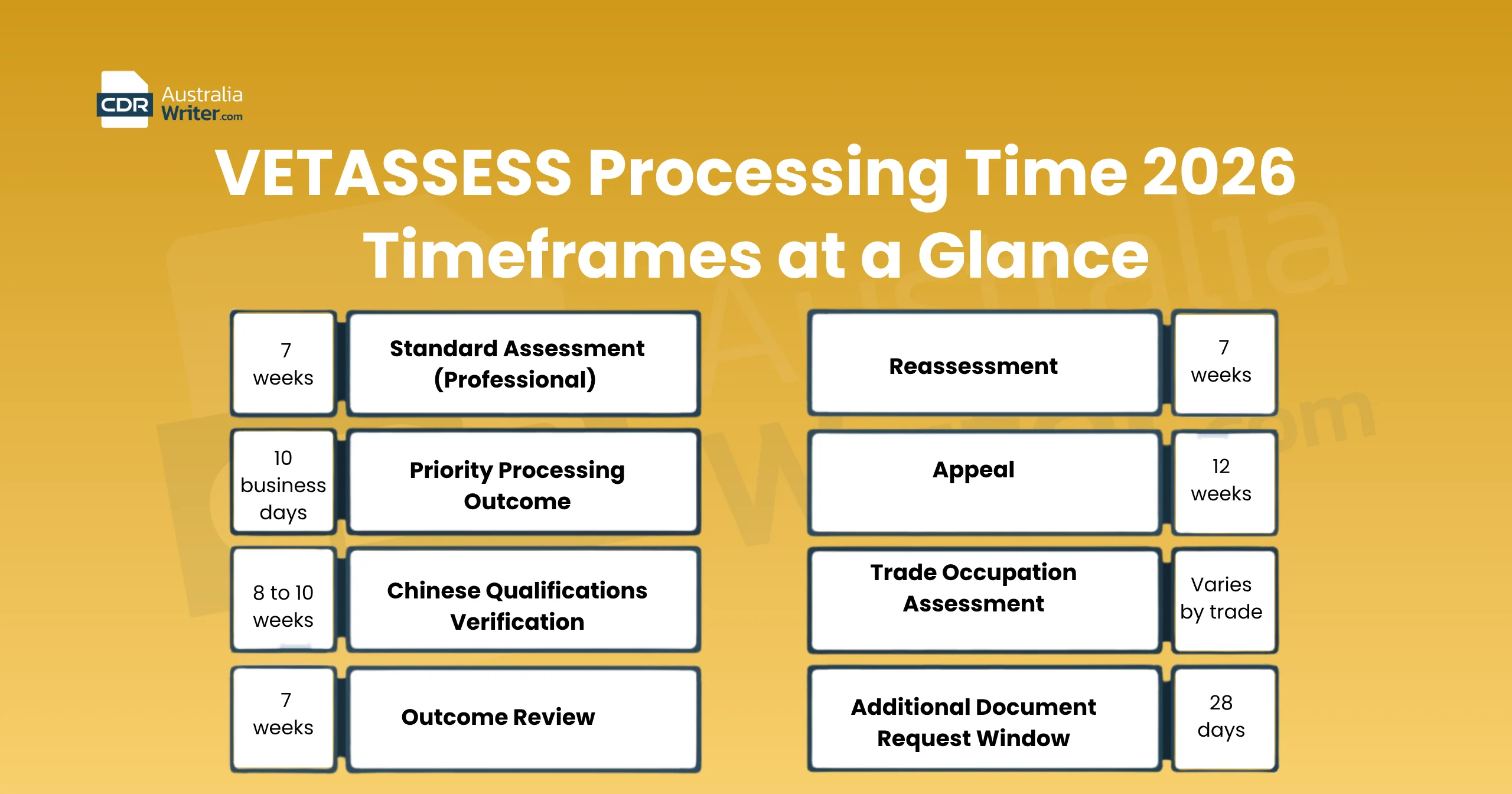
VETASSESS Timeframes at a Glance
The table below summarises every stage of the VETASSESS process and how long each one currently takes, based on VETASSESS’s own November 2025 process update.
Assessment Stage | Timeframe | Starts From |
Standard skills assessment (Professional) | 7 weeks | Date application is lodged |
Priority Processing outcome | 10 business days | Date eligibility is confirmed |
Chinese Qualifications Verification | 8 to 10 weeks | Runs alongside the main assessment |
Outcome review | 7 weeks | Date review is lodged |
Reassessment | 7 weeks | Date reassessment is lodged |
Appeal | 12 weeks | Date appeal is lodged |
Trade occupation assessment | Varies by trade | Depends onTRA program & interview |
Additional document request window | 28 days | Date of request |
VETASSESS Standard Timeframe for Professional Occupations
The 7-week clock applies to General and Professional occupation groups, engineers, accountants, IT professionals, managers, and similar occupation codes. What determines whether you stay inside that window:
- Clock Start: the day VETASSESS accepts your application as lodged, not the day you pay the fee.
- Complete File: identity documents, qualification evidence, and employment references all in the correct format from day one.
- Partial File Risk: a missing reference letter or untranslated transcript is the most common reason applicants exceed 7 weeks.
- Clock Reset: once VETASSESS issues a request for information, that missing piece effectively restarts the timeframe.
VETASSESS Priority Processing: Cost and Turnaround
Priority Processing is available for applicants who need a faster outcome and are willing to pay for it.
- Outcome Turnaround: 10 business days from the point your application is confirmed as eligible for Priority Processing.
- Eligibility Only, not Automatic: VETASSESS must first confirm your file actually qualifies before the 10-day clock starts.
- If not Eligible: the priority fee is refunded and the file moves into the standard queue.
- What it Changes: how quickly your file reaches an assessor, not the document requirements themselves.
- Poorly Prepared Files: still stall even on the priority track if evidence or employment claims cannot be verified in time.
- Availability: offered for Professional and General occupations only, not available fortrade occupations.
Free Urgent Processing: If you already hold an invitation to apply for a visa with a lodgement deadline inside 60 days, VETASSESS offers free urgent processing without the priority fee, provided you email the invitation letter to VETASSESS as evidence.
Have Any Question?
CDRaustraliawriter specialises in high-quality CDR, RPL and VETASSESS reports for engineers. CDRaustraliawriter offer low-cost, customized and reliable services in diverse engineering disciplines.
- +61 482 072 465
- [email protected]
VETASSESS Trade Occupation Processing Time
Trade occupations follow a different pathway through the relevant Trades Recognition Australia program rather than the standard 7-week Professional Occupations track. VETASSESS’s own processing times page does not publish a single figure for trades, it directs applicants to the specific Applicant Guidelines for their program instead, which is a useful signal in itself about how much timeframes vary by trade.
- Technical Component: may include aSkills Assessment Interview or practical demonstration depending on the occupation.
- Timeline Driver: interview scheduling and how quickly supporting evidence is provided, more than a fixed processing window.
- New Requirement (Jan 2026): Pathway 1 trade applicants must submit a completed Language, Literacy, Numeracy and Digital Skills form.
- Evidence Needed: payslips, group certificates, an organisational chart, and job records showing hands-on work.
- Priority Processing: not offered for trade occupations, this fast-track option is Professional and General occupations only.
- Assessment Locations:some trade programs require an in-person or online practical assessment, so location and interview availability can add real time on top of document processing.
- No Single Figure: VETASSESS assesses 27 trade occupations across different programs, so always check the Applicant Guidelines for your specific trade rather than relying on a general average.
Other VETASSESS Service Timeframes You Should Know
The 7-week figure gets most of the attention, but a couple of related services matter to the average skilled migration applicant more than others. Here is what actually applies to most people:
- Renewal of an Existing Skills Assessment: 2 to 5 weeks once all required documents are received, Priority Processing is available for renewals too.
- Post-Vocational Education Work (Subclass 485) Visa Assessment: 1 to 2 weeks, this requirement was reinstated by the Australian Government.
- Points Test Advice: 2 to 4 weeks, useful if you want your points confirmed before lodging anEOI.
Labour agreement pathways such as DAMA and ILA, and the Qualification Comparison Service, run on a separate 2 to 3 week timeframe each. These apply to a smaller group of applicants, so check the relevant VETASSESS fact sheet directly if one of these applies to you rather than assuming the standard 7-week figure covers it.
How Your VETASSESS Timeline Affects Visa Planning
A skills assessment outcome is only useful once you can actually act on it, so the VETASSESS processing time has a direct flow-on effect on your broader migration timeline.
- Expression of Interest (EOI): you cannot submit a validEOI through SkillSelect until you hold a positive assessment outcome for your nominated occupation
- Assessment Validity: most VETASSESS outcomes remain valid for a set period after issue, so lodging your EOI too long after receiving your result can mean reapplying
- State Nomination Windows: state and territory programs often open and close within short windows, so a delayed assessment can mean missing an invitation round entirely
- Renewal Timing:applicants with an assessment nearing expiry should apply for renewal at the same time as a state or territory application, not after
Building in the current 7-week standard timeframe, rather than the outdated 10 to 15 week figures still floating around older forum posts, gives a far more realistic picture of when you can actually lodge your EOI.
Outcome Review, Reassessment and Appeal Timeframes
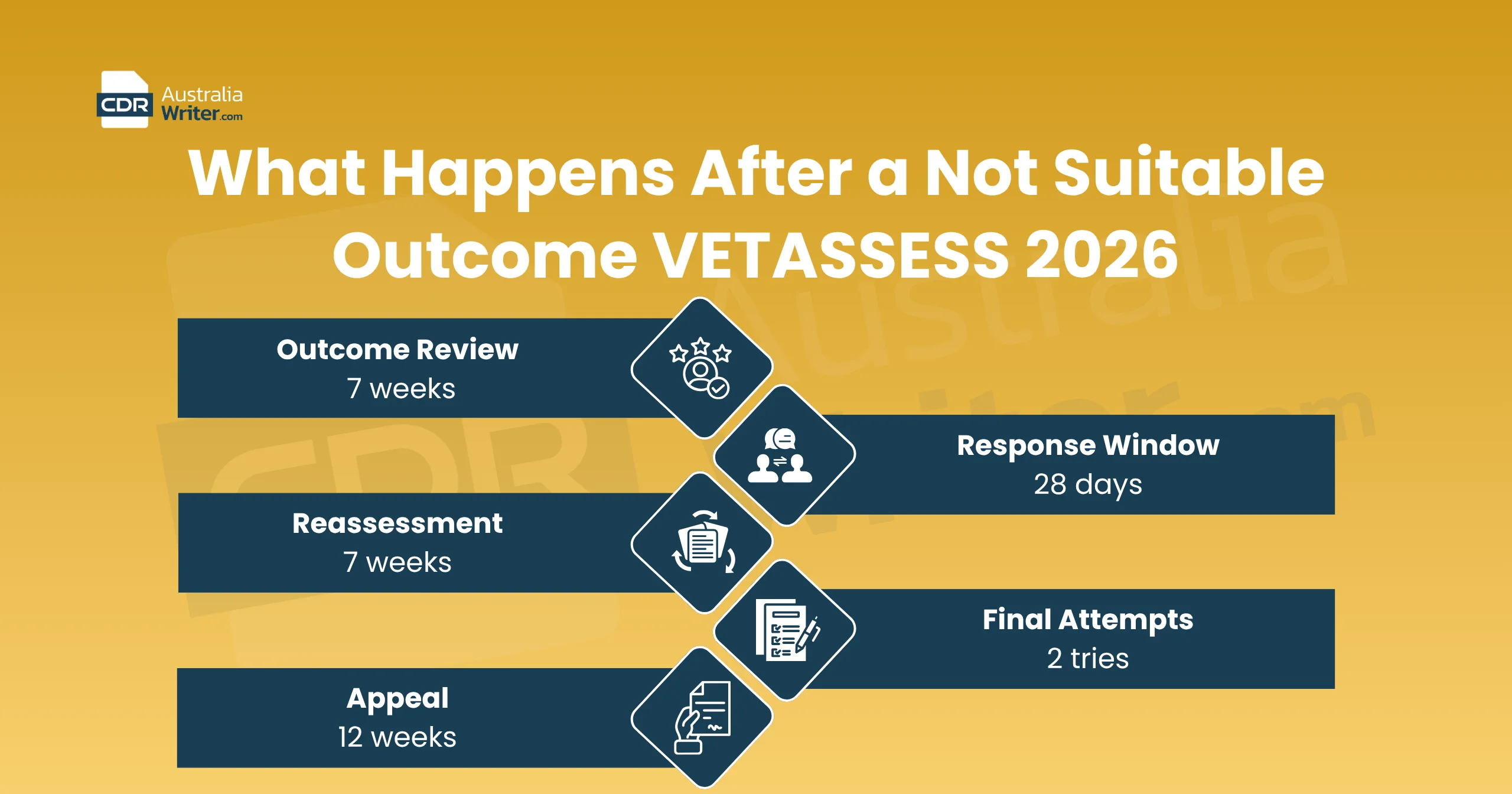
A not suitable outcome is not the end of the process. Each following step carries its own fixed timeframe:
- Outcome Review: 7 weeks, must be requested within 90 days of a not suitable result for the same occupation.
- Reassessment: 7 weeks, whether for the same occupation after 90 days or a different occupation entirely.
- Appeal: 12 weeks, lodged after an unsuccessful outcome review, involves a fresh panel review.
- Response Window: 28 days to respond to any request for additional information at each stage.
- Final Attempts: VETASSESS makes two further attempts to obtain missing material before finalising a not suitable decision.
What Affects Your VETASSESS Processing Time
The published service standards are a target, not a guarantee. The most common factors that push a file outside 7 weeks:
- Employment references that do not match the exact format VETASSESS requires
- Missing organisational charts or unclear duty statements
- Qualifications that need verification with an overseas institution
- Chinese qualifications requiring the separate Chinese Qualifications Verification Service, which itself takes 8 to 10 weeks and runs on top of the standard 7-week assessment
- Identity documents that do not meet the current requirement
Identity Document Rule: VETASSESS now requires at least three separate identity documents, including one current government-issued photo ID. A mismatch in name spelling across documents without a supporting statutory record can trigger a request for further information and add weeks to your file.
How to Avoid Delays and Keep Your Timeline on Track
Most delays trace back to the same handful of gaps in the original submission. Before lodging:
- Employment References: include job title, dates, duties, and hours worked in the exact structure VETASSESS asks for.
- Qualification Documents: scan in full colour, high resolution, with certified translations where needed.
- Identity Documents: must be current, matching, and free of unexplained name variation.
- Multi-Country Employment: gather references and payslips from every employer well ahead of lodgement.
- Occupation-Specific Checklist: read the information sheet for your exactANZSCO code rather than relying on a generic list.

Looking for expert Skill Assessment Writers?

Our expert writing team has successfully assisted clients in obtaining approval through professional services for skill assessments and migration needs.
Document Checklist Before You Lodge
A large share of applications that miss the 7-week window do so because of the same missing items, checked at the last minute rather than before submission. Before lodging, confirm you have:
- Certified academic transcripts and testamurs, with certified translations attached for any document not in English.
- Employment reference letters covering job title, dates, duties, hours worked, and salary, on official letterhead.
- At least three identity documents, including one current government-issued photo ID.
- A detailed CV that matches the dates and job titles in your reference letters exactly.
- Payslips, tax records, or superannuation statements to support employment claims where references alone are not sufficient.
- Evidence of any name changes, such as a marriage certificate orstatutory declaration, if your documents do not all match.
Applicants who prepare this checklist in full before starting the online application consistently report smoother processing, simply because VETASSESS has no reason to pause the file for a request for information.
Getting Professional Support for Your VETASSESS Application
CDR Australia Writer prepares Statements of Service, employment reference documentation, and complete VETASSESS application packages built against current 2026 evidence standards, giving your file the best chance of moving through in the standard 7 weeks rather than sitting in a document request queue.
Get yourVETASSESS processing time working in your favour. Contact CDR Australia Writer before you lodge your application.
Get our free consultation
Do you have a question?
Get our free consultation with specialist and experienced counsellors. Explore our CDR writing packages immediately and receive 100% plagiarism free CDR report
Contact us right now! and Get your CDR report ready for approval.

Do you have a question?
We have mentioned common questions asked by our clients regarding CDR report, ACS RPL report, KA02 report, and skill assessment process.
The standard timeframe for a Professional Occupations skills assessment is 7 weeks from the date VETASSESS accepts your application as lodged, effective from 1 December 2025.
Once your application is confirmed eligible for Priority Processing, VETASSESS delivers an outcome within 10 business days. If your file does not qualify, the priority fee is refunded and standard processing applies instead.
The most common reasons are a request for additional documents, mismatched identity documents, qualifications needing overseas verification, or an employment reference that does not meet the required format.
An outcome review or reassessment is targeted at 7 weeks. An appeal takes longer, at 12 weeks, because it involves a full review of the original decision.
Yes. Trade occupations go through Trades Recognition Australia programs, and timeframes depend on the specific trade, interview scheduling, and the Language, Literacy, Numeracy and Digital Skills form required from January 2026.
A renewal of an existingSkills Assessment takes 2 to 5 weeks once all required documents are received, and Priority Processing is available for renewal applications if a faster outcome is needed.