

Biomedical Engineer Salary in Australia 2026 - What You Can Expect at Every Level
Biomedical engineer salary in Australia in 2026 varies more widely than most engineering disciplines because the field spans hospital clinical engineering, medical device manufacturing, research, and regulatory compliance, and each sector pays differently. The national average sits between AUD 80,000 and AUD 140,000 depending on which source you check, and both figures are accurate for different segments of the profession.
For overseas biomedical engineers considering migration to Australia, this post gives you the full salary picture across experience levels, states, and work sectors, together with the migration pathway required to access these roles legally under askilled migration visa.

Biomedical Engineer Salary in Australia 2026: National Overview
Multiple independent salary sources confirm the following national figures for biomedical engineers in Australia as of mid-2026. The wide range reflects genuine differences between clinical biomedical roles in public hospitals and technicalbiomedical engineering roles in private medical device companies.
Experience Level | Average Salary AUD (Payscale/Indeed/Glassdoor) | Total Package AUD (ERI SalaryExpert 2026) |
Entry level (0 to 1 year) | AUD 60,742 to AUD 68,000 | AUD 98,309 |
Early career (1 to 4 years) | AUD 77,574 average total compensation (Payscale) | AUD 98,309 to AUD 110,000 |
Mid career (4 to 7 years) | AUD 80,000 to AUD 100,000 (SEEK June 2026) | AUD 110,000 to AUD 130,000 |
Senior (8 to 10 plus years) | AUD 125,000 to AUD 140,000 | AUD 140,182 to AUD 173,822 |
Principal or specialist level | AUD 140,000 to AUD 171,022 | AUD 173,822 plus |
National average (all levels) | AUD 95,724 (Indeed March 2026) to AUD 96,000 (Payscale 2026) | AUD 139,824 to AUD 140,182 (ERI 2026) |
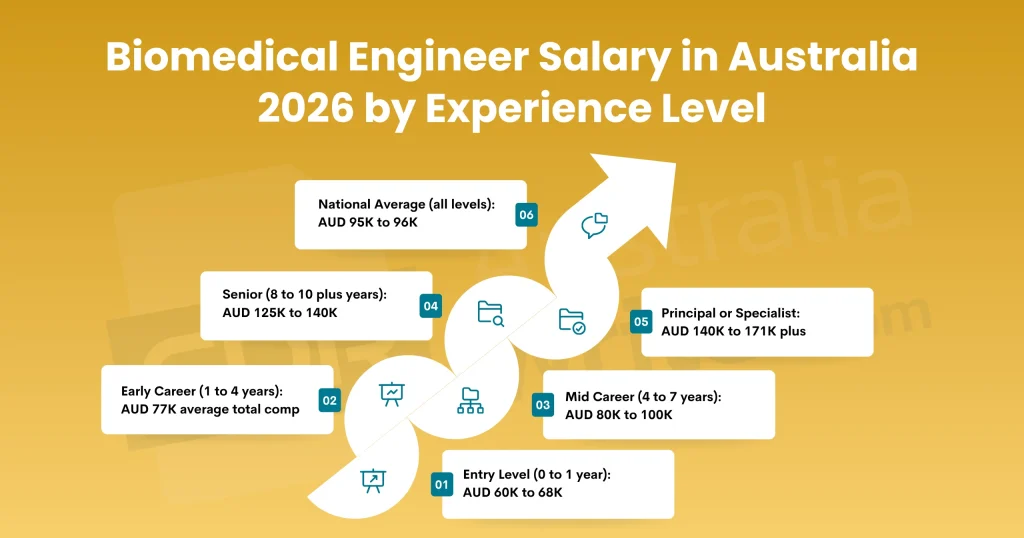
Why the Range is Wide: Payscale and Indeed capture actual self-reported salaries including clinical biomedical technicians in public hospitals who earn AUD 60,000 to AUD 85,000. ERI SalaryExpert captures full compensation packages including bonuses and superannuation, pushing figures to AUD 139,000 and above. Both are real. Your sector determines which end of the range you sit in.
Superannuation Note: From 1 July 2025, the superannuation guarantee rate increased to 12 percent. Add 12 percent to any base salary to calculate your full employment cost package.
New Articles
———
- New Points System for Australia Skilled Migration
- CDR for Mechanical Engineers | Proven EA Migration 2026
- Tasmania Skilled Occupation List | Trusted 2026 Path
- Careers Involving Engineering | Best 6 in Australia
- GradIEAust Engineers Australia | Proven Member Grade 2026
- VETASSESS Processing Time 2026 | Proven 7-Week Guide
- CPD Requirements Engineers Australia | Proven 2026 Guide
- CDR for Nigerian Engineers | Proven 2026 PR Guide
- MIEAust Explained | Proven Engineers Australia Grade
- Biomedical Engineer Salary in Australia 2026 | Real Pay
- Petroleum Engineer Salary Australia 2026 | Real Pay
- Civil Engineer Salary Australia 2026 | Proven AUD Rates

Have Any Question?
CDRaustraliawriter specialises in high-quality CDR, RPL and VETASSESS reports for engineers. CDRaustraliawriter offer low-cost, customized and reliable services in diverse engineering disciplines.
- +61 482 072 465
- [email protected]
State by State Breakdown: Biomedical Engineering Pay in Australia
State location is the second largest driver of biomedical engineer salary in Australia after sector and seniority.
State | Average Base Salary AUD | Key Employers and Notes |
New South Wales (Sydney) | AUD 85,000 to AUD 120,000 | Highest concentration of private medical device companies including Cochlear, Resmed, and Philips Healthcare. Public health research roles at UNSW, Sydney University, and major hospitals. |
Victoria (Melbourne) | AUD 80,000 to AUD 110,000 | Major hospital networks including Alfred Health and Royal Melbourne. Strong medical device manufacturing sector. Biomedical research roles at Monash University and RMIT. |
AUD 75,000 to AUD 100,000 | Growing hospital infrastructure investment. Queensland Health network offering stable public sector roles. Research roles at UQ and QUT. | |
Western Australia (Perth) | AUD 75,000 to AUD 95,000 | Smaller market than eastern states. Mining sector driving demand for industrial biomedical applications. FIFO medical roles in resource communities. |
South Australia (Adelaide) | AUD 70,000 to AUD 90,000 | Defence health applications, SAHMRI research, and SA Health network roles. |
Biomedical Engineer Salary by Sector in Australia
Your sector determines your salary ceiling more than any other single factor in biomedical engineering.
Medical Device Manufacturing and Industry
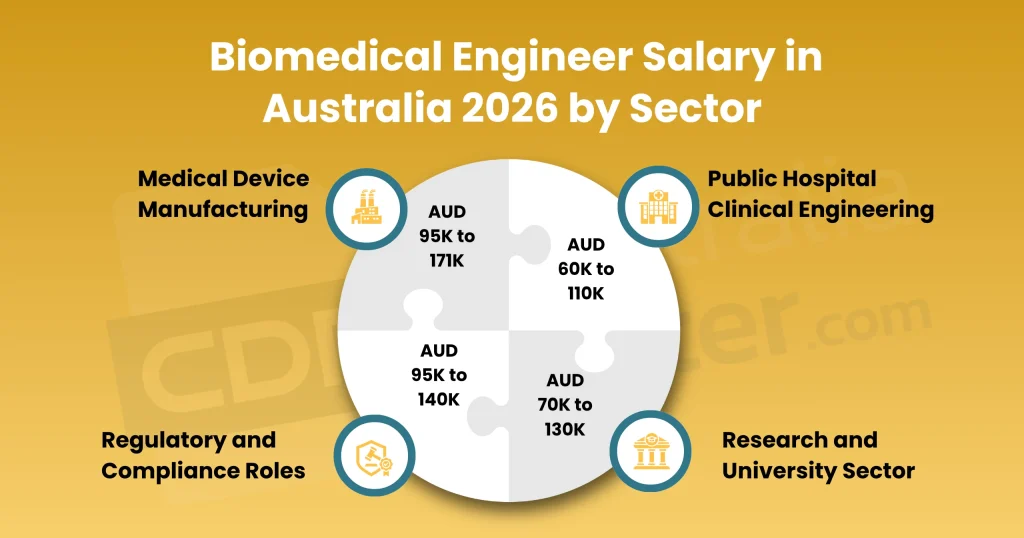
Private medical device companies pay the highest biomedical engineer salaries in Australia. Roles with Cochlear, Resmed, Stryker, Medtronic, Philips Healthcare, and Siemens Healthineers involve product development, regulatory affairs, andquality engineering.
- Mid-Career: AUD 95,000 to AUD 130,000
- Senior/Regulatory Roles: AUD 130,000 to AUD 171,000 and above
These roles demand rigorous documentation skills, understanding of TGA regulations, and ISO 13485 quality system knowledge.
Public Hospital Clinical Engineering
In public hospitals, clinical biomedical engineers work in installation, servicing, and commissioning of imaging systems, life support equipment and surgical equipment. It is a field where stability is offered with good career progression and benefits associated with the public sector.
- Starting (Graduate): AUD 60,000 to AUD 75,000
- Experienced (Senior Level): AUD 90,000 to AUD 110,000
Public sector clinical roles are the largest employment source for biomedical engineers in Australia by headcount, which is why national average figures appear lower than ERI’s full-package data.
Research and University Sector
University and research institute roles vary by seniority and grant funding status.
- General Range: AUD 70,000 to AUD 105,000
- Postdoctoral Research Fellows: AUD 72,000 to AUD 90,000
- Senior Research Fellows / Associate Professors: AUD 100,000 to AUD 130,000
Research roles offer publication opportunities and academic recognition but carry funding uncertainty that industry roles do not.
Regulatory and Compliance Roles
A major sector in 2026 is where biomedical engineers go into regulatory affairs and compliance with the TGA, medical device importers and contract research organisations, with a mid-career remuneration range of AUD$95,000 to AUD$140,000, as regulatory complexity in Australia continues to evolve. This is where biomedical engineering graduates with formal regulatory affairs credentials, such as those holding ISO 13485 auditor credentials, will see the highest salary premiums.
What Increases Biomedical Engineering Compensation in Australia
Several specific factors consistently move biomedical engineers into the higher salary bands in 2026.
- Sector Choice: Private medical device manufacturing pays 20 to 40 percent more than equivalent clinical roles in public hospitals at the same experience level.
- Regulatory Expertise: TGA regulatory affairs knowledge, ISO 13485 familiarity, and IEC 60601 medical device standards experience command measurable salary premiums.
- Imaging Systems Specialisation: Engineers with expertise in MRI, CT, PET, and ultrasound systems earn consistently above the national average due to the high value and complexity of these devices.
- Chartered Status: CPEng through Engineers Australia adds 15 to 25 percent above non-chartered peers at equivalent experience levels.
- Location: Sydney-based private sector roles pay AUD 15,000 to AUD 30,000 more than equivalent roles in smaller markets.
- Postgraduate Qualifications: A master’s degree in biomedical engineering or an MBA in healthcare management is strongly preferred by private sector employers and correlates with faster salary progression.
How Biomedical Engineer Salary Australia Compares to Other Engineering Disciplines
Engineering Discipline | Median Salary AUD 2026 | ANZSCO Code |
Petroleum Engineer | AUD 142,000 to AUD 204,000 | 232611 |
Mining Engineer | AUD 140,000 to AUD 170,000 | 233611 |
Electrical Engineer | AUD 105,000 to AUD 145,000 | 233311 |
AUD 100,000 to AUD 135,000 | 233211 | |
Biomedical Engineer | AUD 80,000 to AUD 140,000 | 233913 |
Mechanical Engineer | AUD 100,000 to AUD 130,000 | 233512 |
Environmental Engineer | AUD 95,000 to AUD 125,000 | 233916 |
Biomedical engineering sits below the median of the Australian engineering pay spectrum at entry and mid-career level, but reaches competitive senior salaries in the medical device and regulatory sectors. The trade-off is a highly specialised career with strong job security, public health impact, and consistent demand from Australia’s growing healthcare sector.
ANZSCO 233913 and the CDR Pathway for Overseas Biomedical Engineers
Biomedical Engineer in Australia is classified under ANZSCO 233913 and assessed by Engineers Australia. A positive skills assessment is mandatory before anyExpression of Interest can be lodged for a points-tested skilled migration visa. ANZSCO 233913 is on the Medium and Long-term Strategic Skills List, qualifying for the 189 independent visa, the 190 state-nominated visa, and the 491 regional visa.
Most overseas biomedical engineers whose degree is not from a Washington Accord-accredited institution apply through the CDR pathway. CDR will comprise of 3 Career Episodes on biomedical engineering project experiences, 1 Summary Statement withmapping of every paragraph to stage 1 competency elements, and a record of your CPD activities of at least last 3 years.
Career Episode focus for ANZSCO 233913: Biomedical engineering Career Episodes must demonstrate hands-on engagement with medical devices, clinical systems, or biomedical research. Describing clinical testing of medical equipment, regulatory documentation for device approval, or design and validation of biomedical systems all satisfy the competency evidence requirement. Generic engineering projects without a clear biomedical or clinical health application do not.
Standard CDR processing takes 10 to 16 weeks from a complete application. Engineers who begin CDR preparation before reaching out to Australian employers are significantly better positioned, most private medical device companies complete recruitment within 4 to 8 weeks, meaning a completed CDR is often the deciding factor in whether an overseas candidate can accept a job offer.

Looking for expert Skill Assessment Writers?

Our expert writing team has successfully assisted clients in obtaining approval through professional services for skill assessments and migration needs.
Build Toward the Biomedical Engineer Salary in Australia You Are Targeting
Thebiomedical engineer salary range in Australia of AUD 95,000 to AUD 140,000 at mid-career is accessible to overseas engineers who enter through the right migration pathway and target the right sector from day one. Clinical hospital roles provide stable entry points. Medical device manufacturing and regulatory affairs provide the highest salary ceilings.
CDR Australia Writer prepares Career Episodes, Summary Statements, and full CDR reports for biomedical engineers targeting ANZSCO 233913, written to Engineers Australia 2026 standards with zero plagiarism and a 100% EA approval record.
Start building toward the biomedical engineer salary in Australia you are targeting. Contact CDR Australia Writer today.
Get our free consultation
Do you have a question?
Get our free consultation with specialist and experienced counsellors. Explore our CDR writing packages immediately and receive 100% plagiarism free CDR report
Contact us right now! and Get your CDR report ready for approval.

Do you have a question?
We have mentioned common questions asked by our clients regarding CDR report, ACS RPL report, KA02 report, and skill assessment process.
$95,724 a year (30 salaries from Indeed March 2026) $96,000 (Payscale) $80,000 to $100,000 per year (SEEK employer reported data from June 2026) $139,824 to $140,182 a year for total pay and benefits, from ERI SalaryExpert 2026.
Private medical device manufacturing pays the highest salaries, ranging from AUD 95,000 to AUD 171,000 at mid to senior level. Public hospital clinical engineering roles pay AUD 60,000 to AUD 110,000 and represent the largest headcount employment segment.
Less than 1 years experience – $60,742 to $68,000 (2026) – from Payscale & Glassdoor. Graduate program entry at major employers like Cochlear and Siemens Healthineers typically starts at AUD 70,000 to AUD 80,000.
Yes, if your degree is not from a Washington Accord-accredited institution. A CDR assessment through Engineers Australia under ANZSCO 233913 is required before any skilled migration visa EOI can be submitted.
Yes. 233913 Biomedical Engineer ANZSCO is listed on theMLTSSL list and the 189 independent skilled visa is therefore available with no job offers or state nomination required.